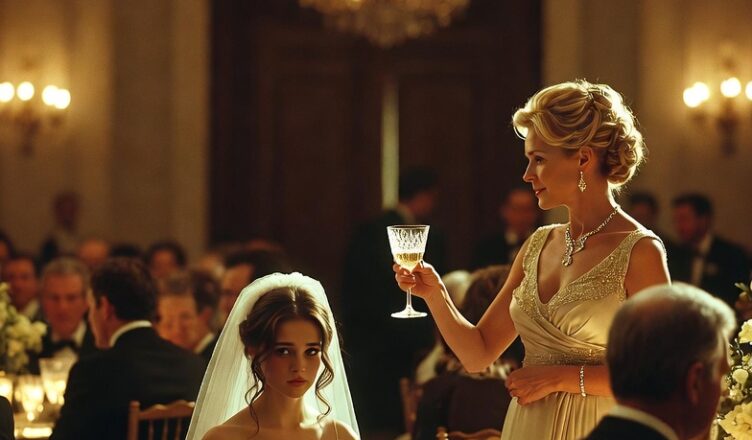
Chloe Bennett had grown up believing that love was supposed to be quiet. Not loud, not showy — just steady, like the hum of the refrigerator in her mother’s cramped kitchen, or the sound of the sewing machine her mother ran late into the night, stitching hems for other people’s expensive clothes to keep the lights on.
She never imagined she’d end up in a world of chandeliers.
She met Mark Whitfield at a coffee shop near the university, back when he still wore secondhand jackets to “blend in” and hadn’t yet told her that his last name belonged to one of the wealthiest real estate families on the East Coast. By the time she found out, she’d already fallen for him — for his awkward jokes, his habit of tapping his pen three times before he spoke in class, the way he listened to her talk about her mother’s debts without once looking uncomfortable.
“My family’s a lot,” he’d warned her, the night he introduced her to his parents. “Just — brace yourself.”
She hadn’t understood what that meant. Not really. Not until she stood in the marble foyer of the Whitfield estate for the first time, and Eleanor Whitfield looked her up and down the way a jeweler examines a stone for flaws.
“So,” Eleanor had said, extending two fingers instead of a hand, “you’re the one.”
Three years of engagement. Three years of Eleanor’s small cruelties, dressed up as concern. Comments about Chloe’s “budget” wardrobe. Questions about her mother’s “situation” at every family dinner, always phrased with a pitying tilt of the head. Suggestions — never demands, always suggestions — that maybe a prenup would “protect everyone’s interests.”
Chloe had endured it because Mark asked her to. Just get through the wedding, he’d whispered more than once. After that, it’s just us.
She should have known that with Eleanor, nothing was ever “just” anything.
Chapter Two: The Corner by the Kitchen
The Whitfield Grand Ballroom glittered on the night of the wedding — three enormous chandeliers, two hundred white roses flown in from overseas, a string quartet that cost more for one evening than Chloe’s mother made in half a year.
Chloe noticed the seating chart before anyone explained it to her. Her family — her mother, her aunt, two cousins, and a family friend who’d driven six hours to be there — had been placed at table fourteen, tucked into the far corner beside the swinging kitchen doors, where waiters bumped past every few minutes carrying trays.
Meanwhile, the head table gleamed at the center of the room like its own private stage. Eleanor sat there in a custom ivory gown, flanked by Mark’s two sisters, Vivian and Grace, both also dressed in ivory — a color no woman at a wedding wears by accident.
“Mark,” Chloe whispered, gripping his hand under the table, “why is my family sitting all the way back there?”
Mark followed her gaze. His jaw tightened, but his shoulders sank in that same defeated way she’d watched for three years.
“Just let her have this, Chloe,” he murmured. “Don’t make a scene. Please.”
It wasn’t the answer of a husband. It was the answer of a boy who had spent thirty years learning that defying his mother cost more than he could ever afford.
Chloe swallowed the lump in her throat and said nothing. She had learned, too — learned that silence was often the price of peace in this family.
She didn’t yet know that Eleanor wasn’t finished.
Chapter Three: The Toast
The first course had barely been cleared when Eleanor rose, smoothed her gown, and lifted a crystal glass. A waiter scrambled to hand her a microphone.
The string quartet fell silent. One hundred and fifty guests turned toward the head table.
“Good evening, everyone,” Eleanor began, her voice honeyed, practiced, the voice of a woman who had given a hundred toasts at a hundred charity galas. “We are just so thrilled to welcome Chloe into our family.”
A ripple of polite applause. Chloe forced a smile.
“You know,” Eleanor continued, tilting her head with theatrical warmth, “Mark has always had such a generous heart. Ever since he was a boy, he’s always been drawn to people who… needed saving.”
The room’s temperature seemed to drop a few degrees. Chloe felt Mark’s hand go rigid in hers.
“When we learned about Chloe’s upbringing,” Eleanor went on, pressing a manicured hand to her chest as though the memory pained her, “and heard how tirelessly her dear mother has worked just to keep the debt collectors at bay… our hearts simply broke. We knew we had to step in.”
Across the room, Chloe watched her mother’s face go white. Her mother — who had worked sixteen-hour days, who had never once complained, who had raised Chloe alone after her father left — sat frozen at table fourteen, mortified in front of strangers.
Eleanor reached into her clutch and produced an envelope, and beside it, a folded legal document. She set them on the white tablecloth with theatrical gentleness, the way someone unveils a gift.
“Chloe, sweetie,” Eleanor said, her smile never wavering, “we know our lifestyle can be overwhelming for someone not used to it. So Mark’s father and I wanted to give you the ultimate wedding gift — a fresh start. Here’s a check to clear your mother’s… burdens.”
A soft gasp moved through the crowd. Someone at a nearby table murmured, how generous.
Eleanor tapped the document with one manicured nail. “And to protect you from any nasty gossip — to prove to everyone here that you aren’t just marrying into our family trust — we’ve prepared this simple formality. Sign it right now, in front of everyone, and you can finally prove your intentions are pure.”
The words landed like a slap dressed in silk. This wasn’t a toast. It was an execution, and Eleanor had invited an audience to watch.
Chloe’s eyes burned. She turned to Mark — say something, please, say something — but he only stared at his plate, his knuckles white around his fork, saying nothing at all.
A tear slid down Chloe’s cheek before she could stop it.
Chapter Four: The Doors
That was when the doors at the back of the ballroom exploded open.
The sound cracked through the room like a gunshot — heavy mahogany slamming against the walls. Every head turned. The quartet’s bows froze mid-air.
A man stood in the doorway, backlit by the hallway light, dressed in a dark, perfectly tailored suit. He didn’t rush. He walked, slow and deliberate, down the center aisle between the tables, his gaze locked on the head table like a man who had waited five years for this exact moment.
Chloe’s breath caught in her throat.
Ben.
Her brother. The one who had walked out of their lives five years ago after one final, explosive fight with their stepfather — the one who had left with nothing but a duffel bag and a stubborn refusal to ever ask their family for help again. The one who had missed birthdays, holidays, phone calls returned months too late. The one Chloe had stopped expecting to ever see again.
She hadn’t invited him. She hadn’t even known where to send an invitation.
And yet here he was, cutting through the room like a blade, ignoring the murmurs rising in his wake, ignoring the cheap table by the kitchen where his own mother sat stunned, and walking straight toward the glowing center of Eleanor’s carefully staged humiliation.
Eleanor’s polished smile faltered. She squinted at the approaching stranger, trying — and failing — to place him.
Ben reached the head table. Without a word, he plucked the microphone from Eleanor’s hand and swept the legal document off the table with the back of his wrist, sending it fluttering to the floor.
“My sister isn’t signing a damn thing,” he said. His voice, amplified, filled every corner of the ballroom.
Chapter Five: How Much
Eleanor’s laugh came out sharp and condescending, a woman recovering her footing. “Oh — I see. The prodigal brother returns.” Her eyes swept over him with practiced disdain. “Tell me, did you scrape together enough for bus fare to come ruin this lovely evening?”
She turned to the room, chin lifted, reasserting control. “Security, please escort this man out. I paid for this entire night. This is my event.”
Ben didn’t flinch. He reached into his jacket, unhurried, and pulled out a leather checkbook.
“How much?” he asked, quiet enough that the whole room leaned in to hear it.
Eleanor blinked. “Excuse me?”
“The venue. The catering. The bar. Give me the number.”
She scoffed, arms crossing over her ivory gown, sizing up his suit with new suspicion — the cut was too clean, the watch on his wrist too fine for a man she’d already decided was beneath her notice.
“Eighty-five thousand dollars,” she said, sharpening the number into a weapon, certain it would end this. “Why? Going to pay me back in installments?”
Ben said nothing. He clicked his pen.
The scratch of ink against paper was the only sound in a ballroom holding its breath. He tore the check free, leaned across the table, and set it face-up on Eleanor’s untouched dinner plate.
Paid in full.
Eleanor looked down. Her eyes moved across the number, then the zeros trailing after it, searching for the trick, the catch, the joke. There wasn’t one. Her jaw slowly loosened.
“I came here to apologize to my sister,” Ben said, his voice dropping, steady and cold, “for staying away too long. And I’m buying this reception, so her night isn’t ruined by a miserable bully.”
He leaned closer, forcing Eleanor to meet his eyes.
“The bill’s paid. Now take your daughters, take your matching dresses, and get out of my sister’s wedding.”
Chapter Six: The Spell Breaks
Eleanor’s face flushed a deep, furious red, the last of her charitable mask cracking apart into something ugly and exposed.
“Mark!” she snapped, whirling toward her son. “Do something! Tell this — this nobody to leave!”
The room held its breath again, waiting.
Mark looked at his mother — really looked at her, at the fury twisting her features, at thirty years of quiet control unraveling in front of a hundred and fifty witnesses. Then he looked at Ben. A stranger, practically, who had just done in thirty seconds what Mark had failed to do in three years of engagement: stand between Chloe and the woman who tormented her.
Something in Mark finally broke loose.
He stood. He didn’t answer his mother. He didn’t even look at her again. He walked around the head table to Chloe, took her hand, and laced his fingers through hers, tight, certain, the way he should have done from the very first toast.
Stripped of her son’s obedience and her financial leverage in the same breath, Eleanor stood alone at the center of a room that had just watched her lose everything that mattered to her — control.
Her hands trembled as she snatched the check off her plate and gathered her purse. Vivian and Grace rose beside her, ivory gowns rustling, faces flushed with secondhand humiliation. The three of them walked the length of the ballroom in silence, heels clicking against marble in a rhythm that sounded, to Chloe, like a countdown finally reaching zero.
The heavy doors swung shut behind them with a soft, final click.
And the tension that had suffocated the room for the better part of an hour simply evaporated.
Chapter Seven: The VIP Table
Ben turned to his sister. The cold, immovable man who had just dismantled Eleanor Whitfield in front of her own guests was gone; in his place stood someone much younger-looking, eyes suddenly bright with a vulnerability he’d clearly been holding back for years.
“I’m sorry it took me so long to get here,” he said quietly, just for her. “Can you ever forgive me?”
Chloe looked at the empty space at the head table where her nightmare had been sitting moments earlier. Then she looked at her brother — really looked at him, at the five lost years suddenly compressed into this one impossible moment — and crossed the distance between them in three steps, throwing her arms around his neck.
He exhaled, long and shaky, and held her like he was afraid to let go again.
After a long moment, he picked the microphone back up. He looked past the chandeliers, past the string quartet, all the way to the dark corner by the kitchen doors, and found his mother’s tear-streaked face.
“Hey, Mom,” he said, his voice cracking into something gentler than anyone had heard from him all night. “Come on up. The VIP table’s ready.”
Chloe’s mother rose on unsteady legs, wiping at her eyes with the back of her hand, and made her way to the head table — the real head table now — as the entire room rose to its feet in applause that shook the chandeliers.
The DJ, sensing his cue, hit play.
And for the first time all evening, the wedding — Chloe’s wedding, not Eleanor’s performance — finally began.
Epilogue
Months later, Chloe would learn the rest of the story: how Ben had spent five years building a software company from nothing, sleeping in his car for the first two, refusing every cent of help because he couldn’t stomach owing his stepfather anything. How he’d found out about the wedding from an old family friend and driven eleven hours straight, not stopping once, terrified he’d arrive too late.
He hadn’t been.
Eleanor never fully recovered her standing in certain circles — stories about the eighty-five-thousand-dollar check traveled fast among people who lived for exactly that kind of gossip. Mark, for his part, spent the following year in quiet, deliberate distance from his mother, rebuilding a version of himself that didn’t flinch every time she raised her voice.
And Chloe learned something she carried with her long after the flowers wilted and the chandeliers went dark: that the family worth keeping isn’t the one with the biggest table.
It’s the one that shows up.