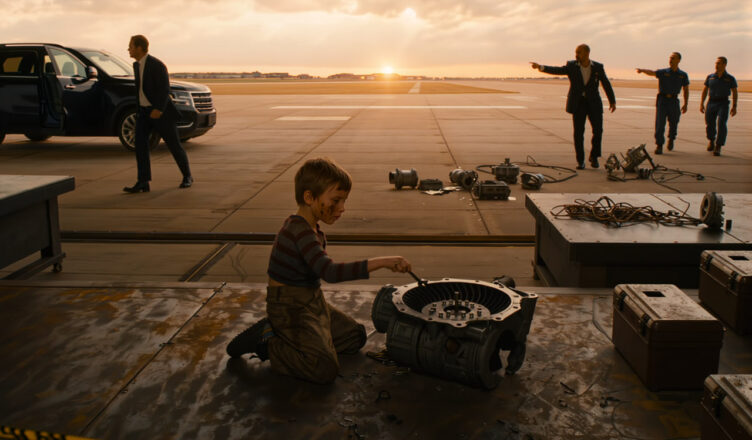
The sun had barely risen over the massive international airport when something happened in the maintenance area that no one would have believed unless they’d seen it with their own eyes.
Overnight, severely damaged engine parts had been removed from a cargo aircraft — cracked housings, tangled wiring, shattered turbine blades. The engineers’ verdict was final: the parts were beyond repair. Replacing them would cost hundreds of thousands of dollars, and the plane would be grounded for weeks.
But in the restricted zone, where entry wasn’t even permitted, someone had forgotten to check one small detail.
There, sitting quietly, was a small boy.
Just twelve years old, wearing torn, oil-stained clothes, dark smudges across his face. Beside him sat an old, worn toolbox that seemed to carry decades of history within it. And while the entire airport was certain these parts were dead, the boy worked on them with calm, confident movements — as if he knew every bolt, every wire by heart.
No one understood why.
Until Daniel Carter appeared — the no-nonsense operations director whose morning had already begun with arguments and pressure. Seeing a child touching expensive equipment, his patience ran out.
“What are you doing?” he shouted.
The boy calmly looked up. Neither afraid nor guilty.
“Check them again,” he said. “I fixed everything.”
What happened in the next few minutes changed everything.
The turbine shaft, which had been grinding horribly the night before, now spun silently and smoothly. The burned wires were perfectly restored. Inside the motor, every component had been rearranged with astonishing precision.
Daniel’s anger turned into disbelief.
“Who helped you?” he asked.
“No one,” the boy replied. “My name is Leo.”
And when one of the workers recognized the last name — Rivera — everything fell into place. Leo’s father, Michael Rivera, had been one of the airport’s finest engineers. He had passed away four years earlier. But before he left, he had taught his son everything he knew — bringing him to the workshop after school, showing him how metal and sound “speak” to each other.
What began as a story of anger ended in respect.
Daniel, who moments earlier had been ready to remove the boy from the area, now placed a hand on his shoulder.
“You just saved us hundreds of thousands of dollars,” he said. “And I think your father would be proud of you.”
And Leo, for the first time that morning, smiled.
A forgotten engineer’s legacy didn’t die with him. It lives on in his son’s hands.