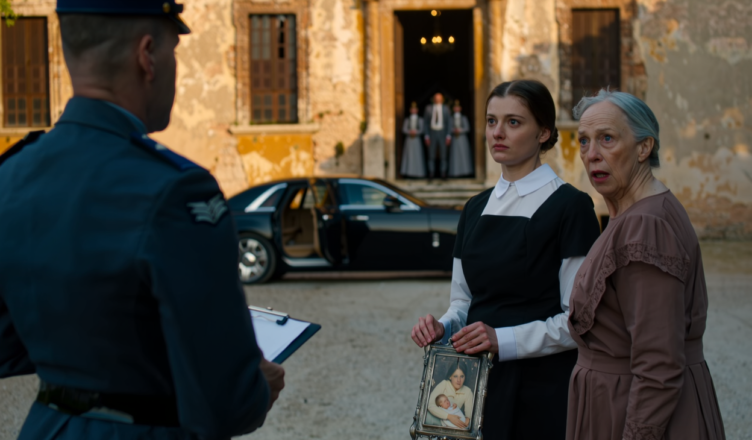
Alba had spent her entire life working at that villa. She knew every creaking floorboard, every drafty hallway, every room where the light fell differently depending on the hour. What she didn’t know — what no one had ever bothered to tell her — was her own birthdate, or who her parents had been.
She had simply always been there. A girl, then a young woman, moving quietly through the halls in her plain uniform, tending to tasks no one else wanted, asking no questions because she had learned long ago that questions rarely brought answers, only silence and sideways glances.
That afternoon, a soldier arrived at the villa’s gates. Official business, though nobody had explained exactly what kind. He moved through the courtyard with a clipboard in hand, methodical, unreadable, stopping in front of Alba and the villa’s stern housekeeper, Mrs. Elena.
“Name?” he asked, looking directly at Alba.
Before she could answer, Mrs. Elena stepped forward quickly, her voice sharp and rehearsed.
“Her name is Lucía.”
Alba lifted her head. Something in her — some quiet, stubborn certainty she couldn’t explain — refused to let the lie stand.
“No,” she said, calm but firm. “My name is Alba.”
Mrs. Elena’s face drained of color, the kind of pale that comes not from surprise, but from fear of being caught.
The soldier’s eyes moved between the two women, and in that instant, he understood: something was being hidden here. Some truth had been buried under years of careful silence.
Then Alba reached beneath the collar of her uniform and pulled out an old silver locket, worn smooth from years of being touched, opened and closed, held onto during quiet, uncertain nights. She opened it carefully.
Inside was a faded photograph: a young woman, cradling a baby in her arms.
The soldier stopped breathing.
He knew that face. He’d seen it before — not in person, but in old case files, in briefings, in a photograph that had once been circulated across the region and then, slowly, forgotten by everyone except those who had been assigned to find her.
The woman in the photograph was Isabel Navarro. Fourteen years ago, she had vanished without a trace, along with her newborn daughter. No leads. No sightings. A case that had gone cold long before Alba could have remembered any of it.
“Where did you get this?” the soldier asked, his voice unsteady now.
“I’ve always had it,” Alba said simply. “For as long as I can remember.”
Before anyone could say another word, the sound of tires crunching against gravel echoed through the courtyard. An elegant black car pulled up in front of the villa, sleek and imposing against the fading afternoon light.
The door opened. A powerful man stepped out, flanked by two bodyguards who moved with quiet, practiced precision. His presence alone seemed to settle over the courtyard like a weight — Mrs. Elena visibly shrank back, and even the soldier straightened instinctively.
The man’s eyes found Alba immediately, as though he had been searching for her face for a very long time.
He smiled — not the polite smile of a stranger, but something older, heavier, full of years he hadn’t yet explained.
“You’ve grown,” he said quietly.
Alba said nothing, her heart pounding, the locket still open in her trembling hand.
Then the man spoke the words that would shatter everything she thought she knew about her own life — every quiet year at the villa, every unanswered question, every silence she had learned to live inside.
“I’m your grandfather.”
This story continues to unfold — check back for the next chapter as the full truth comes to light.