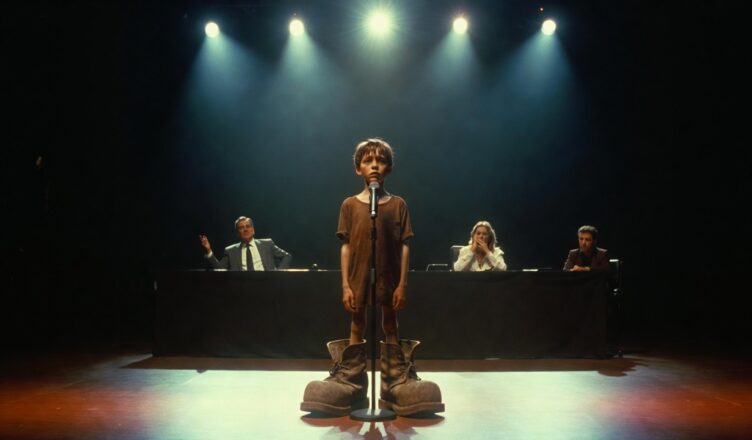
Mateo Rivera was eight years old, and his boots were too big for his legs.
They were tall, made of worn leather, dusty at the seams, marked by years of use that had nothing to do with him. They clashed with the stage lights. They clashed with the gleaming floor. They clashed with the cameras, the spotlights, the expensive suits and elegant dresses of everyone who filled that theater.
But Mateo refused to take them off.
A Boy Who Didn’t Belong — According to Everyone Watching
Backstage, surrounded by vocal coaches and silver dresses and teenagers practicing their reflections in blank screens, Mateo sat alone in a folding chair with his small hands clasped on his knees, staring at the dust still clinging to his boots. His mother, Elena, watched him from the side, exhaustion written into every line of her face, but when she looked at her son, something tender broke through all of it.
That morning, in their small hotel room, she had asked if she could clean the boots a little more.
“No, Mom,” he’d said, shaking his head. “That’s how he used them.”
She hadn’t argued. She never argued with Mateo about the boots.
Now, backstage, she knelt beside him one final time, straightening his collar, running her fingers through his dark hair.
“Remember to breathe before you sing.”
“Yes, Mom.”
“And don’t look at the floor.”
“I’m not going to look at the floor.”
Her lips trembled, but she held back the tears. She knew that if she cried, Mateo would spend his moment onstage worrying about her instead of remembering why he had come.
Walking Into a World That Wasn’t Built for Him
When the assistant called his name, the noise backstage disappeared for a moment, replaced only by the sound of his own heartbeat, fast and loud in his ears. His hands went cold. His throat went dry. But beneath the fear was something steadier — a promise he had made, though not yet to anyone in that theater.
He stood. The boots struck the floor with a heavy, unmistakable sound as he crossed toward the stage entrance, and behind the black curtain, an entire world opened up before him — thousands of people seated in darkness, a long table of judges gleaming under the lights, and in the very center of the stage, a single silver microphone waiting like something enormous.
The presenter announced his name. Mateo barely heard it. The curtain opened, the heat of the lights hit his face, and the murmuring began before he’d even taken his first step.
He took it anyway. Then another. His small frame looked smaller still beneath the vast lights, his worn brown shirt and dusty boots reflected in a floor polished to a mirror shine — every step announcing, to anyone watching, that he did not belong. At least not by the rules everyone in that room seemed to have already agreed upon.
The Cruelty Before the Song
Victor Stone raised an eyebrow first. Then came the laugh — brief, but enormous in a room gone otherwise silent, a laugh that gave everyone else in the audience permission to do the same.
“Where did this kid come from?” Victor said, pointing a lazy finger toward the stage. “Did he wander onto the wrong stage?”
The laughter spread. Sofia Vale pressed a hand to her chest, not quite bothering to hide her amusement, her eyes traveling slowly and deliberately down Mateo’s shirt to his boots.
“With those clothes,” she said, “you don’t look like a singer. You look like you’re here to sell potatoes.”
Another wave of laughter rolled through the theater. Only Howard Bell remained still, watching the boy with the quiet attention of someone who sensed there was more happening onstage than anyone else was bothering to see.
“Sofia,” he said, low enough that only the table caught it.
“I’m just saying what everyone’s thinking,” she answered, unbothered.
Backstage, in the shadow beyond the curtain, Elena’s fists clenched so tightly her nails bit into her palms. Every instinct told her to run out there, to gather her son and carry him away from those cruel, glittering lights. But Mateo hadn’t looked at her. He stood alone at the microphone, small and trembling, and he did not move.
The Weight of the Boots
For one long moment, Mateo thought about running. He thought about the curtain behind him, about how easy it would be to disappear back through it and tell his mother he simply couldn’t do this — that the room was too big, the lights too bright, the laughter too loud.
And then he felt the weight of the boots.
Not the physical weight — though they were heavy, far too heavy for an eight-year-old’s legs. It was the other weight, the one his mother never spoke of directly but that lived in the room with them every single night. The boots had belonged to his father, a man who had worn them through years of work Mateo barely remembered, a man whose photograph sat on the small table beside their hotel bed, and whose voice — Elena had told him this a hundred times — used to fill entire rooms the way sunlight fills a window.
This is how he used them, Mateo had told his mother that morning. And he had meant it as more than an explanation about dust and leather. He had meant it as a promise. Whatever happened in the next three minutes, he would not take one step of it without his father beside him, in the only way his father could still be.
Mateo lifted his head. His trembling hand found the microphone, and something in the tremble began, slowly, to steady.
The laughter in the theater started to fade — not because it had run its course, but because something about the boy standing there, chin lifted, eyes glassy but burning, made it suddenly harder to keep laughing.
He opened his mouth.
And the first note he sang did not sound like an eight-year-old boy in oversized boots who had wandered onto the wrong stage.
It sounded like something the entire room would remember for the rest of their lives.
To be continued…
This story is a work of dramatized fiction. Names, characters, and events are fictional.