The small blue house stood quietly at the end of Maple Street, its white wooden fence slightly broken from years of neglect.
It was the kind of house people drove past without noticing — ordinary, silent, almost invisible. But inside that evening, a storm was building that would change three lives forever.
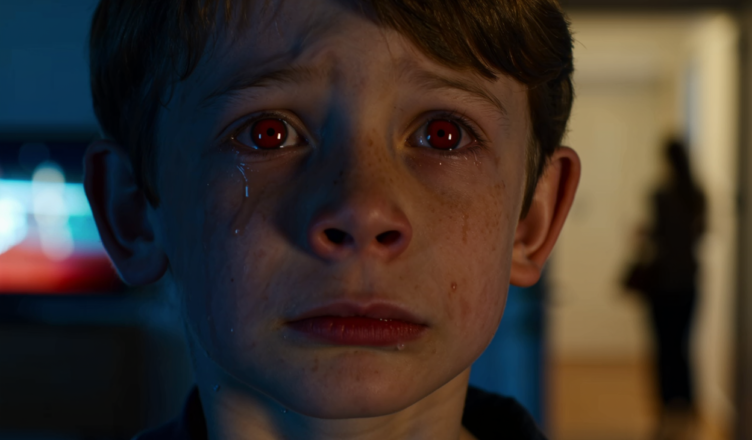
Eight-year-old Jordan pushed open the creaky front door with trembling hands. His backpack felt heavier than usual, not because of books, but because of the weight in his heart.
His eyes were red and swollen from crying on the school bus. The other kids had laughed again. They always did.
He stepped into the living room, his sneakers squeaking softly against the polished wooden floor. The air smelled like burnt toast and cold coffee. A television murmured in the background, flashing colors across the dull beige walls.
Standing near the kitchen counter was Lisa — his stepmother.
She didn’t turn around at first. She was scrolling on her phone, her jaw tight, her fingers tapping the screen with irritation. The sharp sound of her nails against glass echoed in the quiet room.
Jordan swallowed hard.
He wanted to be brave. He had practiced what to say all the way home. But now, standing there in the fading sunlight, his courage melted like ice on a hot sidewalk.
His voice came out in a fragile whisper.
“But… Mom…”
The word hung in the air like a delicate glass ornament about to shatter.
Lisa froze.
Slowly, she turned around. Her face was pale, her eyes tired and shadowed. For a brief second, something softer flickered across her expression — something almost human. But it vanished as quickly as it appeared.
Her lips tightened.
“Don’t call me that,” she said coldly.
A Silence That Said Too Much
Jordan’s fingers curled around the strap of his backpack, knuckles turning white. He didn’t cry — not this time. He had cried enough for one day. Instead, he just stood there, absorbing the words the way a small plant absorbs frost: quietly, and with damage no one could see right away.
Lisa exhaled sharply, as if the boy’s presence itself was a weight she hadn’t asked to carry. She turned back to the counter, her phone screen still glowing in her hand, though her eyes weren’t really on it anymore.
“Go wash up,” she muttered. “Dinner’s not ready.”
Jordan didn’t move.
“I said go,” she repeated, sharper this time.
But something in him — some small, stubborn ember that hadn’t been stomped out yet — made him stay rooted to the spot.
“They said I don’t have a mom,” he said quietly. “At school. They said that’s why nobody picks me up. They said you’re not really—”
“Jordan.” Her voice cracked like a whip, cutting him off. “Stop.”
He stopped. But his eyes didn’t drop this time. For the first time in longer than either of them could remember, he looked at her — really looked — waiting for something. An answer. A correction. Anything.
Lisa’s shoulders sagged. The phone slipped from her hand and landed softly on the counter.
The Weight Behind Her Eyes
What Jordan didn’t know — what no eight-year-old could possibly understand — was that Lisa’s coldness wasn’t born from cruelty alone. It was born from exhaustion, from grief she never let anyone see, from a promise she made two years ago that she was quietly, privately terrified she couldn’t keep.
His father worked nights now, sometimes doubles, leaving before Jordan woke and returning after he’d fallen asleep. The house had become hers to manage — the meals, the homework, the tears, the tantrums, the silences. And somewhere in the middle of all that responsibility, she had stopped seeing the boy in front of her and started seeing only the size of the task.
But underneath the tired eyes and sharp words was something Jordan had never been given the chance to see: the nights she sat outside his door after he fell asleep, unsure whether she was allowed to love him the way she wanted to. The fear that loving him too much — and losing him, or being pushed away — would hurt worse than keeping her distance ever could.
She had built walls not because she didn’t care, but because she cared more than she knew how to handle.
A Crack in the Silence
For a long moment, neither of them spoke. The television flickered uselessly in the background, its noise swallowed by the tension in the room.
Then, unexpectedly, Lisa knelt down — slowly, like the motion cost her something.
“I’m not your mom,” she said, quieter now, the coldness gone from her voice. “You’re right about that.”
Jordan’s chin trembled.
“But that doesn’t mean I don’t—” She stopped herself, searching for words she’d never let herself say out loud. “It doesn’t mean I don’t care what happens to you.”
It wasn’t an apology. It wasn’t a warm embrace or a storybook ending. It was smaller than that — a crack of light through a door that had been shut for a long time.
Jordan didn’t know what to do with it. So he did the only thing his eight-year-old heart knew how to do: he stepped forward, just slightly, and let his backpack slide off his shoulder to the floor.
It wasn’t forgiveness. Not yet. But it was a beginning.
What Comes Next
The blue house at the end of Maple Street would look the same to anyone driving past the next morning — quiet, ordinary, easy to overlook.
But inside, something had shifted. Not resolved. Not healed. Just… shifted — the way a single crack can travel slowly through glass before anyone notices it’s about to break, or before someone finally decides to mend it instead.
Whether Lisa and Jordan would find their way toward something resembling a family, or whether this fragile moment would fade back into silence by morning, was still an open question.
But for the first time in a long time, it was a question worth asking.
To be continued.