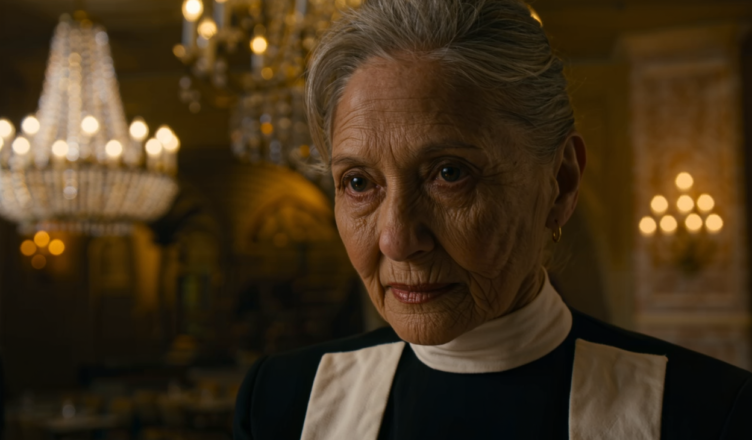
The crystal chandeliers of Bellavista looked like they belonged in a palace.
The restaurant sat on a cliff overlooking the California coastline, a place where celebrities hid from paparazzi, CEOs closed multimillion-dollar deals, and wealthy socialites competed to see who could spend the most money in a single evening. Every table was booked months in advance. On a Friday night, the restaurant buzzed with quiet luxury. A pianist played softly in the corner. Servers moved gracefully between tables carrying plates that cost more than some people earned in a day.
Among them was an elderly waitress named Margaret.
She was seventy-three years old. Her silver hair was tied neatly into a bun. Fine wrinkles lined her face. Unlike the younger servers rushing around her, she moved carefully and slowly. Yet every employee respected her. Even the chefs greeted her warmly. Customers who visited often specifically requested her section. Nobody outside the restaurant understood why. To outsiders, she looked like a sweet old woman who should have retired years ago.
That night, a black luxury car stopped outside. A woman stepped out wearing a designer dress and enough jewelry to buy a small house. Her name was Vanessa Cole. She was famous in California’s elite circles. She inherited a fortune, flaunted it constantly, and treated everyone around her as if they existed solely to serve her.
When she entered Bellavista, conversations briefly paused. Not because people admired her. Because they recognized trouble when they saw it.
Vanessa marched to her table near the window. Two friends followed behind her. The hostess smiled politely. “Welcome back, Ms. Cole.” Vanessa barely acknowledged her.
Margaret happened to be assigned to that section. She approached with a warm smile. “Good evening. May I start you with—”
Vanessa interrupted. “Sparkling water. Imported. And make it quick.”
Margaret nodded. “Of course.”
She returned moments later with the water. As she carefully poured it into Vanessa’s glass, a few drops accidentally splashed near the rim. It wasn’t enough to matter. Most customers wouldn’t have noticed. Vanessa noticed. She stared at the tiny drops as though someone had committed a crime.
“You call that service?” she snapped.
Margaret immediately apologized. “I’m very sorry, ma’am.”
Vanessa rolled her eyes dramatically. Her friends exchanged awkward glances. The old waitress quietly cleaned the table and continued serving.
For a while, everything seemed fine. But Vanessa kept finding reasons to complain. The water was too cold. Then it wasn’t cold enough. The bread arrived too early. The appetizers arrived too late. Every few minutes she summoned Margaret again. The elderly waitress remained calm. Always polite. Always patient. That only seemed to irritate Vanessa more.
Some people become angry when they don’t get what they want. Others become angry when they can’t provoke a reaction. Vanessa belonged to the second group.
The Breaking Point
The breaking point came during dessert.
Margaret carried a tray holding three expensive chocolate soufflés. As she gently placed Vanessa’s dessert onto the table, Vanessa suddenly stood. Without warning, she grabbed her water glass. Then she threw the entire contents directly into Margaret’s face.
The dining room fell silent.
Water dripped from Margaret’s chin onto her crisp white collar. A few nearby guests gasped. Someone’s fork clattered against a plate. The pianist stopped mid-note, his hands frozen above the keys. Vanessa’s two friends stared at their laps, mortified, but neither of them said a word.
“Maybe now you’ll learn to do your job properly,” Vanessa said, loud enough for half the restaurant to hear. She smoothed her dress and sat back down as if nothing had happened, reaching for her purse to check her makeup in a small mirror.
Margaret didn’t cry. She didn’t raise her voice. She simply stood there for a moment, water still dripping from her lashes, and reached for the cloth napkin folded at the edge of the table. She dabbed her face slowly, almost thoughtfully, the way someone wipes away rain rather than an insult.
“Thank you for your patience with me tonight,” Margaret said quietly. Not sarcastic. Not bitter. Simply calm.
Then she turned and walked toward the kitchen.
The Man Who Rose From His Table
What Vanessa didn’t notice — what almost no one in the dining room noticed at first — was the elderly man sitting alone at a corner table near the fireplace. He had arrived an hour earlier, unassuming in a plain gray sweater, sipping tea and reading through a leather folder of papers. The staff had greeted him with a familiarity that seemed odd for someone dressed so simply in a restaurant like this.
He set down his tea, folded his napkin, and stood.
He was in his late seventies, silver-haired like Margaret, walking with the unhurried authority of a man who had never once in his life needed to raise his voice to be heard. Every server in the room seemed to straighten slightly as he crossed the floor. The general manager, who had been watching the scene from the host stand with quiet horror, moved quickly to intercept him — not to stop him, but to walk respectfully at his side.
He stopped at Vanessa’s table.
“Excuse me,” he said gently. “I believe you just threw a glass of water at my wife.”
Vanessa looked up, confused, then irritated. “Your wife?”
“Margaret,” the man said. “We opened this restaurant thirty-one years ago.”
The color drained from Vanessa’s face.
Bellavista wasn’t simply an expensive restaurant with rotating owners and investors — it belonged, quietly and entirely, to Richard and Margaret Hail. Richard had built the business from a single ten-table dining room into one of the most exclusive addresses on the California coast. Margaret had been beside him at every step: choosing the chandeliers, tasting every dish on the menu personally, training the first generation of servers with her own hands.
When Richard’s health had begun to slow him down years earlier, Margaret had refused to disappear into comfortable retirement. She still came in most evenings. Not to oversee the books, not to intimidate the staff, but simply to work a section, pour water, and remember why she’d fallen in love with the restaurant business in the first place — the care in a well-set table, the quiet dignity of good service, the pleasure of making a stranger’s evening a little better. It was why the staff adored her. It was why the regulars requested her section. Not because she was the owner’s wife. Because she had taught half of them everything they knew.
Nobody outside the restaurant had ever needed to know.
The Room That Went Still
“You’re lying,” Vanessa said, though her voice had lost its edge.
Richard didn’t raise his voice. He simply reached into his jacket and withdrew a slim leather card case, sliding a business card onto the table. Richard Hail — Owner, Bellavista. Underneath, in smaller print, the founding year.
“I don’t lie to guests,” he said. “I do, however, ask them to leave.”
Vanessa’s friends were already gathering their purses, eyes fixed anywhere but on Vanessa’s face. The general manager stepped forward with quiet professionalism, ready to escort the party out, but Richard raised a hand — not unkindly.
“Let me finish,” he said. He turned to address the room, though he never raised his voice above a conversational tone. “Most of you have eaten here for years. Some of you know Margaret by name. She has poured your water, remembered your children’s birthdays, and comped more anniversary desserts than I can count — always without asking my permission, because she believes kindness shouldn’t need approval.”
He looked back at Vanessa.
“Tonight, in my restaurant, in front of my staff, you threw water in her face because she made a mistake so small most people wouldn’t have noticed it. I don’t need you to apologize to me. I’d like you to consider, on your way out, why you needed to make someone feel small in order to feel important.”
Nobody in the dining room moved. Even the pianist, still frozen at his bench, seemed to be holding his breath.
Vanessa opened her mouth, then closed it. For perhaps the first time in years, she had nothing to say.
She stood, gathered her things with as much dignity as she could manage, and left without another word. Her friends followed, one of them pausing just long enough to mouth a silent apology toward the kitchen doors, where Margaret had reappeared, dry now, her apron changed, watching the whole scene with the same calm expression she’d worn since the water first hit her face.
What Happened After
The story might have ended there, a satisfying moment of quiet justice in an already unforgettable evening. But Margaret, true to form, wasn’t interested in revenge.
She walked back out onto the floor, refilled water glasses at three other tables, and finished her shift exactly as she always did — checking in on regulars, complimenting a little girl’s drawing on a paper placemat, thanking the kitchen staff by name as dessert plates came out. When a young server, visibly shaken by what she’d witnessed, asked if Margaret was alright, she simply smiled.
“I’ve been splashed with worse things than water, dear,” she said. “Mostly just people’s bad days. It’s not really about me.”
By the following week, the story had made its way through California’s tightly wound social circles — not because Richard or Margaret told it, but because the guests who witnessed it couldn’t stop talking about it. Vanessa Cole, once a fixture on invite lists and gala committees, found several of her usual reservations mysteriously “unavailable” in the weeks that followed. Whether that was coincidence or consequence, no one at Bellavista ever said.
Margaret never asked for an apology. She never needed one.
She still works most Friday nights, moving carefully and slowly between the tables of the restaurant she helped build, pouring water with the same steady hands, and treating every guest — the humble and the arrogant alike — with the same unwavering warmth.
Because the people who really understand power, it turns out, rarely need to raise their voice to prove they have it.