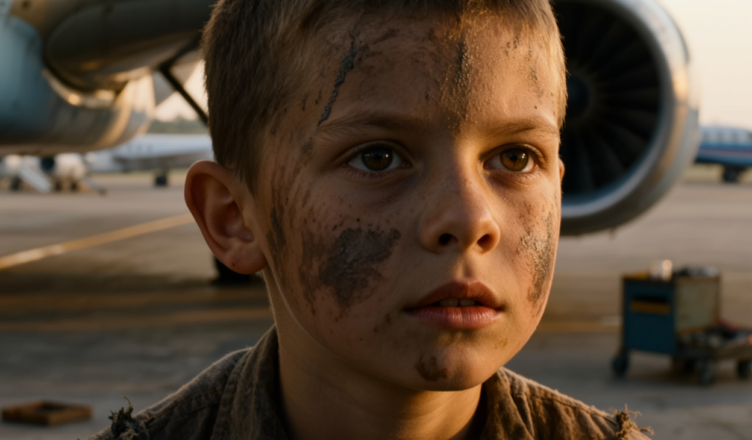
The sun had just begun to rise over the massive international airport, casting a pale orange glow across the endless runway. Ground crews were already busy preparing planes for the morning flights. Huge cargo trucks moved slowly across the concrete, and the distant roar of aircraft engines echoed through the cold morning air.
At the far end of the maintenance area, a section had been blocked off with yellow safety tape. Several large airplane engine components lay scattered on the ground. Heavy turbine blades, cracked motor housings, and tangled wiring were spread across metal tables and tool carts. These parts had been removed from a cargo aircraft the night before after a serious mechanical failure.
The airport engineers had already inspected them. Their conclusion was simple. Beyond repair. Replacing the parts would cost hundreds of thousands of dollars, and the grounded plane would likely remain stuck at the airport for weeks.
But right now, something strange was happening near those broken parts.
The Boy Among the Wreckage
A small boy, no older than twelve, was kneeling on the cold concrete floor. His clothes were old and torn. His shirt had dark oil stains across the sleeves, and his jeans were ripped at the knees. Grease covered his hands and even streaked across his cheeks. Next to him lay a small, worn-out toolbox that looked like it had been used for years.
The boy carefully tightened a bolt inside a turbine housing using a small wrench. His movements were calm and precise. He wasn’t guessing. He knew exactly what he was doing.
He rotated the turbine slowly with his hands, listening carefully to the sound of the metal turning. Then he adjusted a small internal component and wiped sweat from his forehead with the back of his dirty sleeve.
A few feet away, several airport maintenance workers had stepped away earlier after confirming the parts were useless. No one noticed the kid at first. But suddenly, one of the engineers looked back toward the maintenance area and froze.
“What the…?” he muttered. The man squinted and pointed. “Is that a kid?”
Two other maintenance workers turned around. Sure enough, there was a small boy sitting among millions of dollars worth of aircraft components, calmly working on one of the damaged turbines.
“Hey!” one of the workers shouted.
The boy didn’t look up. He continued tightening the bolt. The workers quickly began walking toward him, their expressions growing angrier with every step.
Enter Daniel Carter
At the same moment, a well-dressed man stepped out of a black airport SUV parked nearby. He was wearing an expensive suit and sunglasses, and his polished shoes clicked loudly against the concrete. His name was Daniel Carter. He was the operations director responsible for the grounded cargo aircraft.
Daniel had already spent the entire morning arguing with engineers and executives about the repair situation. Seeing a random kid touching critical airplane parts was the last thing he needed.
“What’s going on over there?” Daniel asked sharply.
One of the workers pointed. “Sir… there’s a kid messing with the turbine parts.”
Daniel’s face hardened immediately. “What?”
Without another word, Daniel and the two maintenance workers started running toward the boy.
The kid was now reconnecting several wires inside a motor casing. He carefully secured the cover and tightened the final screw. Just as he finished, the three men reached him.
“What the hell are you doing?!” Daniel shouted angrily.
The boy slowly looked up. His face was calm, but grease stains covered his cheeks.
Daniel pointed at the turbine parts scattered around. “These parts are completely destroyed!” he continued. “Our engineers already inspected them. They are beyond repair. No one can fix them!”
The maintenance workers nodded in agreement. One of them added, “Kid, you shouldn’t even be here. This is restricted area.”
For a moment, the boy said nothing. He calmly wiped the grease from his hands using a small rag. Then he stood up. Even standing, he barely reached Daniel’s shoulder. But his voice was steady.
“Check them again,” the boy said quietly.
Daniel frowned. “What?”
The boy pointed toward the turbine housing he had just closed. “The compressor blade wasn’t cracked. It was misaligned from the shutdown sequence. Somebody force-stopped the engine mid-cycle instead of following the cooldown procedure. That’s what caused the housing to warp — not a structural failure. I straightened the mounting bracket and reseated the wiring harness your team disconnected. It should hold static pressure now. Test it before you scrap it.”
Silence.
Daniel stared at him, momentarily forgetting his anger. One of the maintenance workers, a heavyset man named Frank who had spent nineteen years servicing aircraft engines, stepped forward with a skeptical scowl. “Kid, that’s not how compressor stalls work. You don’t just—”
“It’s not a compressor stall,” the boy interrupted, still calm. “If it were, you’d hear a distinct whine on spin-up, not a grinding sound on the third rotation. I listened to it. It’s grinding because of a two-degree misalignment in the shaft coupling. I fixed the coupling. I didn’t touch anything I didn’t understand.”
Frank blinked. He glanced toward the turbine housing, then back at the boy, unsettled by how specific — and how correct-sounding — the explanation was.
“Who Taught You This?”
Daniel crouched slightly, studying the boy the way you’d study something that didn’t make sense. “Who are you? Where are your parents? How do you even know any of this?”
The boy hesitated for the first time. He glanced toward the maintenance building, then back at Daniel.
“My name is Mateo,” he said. “My dad used to work here. He was a senior engine mechanic. He taught me everything — turbines, hydraulics, wiring diagrams. I used to come with him on weekends when I was little. He’d let me hold the flashlight, then let me hold the wrench.”
“Used to?” Daniel asked.
Mateo’s jaw tightened. “He died fourteen months ago. Heart attack, on shift, in bay six.” He said it flatly, the way people learn to say things they’ve had to repeat too many times. “After that, my mom couldn’t keep the apartment near the airport. We moved into a shelter about twenty minutes from here. I still come by sometimes. I know the fence gap by the fuel depot. I wasn’t going to hurt anything. I just wanted to see the planes. And then I saw this one was scheduled to be scrapped for parts, and I recognized the fault pattern from something my dad showed me once.”
Daniel said nothing for a long moment. Frank, the veteran mechanic, had gone quiet too, his earlier scowl replaced with something closer to recognition.
“Carter,” Frank said slowly. “Miguel Carter? Bay six, night shift?”
Mateo nodded. “That was my dad.”
Frank exhaled, running a hand over his face. “I trained under that man for six years. Best diagnostic ear I ever worked with. He used to say he could hear a bad bearing through three walls.” He looked at Mateo with new eyes. “Guess it runs in the family.”
The Test
Daniel could have called security right then. Technically, Mateo had trespassed into a restricted zone and handled aircraft parts without authorization — a serious liability on paper, the kind of incident that ends with a report, a lecture, and a firm escort off airport property. But something about the boy’s certainty, and Frank’s stunned silence, made him pause.
“Test it,” Daniel said finally, turning to Frank. “Before you scrap anything. Run the diagnostic again. If he’s wrong, we lose twenty minutes. If he’s right—”
He didn’t finish the sentence.
Two hours later, the turbine assembly was reconnected to a ground test rig. Engineers gathered around, most of them skeptical, a few outright annoyed that a twelve-year-old’s guess was being treated as a legitimate lead. Frank ran the ignition sequence himself.
The engine spun up. Smooth. No grinding. No warning vibration on the third rotation. The diagnostic readout, which had flagged catastrophic internal failure the night before, came back clean.
The lead engineer, a woman named Priya Nair who had signed off on the original “beyond repair” assessment, stared at the readout twice before speaking. “That’s not possible,” she said quietly. “We ran this exact test eighteen hours ago. It failed.”
“Because eighteen hours ago it was misaligned,” Frank said, nodding toward Mateo, who stood a few feet back, arms crossed, watching without a hint of triumph on his face — just quiet, tired relief. “The kid fixed the coupling.”
What Happened Next
The airline didn’t scrap the engine. The repair Mateo had made, once formally inspected and re-certified by licensed engineers — who insisted on redoing every connection to industry standard before signing off — ended up saving the airline an estimated $480,000 in parts and roughly three weeks of grounded downtime for the cargo aircraft.
Daniel Carter didn’t simply thank Mateo and send him on his way. He drove the boy and his toolbox back to the shelter himself that afternoon, and asked to meet his mother. What followed wasn’t a single grand gesture, but a series of smaller ones: a formal meeting with the airline’s HR and legal teams to figure out how a twelve-year-old could be lawfully supported rather than simply liable; a scholarship fund, established quietly by several of the engineers who’d watched the test that morning, aimed at technical and aviation-mechanics education; and a standing invitation for Mateo to shadow the maintenance crew on weekends — legally, safely, and under Frank’s direct supervision, the same way he once shadowed his father.
“I’m not doing this because I feel sorry for the kid,” Frank told a reporter who later covered the story for a local news outlet. “I’m doing it because in nineteen years, I’ve met maybe two people with an ear like that. One of them was his father. I’m not about to let the second one end up sorting cans for a shelter kitchen instead of an engine bay.”
Mateo, for his part, has said little about being called a prodigy or a hero — words he shrugs off almost uncomfortably. When asked why he risked getting in serious trouble to fix an engine that wasn’t his responsibility, his answer was simple.
“My dad used to say a broken engine is just a puzzle nobody’s patient enough to finish,” he said. “I had time. And I missed him. Working on it kind of felt like he was still standing next to me.”
Daniel Carter, the man who once shouted at a twelve-year-old for touching a half-million-dollar engine, now keeps a small keepsake on his office desk: the worn brass wrench Mateo used that morning, gifted to him by Frank as a reminder, he says, “that the smartest person in the room doesn’t always look the way you expect.”