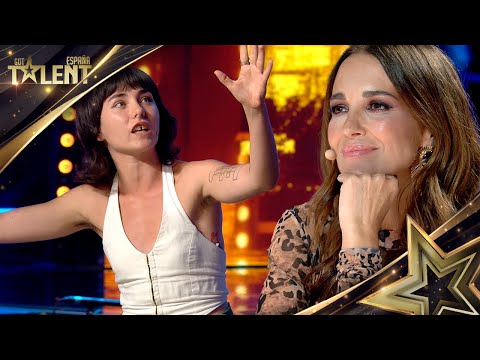
Imagine walking onto one of the biggest talent-show stages in Spain without a dance routine, without a spectacular illusion, and without a powerful musical performance. You simply stand in front of the judges and begin speaking words that you wrote yourself. That takes an incredible amount of courage—and that is exactly what makes this audition from Got Talent España 2024 so captivating.
From the beginning, it is clear that this contestant has something different in mind. She isn’t there simply to demonstrate a conventional talent. She wants to use the enormous platform of Got Talent to bring attention to something she deeply values: poetry. In an age where fast entertainment dominates our screens, she chooses something much quieter—the power of language, emotion, and imagination.
The moment she begins reciting her original poem, the atmosphere changes. There is no need for loud music or elaborate staging. Her voice becomes the center of attention, and every sentence asks the audience to stop and listen. The performance demonstrates that sometimes the simplest presentation can create the strongest connection when the person delivering it truly believes in what they are saying.
What makes the audition even more personal is that these aren’t simply words selected from a famous poet. This is her own creation. Every line represents her perspective and her way of expressing emotions and ideas. Performing something you have written yourself can be incredibly vulnerable because there is nowhere to hide behind someone else’s work. You are sharing a piece of your imagination with an audience that has never met you.
As the poem continues, the audience gets a chance to experience something different from the usual talent-show spectacle. Instead of asking, “How did she do that?” the performance encourages a different question: “What did those words make me feel?” That is one of the unique powers of poetry. A poem doesn’t need to be complicated to be meaningful. Sometimes a few carefully chosen words can stay in someone’s mind for much longer than expected.
Her goal of giving poetry more visibility also gives the audition a deeper purpose. She isn’t simply trying to earn approval from the judges. She is using the stage as a platform for an art form that she believes deserves more attention. Whether viewers are regular poetry readers or people who rarely encounter poems, the performance invites everyone to consider the possibility that poetry still belongs on a modern entertainment stage.
There is something especially brave about choosing such an intimate form of expression for a competition where contestants often rely on spectacular skills. Singing can immediately fill a theater. Dancing can create energy. Magic can create shock. But poetry asks the audience to slow down. It asks them to listen to meaning rather than simply watch movement.
And that is precisely what makes this audition stand out. The contestant doesn’t try to compete with spectacle. She creates her own kind of spectacle through language. Her performance becomes a reminder that talent can take many forms, and that creativity doesn’t always have to be loud to be powerful.
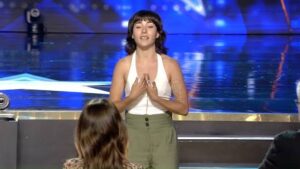
More importantly, this audition shows why platforms like Got Talent can sometimes introduce audiences to art forms they might otherwise overlook. A person who came to watch singing, dancing, comedy, or magic may suddenly discover a new appreciation for poetry. In that sense, the contestant succeeds in doing exactly what she came to do: she gives poetry a voice in front of a huge audience.
Ultimately, this performance isn’t only about whether the judges liked the poem or what decision they made. It is about having the courage to stand in front of thousands of people and say, this is what I created, this is what I believe in, and I want you to hear it. That kind of vulnerability is a talent in itself.
So watch the entire audition and listen carefully to the words. ❤️📖 Did her poem move you? Do you think poetry deserves more space on talent shows? Let us know in the comments, and share this performance with someone who believes that words, stories, and poetry still have the power to make people stop and listen.