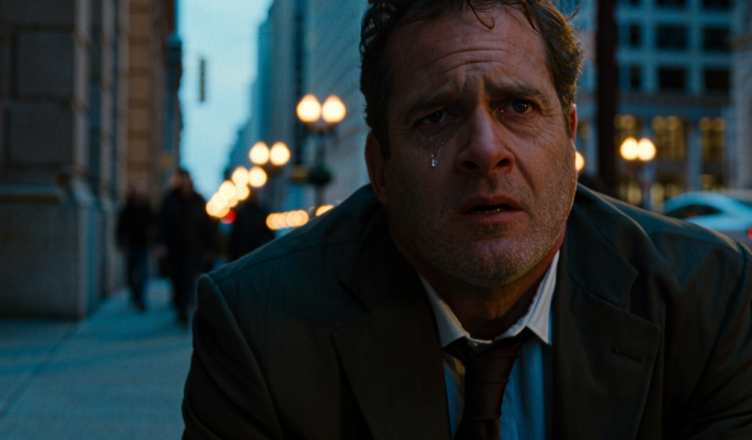
The evening air carried a quiet chill as the city moved on without noticing him.
On the corner of a busy street in downtown Chicago, where traffic lights blinked endlessly and people rushed past with purpose, a man in a perfectly tailored suit sat on the cold pavement.
His polished shoes were dusty now, his tie loosened, his hair slightly disheveled. He looked like someone who belonged in boardrooms, not on sidewalks.
Yet there he was—head bowed, shoulders trembling, tears slipping down his face as if something inside him had finally broken beyond repair.
No one stopped.
A few glanced. Most ignored.
Because in a city like this, pain was common—but invisible.
His name was Daniel Carter. A man who, until that very morning, had everything people chase their whole lives—wealth, respect, success. He was the kind of man others envied silently.
But life has a way of collapsing everything in a single day.
Just hours earlier, Daniel had lost his company—taken over in a ruthless deal he never saw coming. His business partner, someone he trusted like a brother, had betrayed him. Signed documents behind his back. Sold everything.
And as if that wasn’t enough, he received another call.
The hospital.
His wife had been battling a serious illness, something he kept hidden from the world. He had always believed money could fix anything. That he had enough power to protect his family from pain.
But that morning, the doctor’s voice had been calm… too calm.
“There’s nothing more we can do.”
Two sentences.
That’s all it took to shatter a man who once believed he controlled his destiny.
Now, sitting on that corner, Daniel wasn’t crying for his company.
He was crying because for the first time in his life… he was completely powerless.
He buried his face in his hands.
And whispered, barely audible—
“I can’t fix this…”
That’s when a small voice interrupted the silence.
“Are you hungry?”
Daniel didn’t respond immediately. He assumed it was just someone passing by.
But then the voice came closer.
“You can eat this.”
He slowly looked up.
Standing in front of him was a little girl—no older than eight. Her clothes were worn and dirty, oversized and torn in places. Her hair was messy, her face smudged with dust.
In her small hand, she held a piece of bread.
Not fresh. Not perfect.
But it was all she had.
And she was offering it to him.
For a moment, Daniel just stared at her, confused by the contrast.
Here he was—a man who once signed million-dollar deals—being offered food by a child who clearly had nothing.
His lips trembled as he shook his head.
“No… I’m not hungry…”
The girl didn’t walk away.
Instead, she gently sat beside him, placing the bread in her lap.
She studied his face with quiet curiosity, not judgment.
“Then why are you crying?” she asked softly. “Tell me… I’ll help you.”
Daniel let out a broken laugh—one filled with disbelief, pain, and exhaustion.
“You’ll help me?” he said, voice shaking. “No one can help… in this situation…”
The words hung in the air.
Heavy. Final.
Like a door closing forever.
The girl didn’t argue.
She didn’t look confused.
She simply smiled.
Not the kind of smile people use to be polite.
But a calm, knowing smile—like someone who sees something others don’t.
Part Two: The Girl Who Had Nothing, and Gave Everything
“My name is Mia,” she said, as if that alone would explain everything. “I used to have a big house too. And a dad who wore suits just like yours.”
Daniel blinked, caught off guard.
“He lost his job,” Mia continued, tearing a small piece off the bread and holding it out to him again. “Then we lost the house. Then… he stopped smiling. And one day, he just stopped getting up.”
She said it plainly, without self-pity, the way children sometimes speak of the unbearable as though it were simply weather.
“I’m sorry,” Daniel managed, his voice hoarse.
“Don’t be sorry for me,” Mia said, shaking her head. “Be sorry for the people who still have everything and don’t know it’s already slipping away.”
Daniel stared at her. Something about the phrase struck him harder than any boardroom insult ever had.
“You lost your company today,” she said, not as a question. “And someone you love is sick.”
“How do you—”
“You keep looking at your ring,” she said simply, glancing at his hand. “And you keep touching your chest, like your heart hurts more than your head does.”
Daniel looked down. She was right. His wedding ring caught the streetlight, and his hand had, without him realizing it, pressed flat against his sternum.
Part Three: A Lesson From the One Who Had the Least
“You said no one can help you,” Mia said, breaking off another small piece of bread and eating it herself now, matter-of-fact. “But you’re wrong. Someone already came looking for you. Not money. Not your business partner. Someone else.”
“Who?” Daniel asked, almost afraid of the answer.
“Whoever is waiting for you at that hospital,” she said. “You’re sitting here, crying about what you lost, while she’s still there. Still breathing. Still waiting for you to walk through that door.”
The words hit him harder than the phone call had that morning.
He had left the hospital in a daze after hearing the doctor’s words, unable to process anything, unable to face his wife’s eyes. He had walked for hours without direction, ending up on a street corner, mourning a future that hadn’t happened yet as though it already had.
“I was so afraid of losing her,” Daniel whispered, “that I left before I could lose the time I still have.”
Mia nodded slowly, as if she had known this all along and had simply been waiting for him to say it out loud.
“Money couldn’t fix my dad,” she said quietly. “But somebody staying next to him might have helped more than he ever let on.”
Part Four: The Return
Daniel sat in silence for a long moment, the weight of her words settling over him like the evening chill.
Then, slowly, he reached for his wallet — not out of habit, but out of instinct, wanting to give her something, anything, in return for what she had just given him. But when he opened it, Mia gently pushed his hand back down.
“I didn’t give you bread because I wanted something,” she said. “I gave it because you looked like you needed to know someone still saw you.”
Daniel’s eyes filled with fresh tears — different ones this time. Not tears of collapse, but of something breaking open instead of breaking down.
He stood, brushing the dust from his suit, and for the first time all day, his shoulders weren’t trembling.
“Will you be okay?” he asked her, suddenly aware of how little he actually knew about her life, where she slept, whether anyone was looking for her too.
Mia smiled again, that same calm, knowing smile.
“I always find a way,” she said. “Now go. She’s waiting.”
Daniel hesitated only a second before turning and walking quickly toward the street, raising his hand for a cab, his mind no longer on the company he’d lost, but entirely on the hospital room he had run from — and the woman inside it who still needed him.
He didn’t look back to see whether Mia was still sitting there.
If he had, he might have noticed she was already gone — vanished into the evening crowd as quietly as she had appeared, leaving behind nothing but a half-eaten piece of bread on the cold pavement, and a man who would never see loss the same way again.
This story continues in Part Two, where Daniel returns to the hospital — and searches the city for the little girl who saved him, only to discover something about her that no one could explain.