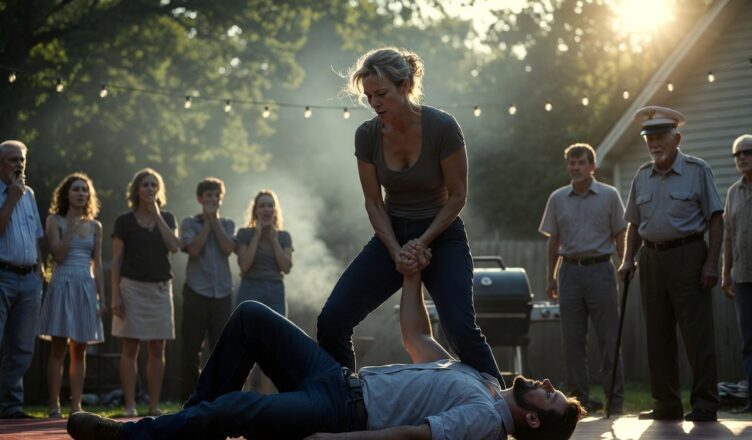
Caleb hit the grass on his hands and knees while the grill hissed behind him and distant fireworks cracked over the Richmond skyline, and I watched my thirteen-year-old son’s face turn red with a humiliation no child should have to feel at a family cookout.
Derek laughed.
“Come on, kid,” he said, loud enough for every relative gathered in my mother’s backyard to hear. “You’ll never become a man if you fall apart every time somebody challenges you.”
Caleb stood slowly, brushing grass from his palms. He didn’t cry. He just lowered his eyes, and that quiet, practiced way he shrank into himself hurt me worse than tears ever could have.
My nine-year-old, Emma, slipped her small hand into mine. “Mom, why does Uncle Derek always treat him like that?”
I didn’t have an answer that wouldn’t have shamed me to say out loud.
Years of Letting It Slide
Derek had spent years testing people he assumed would never push back — quiet men, women he could talk over, anyone who valued peace at a family gathering more than confrontation. He turned every holiday into a stage for stories about his brief stint in the military and his opinions on what real discipline looked like.
I had let too much of it happen. Not because I didn’t notice. Because I’d learned, over twenty-two years, that some battles aren’t worth fighting in front of children — until suddenly, they are.
My name is Laurel Bennett. I was forty-four years old, retired from the United States Marine Corps, and my own family knew almost nothing about what those two decades had actually held.
They knew I’d worn a uniform. They didn’t know about the deployments that kept me away for Christmases I never talked about, the rescue operations I still dreamed about some nights, the injury that occasionally woke me at 3 A.M., or the small plain box at the back of my closet holding medals I’d never once shown anyone at that table.
I never wanted praise for any of it. But my silence had quietly taught Derek that my service was something he was allowed to reduce to a punchline whenever he needed one.
He slapped the edge of the mat and looked straight at me. “Maybe the office Marine can show Caleb how it’s done,” he said, grinning, “unless paperwork made you too delicate.”
A few relatives laughed — the nervous kind of laughter people use when they’re relieved the joke isn’t aimed at them. My sister Mallory stared down hard at a tray of hamburger buns like it required her full concentration. My mother stayed seated under the patio umbrella.
“Derek, that’s enough,” she said. But there was no weight behind it, and Derek had known for years there wouldn’t be.
My husband stood by the cooler, jaw tight, saying nothing. That silence stung almost as much as Derek’s words, because I watched Caleb notice it too — watched my son understand, in real time, that even his father wasn’t going to step in.
The Moment I Stopped Waiting
I looked at Caleb. His shoulders had curled inward, the posture of a kid trying to take up as little space as possible so the adults around him would just stop looking.
That was the exact moment two decades of restraint finally ran out.
I took off my watch and handed it to Emma. “Stand beside Grandma.”
Her eyes went wide. “Mom?”
“I’m all right,” I told her, and I meant it — maybe for the first time all afternoon.
I stepped onto the mat. I didn’t raise my voice. I didn’t threaten him. I just looked at Derek and said, “You wanted to demonstrate strength. Go ahead.”
His grin got wider, because he assumed I’d just volunteered to be the next joke of the afternoon. He came at me carelessly, expecting me to stumble back the way Caleb had.
I stepped aside instead, redirected his own momentum against him, and guided him down onto the padded mat with the kind of control that comes from doing this thousands of times, in far worse conditions than a suburban backyard. Within seconds he was flat on his back, staring up at me while I held his wrist in a joint lock precise enough to cause no injury and leave absolutely no ambiguity about who had underestimated whom.
The backyard went dead silent.
“Let go,” Derek muttered.
“Say you’re finished.”
He tried once, uselessly, to twist free. Then he stopped fighting it. “Finished.”
I released him immediately and stepped back, giving him room to get up with whatever dignity he had left.
What Derek Didn’t Expect
He scrambled to his feet, face burning red now for entirely different reasons. “That was cheap.”
“It was controlled.”
“You embarrassed me in front of everyone.”
I looked past him, toward my son. “You embarrassed yourself when you chose a child as your audience.”
A few relatives looked away. Near the patio table, someone quietly lowered a phone they’d been holding up to film — I never found out whether they’d been recording Caleb’s humiliation or mine, and by then it didn’t matter which.
Derek took one angry step toward me. That’s when a firm, weathered voice cut across the yard from the side gate.
“Step back, Corporal Vaughn.”
The Neighbor Who Knew
Silas Mercer, my mother’s elderly next-door neighbor, stood at the fence with one hand resting on his cane. He wore a faded Marine cap that had clearly seen decades of sun, and though age had bent his shoulders forward, his voice still carried across the entire yard without effort.
Derek scoffed, some of his bravado returning now that the “threat” had a cane instead of a wrestling stance. “This is family business.”
Silas looked past him — at Mallory, at my mother, at every relative who’d laughed twenty minutes earlier.
“No,” he said. “This is about respect. And none of you understand who you’ve been insulting.”
My stomach dropped. “Silas, please don’t.”
He didn’t stop.
“In 2011, Lieutenant Colonel Bennett led the team that reached my disabled convoy,” he said, his eyes never leaving Derek’s face. “When my leg failed under me, she carried me to safety herself. She refused to leave anyone behind — including men twice her size who told her to go on without them.”
Mallory’s face drained of every trace of color. “Lieutenant colonel?”
Caleb already had his phone out, my name typed into the search bar before Silas had finished his sentence. An old veterans’ association article filled the screen, a photograph beside it that I hadn’t looked at myself in years — younger, in fatigues, standing beside men I hadn’t spoken to in over a decade.
“Mom,” Caleb whispered, staring at the list of commendations beneath the photo. “Why didn’t you ever tell us?”
Before I could find an answer, Derek leaned over my son’s shoulder to read the screen for himself.
He went completely still.
After the Silence
I won’t pretend the rest of that afternoon was comfortable. Nobody quite knew what to do with the version of me that had just stood in front of them — the one that had apparently been sitting at every holiday table for years, quietly declining to correct anyone’s assumptions.
Mallory apologized twice before we left, each time more awkwardly than the last. My mother said nothing at all, which told me everything about how long she’d known and chosen not to mention it. My husband found me by the cooler afterward, guilt written plainly across his face, and said only, “I should have said something before you had to.”
He was right. But I’d stopped waiting on other people’s timing a long time ago — I just hadn’t realized, until that mat, that I was still waiting on my own.
Caleb didn’t say much on the drive home. But somewhere around the third stoplight, he reached over from the back seat and rested his hand briefly on my shoulder — the kind of gesture a thirteen-year-old boy doesn’t quite have the words for yet, but means completely.
Derek hasn’t made a joke about my service since. He hasn’t made much conversation with me at all, honestly. That’s a trade I’ll take every single time.
If this story resonated with you, share it with someone who’s spent too long letting others underestimate them.