For one terrible second, I forgot how to breathe.
At 11:17 that morning, I’d been stocking shampoo at a beauty supply store in Pasadena when Ethan’s school called. “Your son collapsed on the playground,” the voice on the other end said. “There’s blood, but we can’t find an injury.”
My hand went numb around the phone.
Ethan was seven, and fearless in the specific, exhausting way only seven-year-olds manage. He raced his bike down hills he had no business racing down. He climbed trees taller than our roof. He’d once informed me, with complete conviction, that dinosaurs had invented homework as a form of prehistoric revenge. He did not simply collapse.
When I reached Oakridge Elementary, an ambulance was already parked beside the basketball court. Ethan lay pale on the grass while paramedics worked over him, a nurse’s hands slick with blood pressing gauze against his stomach.
I dropped to my knees beside him. “Baby, look at me.”
His eyelids fluttered open. “Mom,” he whispered. “I didn’t fall.”
There were no cuts on him. No bruises anywhere. And yet the gauze against his stomach kept soaking through, blood appearing from a source no one could locate.
The Lie I’d Told for Seven Years
Inside the ambulance, Ethan’s blood pressure kept dropping despite everything the paramedics tried.
“Family history of bleeding disorders?” one of them asked me, working fast.
“Not on my side.”
“What about his father?”
“He’s gone.” The lie came out easily. It had gotten easier every year for seven years.
Ethan’s father wasn’t gone. He was Adrian Blackwood — the most feared name in American organized crime, a man whose reputation alone made prosecutors double-check their locks at night and made hardened criminals lower their voices without being asked to.
I’d loved Adrian before I understood what that name actually meant. By the time I found out the truth — really found out, not the version he’d let me believe for the first year we were together — I was already pregnant, and terrified in a way I hadn’t known a person could be terrified. So I ran. Changed my name. Built a small, quiet life in Pasadena where the Blackwood empire, as far as I knew, had never once thought to look.
I told myself for seven years that I’d done the right thing. Sitting in the back of that ambulance, watching my son’s blood pressure drop on a screen I didn’t fully understand, I wasn’t sure anymore.
The Lockdown
At San Gabriel Medical Center, doctors rushed Ethan toward emergency surgery the moment we arrived, moving with the kind of urgency that told me everything I didn’t want to know without a single word being said.
Then the entire hallway went dark.
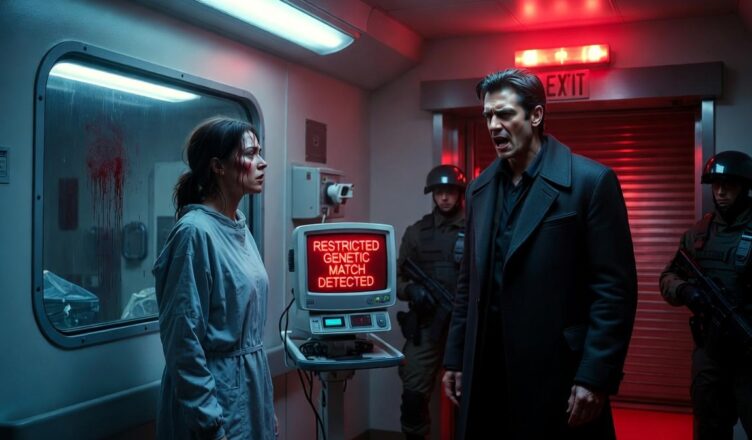
Every monitor on the floor died simultaneously. Steel shutters slammed down over every visible exit. Security doors locked with a sound I felt in my chest. Armed guards — not hospital security, but something else entirely, something professional and coordinated — poured out of the elevator bank at the end of the hall.
A red warning appeared on the one screen still glowing, positioned directly beside Ethan’s name and patient number:
RESTRICTED GENETIC MATCH DETECTED. PRIMARY DONOR NOTIFIED. BLACKWOOD PROTOCOL ACTIVATED.
The nurse standing closest to the screen stared at it for a long moment before slowly turning to face me.
“Mrs. Bennett,” she said, careful, quiet. “Who is this child’s father?”
My stomach dropped through the floor.
Before I could find any answer — true or otherwise — the elevator at the end of the hall chimed.
Adrian
The doors opened, and Adrian Blackwood stepped into the hallway surrounded by armed men who moved like extensions of him rather than employees.
Seven years had changed him. He looked older, harder, more dangerous in some fundamental way than the man I’d fled in the middle of the night with nothing but a duffel bag and a positive pregnancy test I hadn’t told him about yet.
Then his eyes found me.
They moved from my face to the blood-smeared window of the operating room behind me, and I watched something in him fracture in real time — the kind of controlled, absolute composure that men like Adrian spend their entire lives constructing, gone in the space of a single breath.
He crossed the hallway toward me, and every armed guard in the corridor stepped aside without being told to.
“You stole seven years of my son’s life,” he said, his voice low enough that only I could hear it, which somehow made it worse than shouting would have.
“Adrian, I can explain—”
“No.” He stopped inches from me, fury burning behind eyes I used to know better than my own reflection. Then, without warning, his voice dropped to something closer to a whisper. “But if Ethan dies, you won’t survive the truth about why.”
What the Protocol Actually Meant
I found out, in pieces, over the following hour, exactly what had just locked down an entire hospital floor around my son.
Years before I’d ever met him, Adrian had quietly built a private genetic registry system linked to select hospitals across the country — a fail-safe, originally designed to protect his own biological children from targeted harm by rival organizations, activated automatically the instant a Blackwood genetic match entered emergency care anywhere in the network. I hadn’t known it existed. I certainly hadn’t known Ethan’s blood work, run routinely on intake, would trip it within minutes of arriving.
Ethan wasn’t the target of an attack. He had a rare, inherited bleeding disorder — one that ran, as it turned out, directly through Adrian’s side of the family, a condition Adrian himself carried in a mild, largely asymptomatic form he’d never had reason to mention to me during the year we were together, because he hadn’t known either.
It also meant the surgical team now operating on my son had access, within minutes, to genetic and treatment data from three other Blackwood family members with the same rare condition — data that, under any normal circumstance, would have taken days to compile, if it could have been found at all.
The protocol that had terrified me in that hallway may very well have been the reason Ethan survived the surgery.
What Adrian Said in the Waiting Room
We sat three chairs apart in the surgical waiting room for the first two hours, neither of us speaking, armed men positioned at every entrance like it was the most normal thing in the world.
Eventually, Adrian broke the silence. “Why did you run?”
I told him everything I’d never said seven years earlier — not because I hadn’t loved him, but because of what I’d learned about the life waiting for any child born into his world. The threats that came standard with the name. The kind of childhood I’d watched, from the outside, other Blackwood children endure. I told him I hadn’t run from him. I’d run from what I was afraid our son would become by simply existing inside that world.
“You didn’t get to make that decision alone,” Adrian said, echoing words I’d heard, almost verbatim, in some other version of this exact argument years before I’d ever met him — though I didn’t know that yet.
“I know,” I said. “I still don’t fully regret it. I regret that he almost died today without either of us in the room understanding why.”
Adrian was quiet for a long time after that. When he finally spoke again, his voice had lost most of its earlier edge. “The protocol found him because of me,” he said. “If you’d never run, he’d have been diagnosed with this at two years old, the way my sister was. Instead he almost bled out on a playground because nobody knew to look.”
I didn’t have an answer for that. I’m not sure there was one that would have made either of us feel better.
Six Months Later
Ethan came out of surgery, and eventually out of recovery, with a full diagnosis, a treatment plan, and — more complicated than either of those things — a father he was slowly, carefully getting to know for the first time in his life.
Adrian didn’t demand custody, didn’t threaten legal action, didn’t do any of the things I’d spent seven years quietly bracing myself for if he ever found us. He asked, instead, for supervised visits, then unsupervised ones, then eventually a standing weekend arrangement that Ethan now looks forward to with an enthusiasm that both terrifies and humbles me in roughly equal measure.
I still don’t fully know what Adrian’s world looks like day to day, and I’ve made it clear — as clear as anyone reasonably can with a man like him — that Ethan’s exposure to it stays limited for as long as I have any say in the matter. So far, Adrian has honored that, which is more than I expected and more than I think either of us fully trusts yet.
What I know for certain is this: the lie I told seven years ago in the back of an ambulance — he’s gone — nearly cost my son his life in a hallway neither of us understood until it was almost too late. Some truths, it turns out, aren’t ours to bury alone, no matter how good our reasons feel at the time.
Ethan still races his bike down hills he has no business racing down. He still insists, with total conviction, that dinosaurs invented homework. But now, some weekends, he comes home talking about a man he calls Dad in a tone I’m still learning to live with — grateful, uneasy, and, for the first time in seven years, honest.