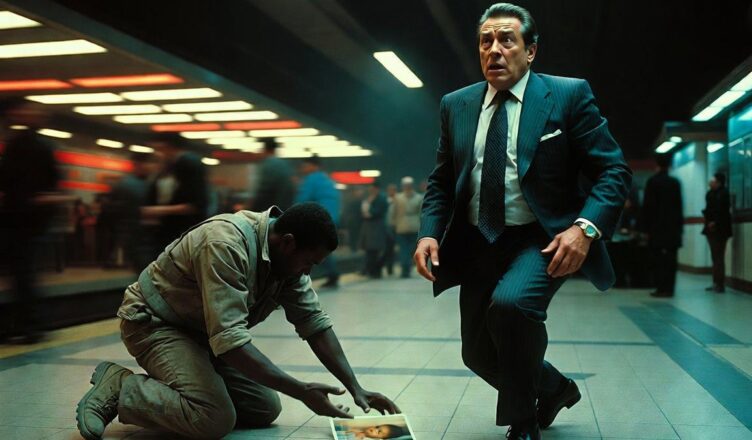
Ethan couldn’t move.
The photograph. The little girl. The hospital bed. The bald head wrapped in a thin blue blanket.
He knew that face.
“Wait,” he said, his voice barely a whisper. “Where did you get that?”
The construction worker froze mid-reach, his rough hand still hovering over the photo. He looked up at Ethan for the first time — really looked at him — and something like fear flickered across his exhausted eyes.
“That’s my daughter,” the man said quietly. “Why does it matter to you?”
Ethan’s heart pounded so hard he could hear it in his ears. He crouched down — something a man like him never did in a subway station — and picked up the photograph before the worker could stop him.
He turned it over.
On the back, in faded pen, was a name and a date.
Mia. Age 7. Memorial Sloan Kettering.
Ethan’s hands started to shake.
“This is impossible,” he muttered.
“What’s impossible?” the worker snapped, snatching the photo back, his patience gone. “That my daughter’s dying? That I can’t afford her treatment? That I’m on my third job this week just to cover one more round of chemo?” His voice cracked. “Yeah. It’s impossible. Now if you don’t mind—”
“I donated a kidney to a seven-year-old girl named Mia three years ago.”
The words hit the worker like a physical blow. He went still. The crowd around them, which had already started to disperse, stopped moving again.
“That’s not possible,” the worker said slowly. “There are thousands of—”
“At Sloan Kettering. Anonymous donor. The hospital wouldn’t let me meet her — I insisted on staying anonymous. I never even knew if she survived.” Ethan’s voice broke. “I’ve thought about her every single day for three years.”
The construction worker’s face went pale. He reached into his jacket with trembling hands and pulled out a folded piece of paper — a hospital letter, worn soft from being carried for years.
“My daughter’s donor record,” he whispered. “I kept it. In case I ever wanted to say thank you. In case I ever found out who—”
He stopped.
He stared at the letter. Then at Ethan. Then back at the letter.
“Oh my god,” he said.
The date matched.
The hospital matched.
And taped inside the folded paper, barely visible, was a small transplant identification number.
Ethan reached into his own wallet — the one compartment he never opened in public — and pulled out an identical card he’d carried for three years, the only proof of the surgery that changed his life.
He held it next to the worker’s paper.
The numbers were identical.
For a long moment, neither man spoke. The subway rushed past behind them, but neither of them heard it.
“You’re the reason my daughter is alive,” the worker finally said, his voice shattering. “I’ve spent three years wanting to find you. And I just yelled at you on a subway floor.”
Ethan looked down at the tools scattered across the ground — the same tools he’d sneered at minutes earlier — and felt something inside his chest crack open.
“How is she?” he asked. “Is she—”
“She’s twelve now,” the worker said, tears finally falling. “Cancer’s been gone for two years. She wants to be a doctor.”
Ethan’s knees nearly gave out.
The crowd, once silent out of awkwardness, was now silent out of something else entirely — the kind of silence that only happens when strangers witness something they’ll never forget.
Ethan Walker, the man who never apologized, knelt fully to the ground next to a construction worker’s spilled tools and began, for the first time in years, to cry.
But this wasn’t the end of the story.
Because what neither man knew yet — what neither of them could have possibly imagined — was that Mia’s medical bills weren’t the only thing about to change forever.
Someone in the watching crowd had been filming the entire encounter.
And by the next morning, it wouldn’t just be a subway station that knew their names.
It would be the entire country.