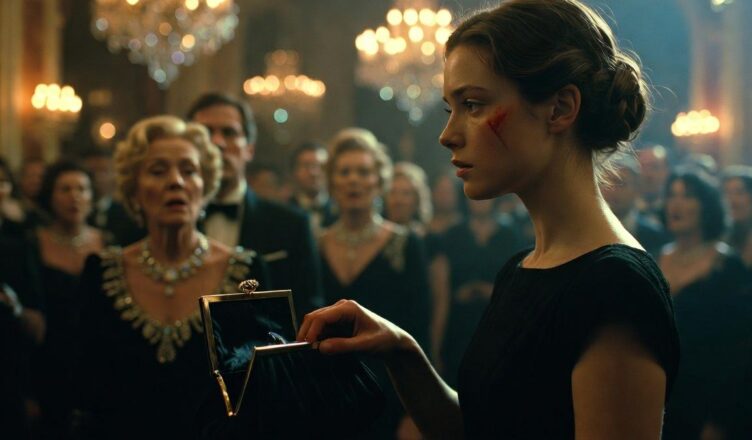
The slap still echoed through the ballroom.
Nobody moved. Nobody breathed. Even the orchestra had stopped mid-note, the conductor frozen with his baton raised.
Emily’s cheek burned red, but her eyes never wavered from Victoria’s face.
“A girl like you doesn’t deserve to stand among people like us,” Victoria repeated, louder this time, as if she needed the crowd to hear it again.
Emily said nothing.
She reached into her purse.
Victoria smirked, expecting tears, an apology, maybe a tissue to dab at her eyes. Instead, Emily’s fingers closed around something cold and metallic.
She pulled out a small velvet case.
Gasps rippled through the crowd — not because of what it was, but because of what was engraved on it.
The Harrington Foundation. Board of Directors.
Victoria’s smirk vanished.
“That’s impossible,” she whispered. “That case is only given to—”
“Board members,” Emily finished calmly. “Yes. I know.”
She opened it. Inside was an ID badge with her photo, her name, and beneath it, a title that made the entire room lean in closer.
Emily Carter — Chief Philanthropic Officer, Harrington Foundation.
The same foundation Victoria’s late husband had built. The same foundation whose board Victoria had spent the last two years trying — and failing — to gain a seat on.
“I was appointed three weeks ago,” Emily said quietly, “by unanimous vote. Including your own son.”
Victoria’s face drained of color.
“That’s not possible,” she stammered. “My son would have told me—”
“He tried,” Emily said. “You hung up on him. Twice. You said you didn’t have time for ‘foundation nonsense.'”
A few guests exchanged uneasy glances. Someone near the back murmured, “Oh my god.”
Victoria’s hand, the one that had struck Emily seconds earlier, began to tremble.
“I came here tonight,” Emily continued, her voice steady enough for the entire ballroom to hear, “to quietly observe the gala I now help fund. I wasn’t going to say anything. I wasn’t going to embarrass anyone.” She paused. “But you made sure that wasn’t an option.”
Victoria opened her mouth, but nothing came out.
“The board meets tomorrow morning,” Emily said, closing the velvet case with a soft click. “We’ll be discussing next year’s charity partners.” She looked directly into Victoria’s eyes. “And whether tonight’s behavior reflects the values this foundation was built on.”
She didn’t raise her voice. She didn’t need to.
Victoria’s friends, who had been laughing minutes earlier, now took a slow step back from her, as if distancing themselves might erase what they’d just witnessed.
The silence stretched unbearably long.
Then, from somewhere near the bar, a single guest began to clap.
Then another.
Within seconds, the entire ballroom was applauding — not for Victoria, but for the quiet, composed young woman she had just tried to humiliate.
Victoria stood alone in the middle of the crowd she’d ruled for decades, her cheeks burning with a humiliation far worse than any slap could cause.
Emily simply turned, thanked the host for the invitation, and walked toward the exit.
But as she reached the door, she paused and looked back one final time.
“Oh, and Victoria?” she said. “The board will be in touch about your foundation membership too.”
She smiled — not cruelly, just knowingly.
Because what Victoria didn’t know yet — what nobody in that ballroom knew yet — was that Emily’s appointment wasn’t the only decision made three weeks ago.
And by morning, Victoria would find out exactly what else had changed.