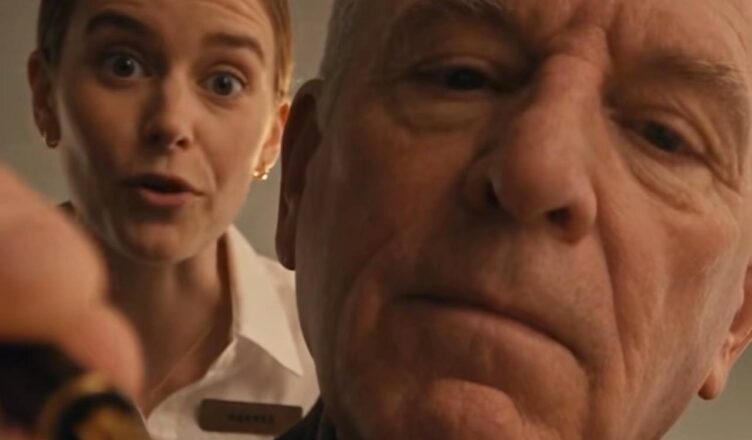
The waitress looked at the receipt again.
The words were still there.
“I’ll come back when I’m old enough to understand.”
“What does this mean?” she asked.
The man didn’t answer immediately.
He stared at the small backpack underneath the chair.
Then he placed the flowers on the table.
“How long has it been here?” he asked.
“The backpack?”
He nodded.
“For three years.”
The waitress frowned.
“Then you know who it belongs to.”
The man nodded slowly.
“Yes.”
He sat down for the first time.
“It belonged to my daughter.”
The waitress looked at the untouched child’s meal.
“You mean… belonged?”
The man nodded.
“My daughter died three years ago.”
The waitress went quiet.
But there was something strange about the way he said it.
He wasn’t talking about his daughter as though she had simply disappeared from his life.
He was talking as if he were still waiting for her.
“How did she die?” the waitress finally asked.
The man looked at the clock on the wall.
“Every Monday, at one-thirty, she used to sit here with me.”
The waitress remembered the reservations.
Three years.
Every Monday.
Always the same table.
Always a meal for two.
“Why did you stop coming?”
The man lowered his eyes.
“Because I was the one who stopped coming.”
She didn’t understand.
He continued.
“My daughter was nine when we found out she was sick.”
He didn’t say what illness it was.
He didn’t need to.
His voice became quieter.
“The doctors told us she probably wouldn’t make it to the end of the year.”
The waitress looked at the small meal on the table.
“So you started coming here.”
“Yes.”
The man smiled faintly.
“She loved this place. She said the food tasted better when she could see the street through the window.”
The waitress remembered something.
She had worked there for four years.
But she had never seen the girl.
“I don’t remember her.”
“You wouldn’t. You started working here afterward.”
The man pulled a small card from his pocket and placed it on the table.
It was a child’s birthday card.
Three people were drawn holding hands.
A man.
A woman.
And a little girl.
The waitress pointed at the woman.
“Your wife?”
The man shook his head.
“Her mother.”
There was an uncomfortable silence.
“Is she dead too?”
The man took a moment before answering.
“No.”
The waitress waited.
“We divorced when our daughter was four.”
Now she understood why the table had always been reserved for two.
But one question remained.
“Why do you still reserve it?”
The man looked toward the window.
“Because my daughter asked me for something before she died.”
He took another piece of paper from his pocket.
It was torn from a child’s notebook.
The handwriting was uneven.
“Dad, when I’m older, I want to ask you why Mom left.”
The waitress looked up.
“She never knew the truth?”
The man slowly shook his head.
“I told her that her mother left because she didn’t love us anymore.”
The waitress stared at him.
“That wasn’t true?”
“No.”
For the first time, the waitress understood.
That table wasn’t simply a place where a father remembered his daughter.
It was a place where a father had been living with a lie.
“Then what really happened?”
The man took out an envelope.
“Her mother didn’t leave because she stopped loving her.”
Inside were letters.
Dozens of them.
All addressed to his daughter.
None had ever been delivered.
“Her mother wrote them over the years,” he explained.
“Why didn’t you give them to her?”
The man looked at the empty chair.
“Because I was angry.”
The waitress said nothing.
“I thought her mother had chosen another life. I thought my daughter needed to believe she’d been abandoned.”
He paused.
“But three years after my daughter died, I found these letters.”
The waitress looked at the envelope.
“What did they say?”
The man pulled one out.
“They said her mother had tried to come back.”
The waitress looked at him.
“Come back?”
“Many times.”
The man glanced at the clock.
1:26.
Four minutes remained.
“What happened to her?”
“She’s alive.”
The waitress looked surprised.
“Does she know her daughter died?”
“Yes.”
“And you’ve never told her?”
The man shook his head.
“I couldn’t.”
Then the restaurant door opened.
A woman in her early fifties walked inside slowly.
She was wearing a dark coat and holding an envelope in both hands.
The man stood.
The woman looked at him.
Neither spoke.
The waitress understood immediately.
It was the mother.
The woman walked toward the table.
She looked at the child’s meal.
Then the backpack.
Finally, she looked at the man.
“You reserved it again?”
He nodded.
“Every Monday.”
She placed the envelope on the table.
“Then today is the last time.”
The man looked confused.
“Why?”
She pushed the envelope toward him.
“Because you don’t have to wait for her anymore.”
He opened it.
Inside was a letter.
The handwriting was unmistakably that of a child.
The same handwriting from the note on the receipt.
The man began reading.
There was no supernatural secret.
No impossible explanation.
Just a nine-year-old girl writing something neither of her parents had wanted to hear.
“Dad, Mom, I know you’re angry at each other. But when I grow up, I want both of you to be sitting with me at the same table.”
The man stared at the letter.
The woman sat across from him.
For the first time in years, both parents occupied the two chairs.
The waitress quietly reached for the second plate.
But the man stopped her.
“Leave it.”
She looked at him.
“Why?”
He pointed toward the empty chair.
“For three years, I thought I was waiting for her to come back.”
He looked at the woman sitting across from him.
“Now I understand that I was waiting for the courage to sit here with her mother.”
The woman reached across the table and took his hand.
There were no dramatic speeches.
No apologies that could erase the past.
Just two people who had lost the same little girl and had spent years blaming each other.
At exactly 1:30, the waitress turned down the restaurant music.
The man looked at the empty chair one final time.
Then he picked up the backpack from underneath the table.
Inside was a small notebook.
He placed it on the table.
“I want you to keep this.”
“Why?” the waitress asked.
He smiled.
“Because she wanted someone to know her story.”
After they left, the waitress opened the notebook.
On the first page was a sentence written in pencil:
“If someone finds this, I don’t want them to remember how I died. I want them to remember how we lived.”
The waitress closed the notebook.
From that day forward, the table was never reserved again.
But every Monday at exactly 1:30, the waitress placed a small glass of lemonade on it.
Not because she expected someone to return.
But because she wanted to remember a little girl who, even when she knew she didn’t have much time left, still believed that one day her parents would sit together again.
And, finally, they did.