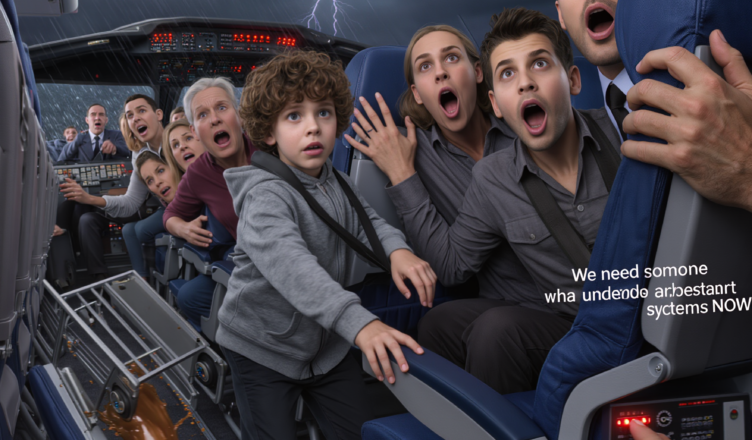
The coffee cart hit the aisle wall like a gunshot.
For half a second, nobody on Flight 728 moved. Then the baby in row nine started screaming, and the spell of denial broke all at once — because this wasn’t turbulence anymore. This was something else.
Outside the windows, the sky had turned the color of a bruise. Thick black clouds had swallowed the aircraft whole somewhere over Nebraska, and now lightning was flashing so close and so often that the entire cabin kept lighting up in flat, merciless white, like a strobe at the world’s worst party. The overhead lights flickered once, twice, then dimmed to a dull emergency red for a full second before snapping back — a small detail that nobody wanted to think too hard about, because deep down, every frequent flyer on that plane knew exactly what a red cabin light usually meant.
Flight 728 had been in the air for barely two hours, Chicago to Los Angeles, a routine Tuesday evening run. Then the storm found them.
“Why is the plane dropping like this?” a woman near the back hissed at her husband, her fingers digging into his forearm hard enough to leave marks. He didn’t answer. He didn’t have one.
Up front, near the galley, a flight attendant was on the cabin phone, her voice pitched low and urgent, the kind of urgent that adults use when they’re trying very hard not to alarm the children sitting three feet away. Another attendant hurried toward the cockpit, her heels catching against the shuddering floor.
Then the plane jerked downward — a real drop this time, not a bump, the kind that leaves your stomach somewhere up around row twelve while the rest of you is still in your seat. Overhead bins rattled open. A man three rows from the front shouted something that got cut off by his own fear. And the cockpit door swung open.
“Is there an engineer on this flight?”
The flight attendant who stepped out was young, blonde, and visibly shaking in a way that no amount of airline training prepares you for. Her hands trembled against the doorframe. She looked out over a cabin of two hundred strangers and asked the strangest question any of them had ever heard on an airplane.
Not is there a doctor on board.
“Is there an engineer on this flight?”
The silence that followed was its own kind of answer. People looked at each other. A few shook their heads slowly, apologetically, as if being asked for directions in a city they didn’t know.
“Please,” the attendant said, louder now, her voice cracking down the middle. “We need someone who understands aircraft systems.”
And that’s when a small hand went up in seat 14A.
“I am.”
Every head in the cabin turned at once.
He couldn’t have been more than nine years old. Curly brown hair, a hoodie two sizes too big for him, sneakers that didn’t come close to touching the floor. He looked, in every visible way, like exactly what he was — a child on a plane, traveling alone or with a guardian nobody could immediately spot, the kind of kid you’d expect to be playing a handheld game, not raising his hand to a terrified flight crew.
“I’m an engineer,” he said again, and somehow, despite everything, his voice didn’t shake at all.
Somebody near the back let out a short, nervous laugh — the kind that escapes before your brain can stop it. The flight attendant’s face, already pale, went tight with something close to anger.
“Stop it,” she snapped. “This is not a joke. This is a life-or-death situation.”
Those five words landed on the cabin like a stone dropped into still water. A man near the front pulled out his phone and started recording, hands unsteady. A woman two rows up began praying under her breath, quietly, the way people do when they’ve stopped caring who hears them.
But the boy didn’t flinch. He unbuckled his seatbelt, stood up in the narrow space between seats, and looked the flight attendant directly in the eye.
“Trust me,” he said. “I know my work.”
The Name That Changed the Air in the Cabin
It might have ended there — a strange, unsettling moment, quickly forgotten in the chaos — if not for the elderly man sitting across the aisle, who leaned forward slowly, studying the boy’s face like he was trying to place a photograph from a long time ago.
“Wait,” he said. “Your name is Ethan, right?”
The boy nodded.
The old man’s eyes went wide. “Oh my God.”
“You know him?” someone asked.
The old man looked around the cabin, almost apologetically, like a man about to say something he wasn’t sure anyone would believe. “That boy,” he said, “is Ethan Brooks. His father was Daniel Brooks — the lead systems engineer who designed emergency stabilization software for military aircraft.” He pointed, his hand trembling slightly. “I saw this kid on the news last year. He rebuilt a damaged drone system completely on his own. Nine years old.”
The cabin, which had been a roar of panic seconds earlier, went very quiet.
“You’re serious?” the flight attendant asked, staring at the boy as if seeing him for the first time.
“My dad taught me everything,” Ethan said simply.
“That child,” the old man added, almost to himself, “has an IQ higher than most of the adults on this plane.”
And then, as if the universe wanted to underline the point, another alarm sounded from the cockpit — sharper this time, more insistent — and the captain’s voice finally crackled over the speakers.
“This is your captain speaking. We are experiencing a serious electrical systems failure due to the storm. Please remain calm.”
Please remain calm.
Four words that did the precise opposite of their intention. The cabin erupted — questions shouted over one another, a woman sobbing openly now, the man with the phone recording faster, hands shaking so badly the footage would later be almost unusable.
Ethan stepped into the aisle.
“What system failed?” he asked the attendant, and something about the directness of the question — a child asking an adult a technical question and expecting a technical answer — cut through the noise like a blade.
The attendant hesitated only a moment. “The stabilization controls,” she whispered. “Autopilot disconnected. The backup isn’t responding properly.”
For the first time since he’d stood up, Ethan’s calm cracked — just slightly, just enough for the fear underneath to show through.
“How bad?”
She didn’t answer. She didn’t have to.
“Take me there,” Ethan said, nodding toward the cockpit door.
“What?”
“Now.”
“Are you insane?” a man nearby burst out. “He’s a child!”
Ethan turned to him, and when he spoke, his voice was steady in a way that silenced the man completely.
“If nobody fixes it,” he said, “this plane won’t survive the storm.”
Nobody argued after that.
Inside the Storm
The cockpit, when the door finally opened, looked like the inside of a machine having a nervous breakdown. Warning lights bled red across every panel. Rain lashed the windshield in sheets so heavy the world outside had become an abstraction. The co-pilot fought the controls with both hands while the captain barked into the radio, his voice fraying at the edges.
“Hydraulics aren’t responding correctly!”
“Altitude dropping!”
“Backup stabilization failed — again!”
Then they saw the boy standing in the doorway, and for one full second, both men simply stared, uncomprehending. Then the captain’s face hardened into something close to fury.
“What is this?”
“He says he can help,” the attendant said, and even she didn’t sound entirely sure she believed it.
The captain looked ready to explode — and then Ethan walked past him, straight to the console, and fixed his eyes on a single blinking warning symbol like it was the only thing in the world.
His expression changed instantly.
“That’s not a hydraulic failure,” he said.
The pilots froze. “What?”
“The storm overloaded your secondary flight control bus,” Ethan said, pointing. “The system’s rerouting power incorrectly.”
“How could you possibly know that?” the co-pilot asked, disbelief written across every line of his face.
“Because my father designed this architecture.”
Nobody spoke. Outside, lightning turned the windshield white for a fraction of a second, and in that flash, the boy looked less like a child and more like someone who had simply been waiting his whole short life for this exact moment.
“If you keep forcing manual correction,” he said, “the aircraft is going to overcompensate.”
He had barely finished the sentence when the plane tilted violently sideways. Screams tore through the cabin beyond the cockpit door. The captain grabbed the yoke with both hands, knuckles white.
Ethan’s eyes moved to the auxiliary power panel.
“Turn off stabilization channel B.”
“That could kill backup balancing completely!”
“It’s already corrupted,” Ethan said. “You’re not flying the aircraft right now. You’re fighting it.”
Another alarm shrieked. The altitude indicator kept falling. Lightning cracked across the sky in a jagged white vein, and for one endless second, the captain stared at the nine-year-old beside him, weighing forty years of training against the calm certainty in a child’s voice.
Then he flipped the switch.
For a moment — nothing.
And then the violent shaking eased. Just slightly. But enough. The screaming alarm cut out. The controls steadied under the captain’s hands like a spooked animal finally settling.
“Oh my God,” the co-pilot breathed.
Ethan wasn’t finished. “Reroute auxiliary power through emergency channel three. Manually.”
“That system isn’t supposed to be touched mid-flight—”
“It works,” Ethan said. “My dad showed me.”
The captain followed the instruction. One by one, red warning lights across the panel blinked out. The aircraft steadied further, and somewhere beyond the cockpit door, passengers who had been bracing for the worst slowly realized the shaking had stopped.
“He Died Six Months Ago”
The captain studied the boy beside him the way you’d look at something you couldn’t quite explain.
“How old are you?”
“Nine.”
The co-pilot let out a short, disbelieving laugh. “That’s not possible.”
Ethan didn’t answer. His eyes were still fixed on the panel, watching for the next problem before it announced itself — which it did, seconds later, in the form of a fuel imbalance warning.
“The left wing intake partially froze during the storm,” he said immediately. “You’ll need to adjust feed pressure before landing.”
The captain shook his head slowly. “How do you know all of this?”
And for the first time all night, Ethan looked down. The confidence that had carried him from row fourteen to the flight deck seemed to falter, just for a moment.
“My dad used to let me sit with him while he worked,” he said quietly.
The cockpit went still.
“He died six months ago.”
Nobody said anything after that. There was nothing to say. Just the sound of rain against the fuselage, softer now, the storm finally beginning to loosen its grip on the aircraft. The captain looked at the boy differently in that silence — not as a curiosity, not as a child who didn’t belong there, but as the son of a man whose work had, in some strange and unrepeatable way, just saved two hundred lives.
Coming Home
Twenty minutes later, Flight 728 broke through the last of the storm clouds into clear night air. The cabin lights returned to their normal, unremarkable white. When the captain announced they’d be making an emergency landing in Denver — safely, on solid ground — the applause that broke out was immediate and overwhelming. Strangers hugged each other. A woman who had been praying quietly for half an hour finally let herself cry. Phones came out everywhere, all of them pointed toward one seat.
But Ethan had already slipped back into 14A, buckled his seatbelt, and turned to look out the window, as if none of it had happened.
As the plane began its descent, the captain’s voice came over the speakers one final time.
“Ladies and gentlemen — today, this flight owes its safety to an unexpected hero.”
Every head in the cabin turned toward the boy in the window seat. The applause started again, louder this time, some passengers rising to their feet. Ethan looked down at his hands, visibly embarrassed by the attention he clearly hadn’t been chasing.
Then the captain added one more line — quieter, almost private, though everyone heard it.
“Ethan Brooks — your father would be very proud of you.”
And for the first time that night, the boy smiled. Small. Quiet. Real.
Outside the window, the storm was already gone, folded into the dark behind them, as if it had never happened at all.
The Nine-Year-Old Who Talked a Cockpit Through the Storm…