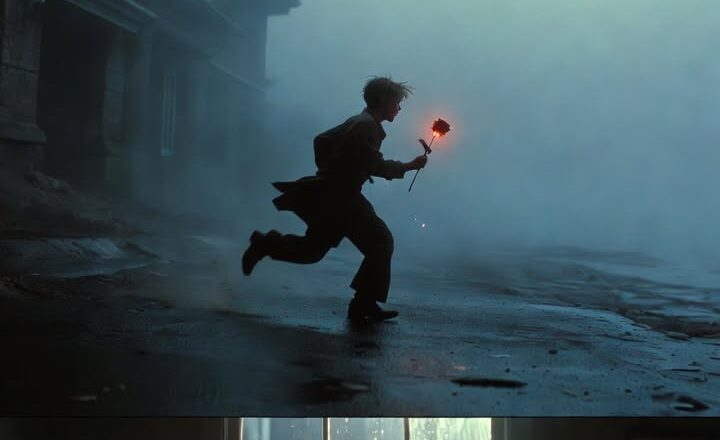
The Rose Thief
The cold came before the light. It seeped through Leo’s thin jacket, through his cracked shoes, into his knuckles as he crouched at the base of the iron gate. Above him, the sky hung in that deep, bruised blue belonging to no hour at all — too late for night, too early for morning. His breath left him in short white clouds that vanished as fast as they formed.
He’d counted the bars fourteen times over the last three nights. On the other side, growing in perfect rows, were roses — the reddest he’d ever seen, somehow still blooming this late in the season.
His sister had asked for a rose. Not flowers in general — a rose, specifically. She’d said it so softly from her hospital bed that he’d nearly missed it. “I just want to see something still growing, Leo.” Then she’d smiled the way she always did, like none of this scared her, like she was doing it all — the tubes, the beeping, the too-bright lights — for his sake, so he wouldn’t worry.
He worried anyway. Every second.
So here he was, ten years old, reaching through a gap in the bars because digging hadn’t worked, because the gate wasn’t opening for a boy who owned nothing but his father’s old pocketknife and a stubbornness no one could talk him out of.
His fingers closed around the stem. He drew the knife and cut it free, and a single drop of dew slid off the lowest petal, catching the first light of dawn before it vanished into the dirt. He held the flower to his chest like it might still get away from him.
He never noticed the light in the window.
Eleanor Ashworth stood watching from the glass, the way she always did — sixty-one years old, alone in a house too big for a woman who ate dinner by herself every night. She saw the boy slip through the bent bars and felt none of the fury she should have felt. Instead, she found her palm pressed against the cold pane, watching him vanish into the fog.
There had been something in the way he carried that flower. Not a thief’s grip. A boy’s grip, holding something too precious to drop.
She was in her car before she’d decided to follow him.
She trailed him through the sleeping city, keeping her distance, watching him run with the graceless, exhausted stride of a tired child, one shoe flapping loose. He stumbled once and nearly fell, and her foot came off the gas before she caught herself.
She told herself this was about the rose. It wasn’t. It was about the look on his face in the pre-dawn light — not guilt, but a fierce, focused love she hadn’t seen on a child in years.
Then, ahead, she saw the hospital.
The doors slid open and swallowed him. She parked crookedly and followed, down a fluorescent hallway that smelled of antiseptic, until the footsteps stopped outside a door with a narrow glass window. Something told her not to open it yet.
Inside, a pale little girl lay in a bed too big for her. Older roses lined the windowsill, wilting at different stages — a small graveyard marking how many nights this had happened before. Leo placed the new rose in a plastic cup of water, then sat on the edge of the bed, and his sister’s thin hand reached slowly toward the petals.
Eleanor’s breath fogged the glass. A single tear slid free.
The door handle turned before she’d decided to open it. Leo spun around, throwing his arm out to shield his sister, his face hardening into something fierce and afraid.
Eleanor crossed the room and knelt on the cold floor in front of him, not caring about her coat. “I’m not here to be angry,” she said. “I saw you take it. I followed you because I wanted to know why.”
“She’s sick,” Leo said, the words rough. “She likes roses. I wasn’t trying to steal, I was trying to —”
“I know,” Eleanor said, and took his trembling, dirt-streaked hands in hers. “I know exactly what you were trying to do.”
What followed happened slowly, the way real things do. Eleanor came back the next day, and the one after — first with armfuls of roses, then books to read aloud, then simply herself, sitting for hours while a doctor down the hall began speaking the word improvement instead of what had come before it.
She never fully explained, even to herself, why she kept returning. Maybe it was guilt. Maybe it was the ache of a house that had gone quiet in a way she’d stopped noticing. Or maybe some part of her recognized, in Leo’s face at that gate, something she’d refused to let go of ever since.
Whatever the reason, she was there the morning the girl’s eyes opened clear and steady, color returned to cheeks that had been pale for weeks. She was there when the doctor finally said the word home.
The gates stood open now, had stood open for months. Late afternoon light spilled gold across the garden as Eleanor walked between the rows with a child on either side — Leo, taller now, laughing; his sister beside him, color in her cheeks, steady on her feet.
Eleanor knelt at one of the bushes and cut a single rose, the same careful motion Leo had once used on a stolen stem in the cold blue hour before dawn. She tucked it behind the girl’s ear. The girl beamed. Leo laughed. And the light kept falling, warm and unhurried, over a garden that had once belonged to no one — and now, in the only way that mattered, belonged to all of them.