Some stories don’t need loud beginnings. They need silence — the kind that settles over a room right before something goes terribly wrong.
Inside Blackstone Juvenile Correctional Facility, the cafeteria was never quiet. Trays slammed. Voices shouted over each other. Guards leaned against the walls, worn down by years of pretending they still had control. It smelled like bleach and burnt coffee and something underneath that no cleaning product could fix.
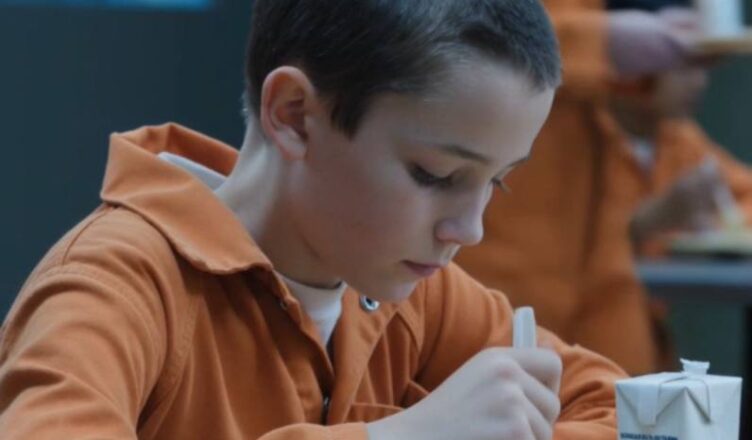
Every inmate wore the same orange jumpsuit. Every inmate, except for the way one of them carried himself.
In the far corner, away from the noise, sat a boy who looked far too small for a place like this. Twelve years old, maybe younger. Pale. Thin. Silent. His tag read Ethan Cole — Cell Block C, and he ate like the rest of the room didn’t exist.
That’s exactly what made people afraid of him.
Nobody knew what Ethan had done to end up at Blackstone. The stories changed depending on who was telling them — a foster father, a house fire, a beating he supposedly watched with a smile. None of it was confirmed. All of it stuck to him like smoke.
And in a place like Blackstone, uncertainty was more dangerous than any confession.
For weeks, the other inmates left him alone. Not out of kindness — out of instinct. Something about the way Ethan never blinked, never flinched, never looked up when spoken to, made even hardened kids twice his size take the long way around his table.
Everyone stayed away.
Except Marcus Kane.
Marcus was the kind of presence a room reorganized itself around the moment he walked in. Six-foot-five. Built like a wall. Tattoos climbing from his knuckles to his neck. Guards who supervised armed adults every day still found reasons not to make eye contact with him. He didn’t need to raise his voice to be obeyed — he simply was obeyed.
And Marcus had one rule he lived by: weakness didn’t get to exist quietly in his prison.
So when he noticed the small, silent boy who sat alone every single day, never reacting to anything, never showing fear — Marcus decided it was time for a show.
He grabbed his tray, two inmates trailing behind him already grinning, and crossed the cafeteria floor. Conversations died as he passed. Everyone recognized the walk. Everyone knew what it meant.
Ethan kept eating.
Marcus stopped at his table and looked down at him the way a man looks down at something he’s about to step on.
“Well,” he said, loud enough for the whole room, “look what we got here.”
Nothing.
“A baby prisoner.”
Laughter rippled through the tables. Ethan lifted another spoonful of beans, calm as still water.
That calm was the first crack in Marcus’s confidence, though he didn’t know it yet.
“You deaf, kid?”
Silence.
Marcus slammed both hands on the table. Milk sloshed sideways across the tray. A few inmates nearby flinched at the sound.
Ethan didn’t.
That absence of fear did something to Marcus that fear itself never could — it unsettled him. So he grabbed the tray and hurled it across the room. Food scattered across the floor in a wet, ugly arc. The cafeteria went completely silent, the kind of silence that has weight to it.
Marcus spread his arms, grinning at his own performance. “Look who we have here, kid.”
Some inmates laughed nervously, eager to be on the winning side. Others looked away, sensing something they couldn’t name.
Then Ethan lifted his eyes.
And Marcus felt it — a cold drop low in his stomach, the kind that has nothing to do with size or muscle. Because the eyes looking back at him weren’t the eyes of a frightened twelve-year-old.
They were something else entirely.
“Are you done?” Ethan asked. His voice was quiet. Level. Wrong in a way no one in that room could quite explain.
Marcus blinked, then forced a laugh, louder than before. “You hear this little psycho?” He leaned down until his face was inches from the boy’s. “Yeah. Now what?”
The cafeteria held its breath. Even the guards, usually indifferent, stopped moving toward the exits.
Ethan looked at him for a long moment. Then he stood — small, impossibly small next to Marcus’s frame — and spoke two words that would be repeated throughout Blackstone for years afterward.
“Good,” he said. “It’s my turn now.”
Marcus smirked, ready to laugh it off.
And then the lights went out.
(What happened next in that darkened cafeteria has never been fully explained — read the continuation to find out what Marcus Kane discovered about the boy nobody wanted to sit near.)