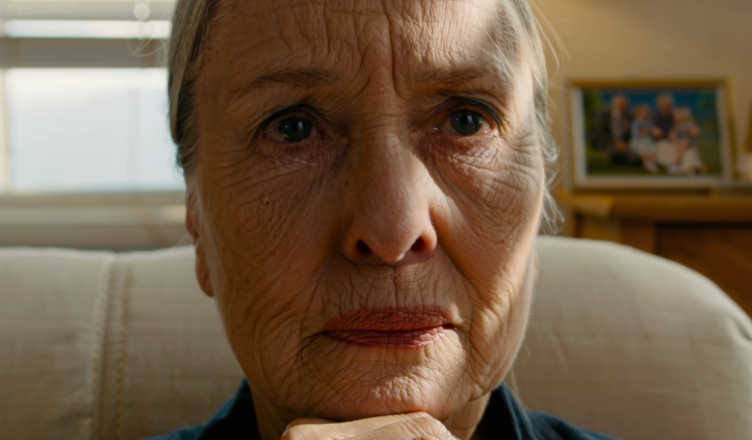
A quiet visit turned into a confrontation no one was supposed to witness. But silence, it turns out, has more than one meaning.
Margaret had come with nothing but good intentions and a small bag of gifts she never got the chance to unpack.
She sat on the couch where she used to sit every Sunday, back when the house still felt like it belonged, in some small way, to her too. Now the cushions felt unfamiliar beneath her, the family photo on the wall hanging at an angle no one had bothered to fix.
Her son wasn’t home. That, she would later understand, had never been an accident.
Emily paced the length of the living room, her heels clicking sharp against the hardwood, each step landing like punctuation on words she hadn’t said yet. She stopped in front of the window, sunlight slicing across her face, and for a moment she looked almost calm — the kind of calm that came right before a storm found its voice.
“You really thought you could just show up,” Emily said, not quite a question.
Margaret’s hands tightened in her lap. “I wanted to see my grandson. Is that so wrong?”
“It’s wrong when you use it as an excuse to snoop.”
Margaret opened her mouth to protest, but the words caught somewhere in her throat. She hadn’t been snooping. She had only asked — gently, carefully — about the bruise she’d seen on her son’s arm the week before, the one he’d brushed off with a laugh that didn’t reach his eyes.
She hadn’t expected the question to detonate like this.
The Weight of a Question
What Margaret didn’t know, as she sat trembling on that couch, was that her son had installed a small camera in the living room months earlier — not out of suspicion, but out of the quiet unease that had been building in him for longer than he wanted to admit. A camera meant to catch a package thief, or so he’d told himself. A camera he’d almost forgotten was there.
It was still running.
Every word. Every shove. Every hissed threat Emily thought would disappear into the silence of an empty house.
Margaret, of course, had no idea. All she knew was the pain radiating from her knee where she’d struck the coffee table, and the tightness in her chest that came from trying so hard not to cry in front of someone who found her tears an inconvenience.
“Stop crying,” Emily said again, sharper this time. “You’re being dramatic.”
“I raised him,” Margaret whispered, the words slipping out before she could stop them. “I just wanted to visit.”
It was the wrong thing to say — she knew it the moment Emily’s expression shifted, the anger sliding into something colder, more deliberate.
“This is my house now,” Emily said, each word measured like a warning. “My rules. And if you say one word to him about any of this, I promise you, I will make sure you never see that boy again.”
The threat landed exactly where it was meant to. Margaret had spent sixty years learning how to read a room, how to sense the difference between anger that would pass and anger that would follow her home. This was the second kind.
A Silence That Wasn’t Empty
Emily turned away, pacing again, muttering something under her breath about ungrateful in-laws and boundaries no one respected. She didn’t notice the small blinking light near the bookshelf. She never had.
Margaret sat frozen, arms wrapped around herself, replaying the last few minutes like she was trying to make sense of how quickly a quiet Sunday afternoon had turned into something she didn’t have language for yet.
She thought about leaving. She thought about calling her son right there, phone shaking in her stiff fingers. But some old instinct — the same one that had carried her through decades of difficult decisions — told her to wait. To not make it worse. Not yet.
So she did what she had always done in moments like this.
She stayed quiet.
But quiet, this time, wasn’t the same as powerless.
What Came Next
Three days later, Margaret’s son sat alone in his home office, scrolling through old security footage after noticing the camera app had flagged unusual activity. He almost closed the app without watching. He almost let the moment pass the way so many moments in that house had been allowed to pass, unexamined, unquestioned.
He didn’t.
What he saw in the next four minutes would end a marriage he thought was solid, and begin a conversation with his mother he had spent years avoiding.
But that part of the story hadn’t happened yet — not on the afternoon Margaret sat crying on a couch that no longer felt like hers, in a house that had, in every way that mattered, stopped being a home.
This is a work of fiction. Part two continues as Margaret’s son discovers the footage — and Margaret finally finds the courage to say what she’s been carrying for months.