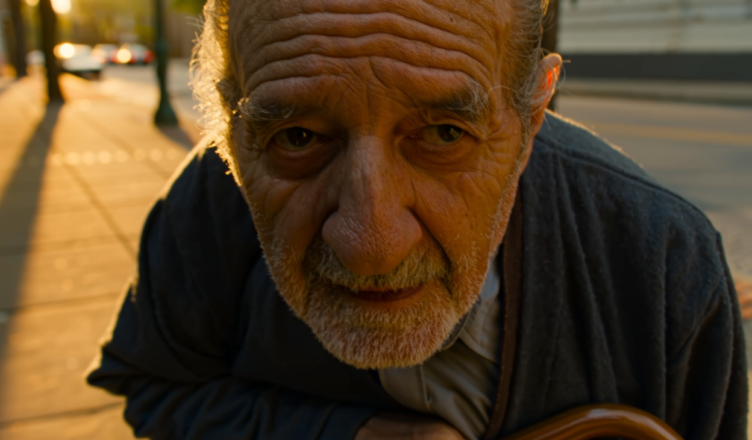
He was just “the old man” on the corner, invisible to a neighborhood that walked past him every day. What happened that afternoon changed that forever.
The street had never felt this loud to him before.
For years, his afternoon walk had been the same: quiet, unremarkable, a ritual so consistent that the neighborhood had stopped seeing him as a person and started seeing him as a fixture — something you passed without thought, like the cracked sidewalk or the streetlight that flickered on two seconds too late every evening.
He liked it that way, mostly. Invisibility had its comforts.
But invisibility, he was about to learn, only lasted until someone decided to notice you for the wrong reasons.
“Well look at this,” the boy repeated, louder now, playing to his friends. “We got a traffic jam.”
The old man said nothing. He simply stood there, cane in hand, studying the five faces in front of him with the kind of patience that only came from having outlived several versions of this exact moment.
A Silence They Didn’t Understand
The girls laughed — not unkindly, not yet, but with the careless energy of people who had never once considered that the world might not be arranged for their entertainment. One of the boys pulled out his phone, angling it toward the old man, already narrating for an audience that didn’t exist yet.
“Should we help him cross?” he said, smirking. “Looks like he needs it.”
The old man’s grip on the cane didn’t loosen. If anything, it steadied.
“I’ve crossed streets longer than you’ve been alive,” he said. His voice was quiet, but it carried — the kind of voice that had once commanded rooms far larger than a sidewalk café crowd.
Something in his tone made the laughter falter, just slightly. Not stop. Falter.
“Ooh,” one of the girls said, nudging her friend. “He’s got jokes.”
“Move along, old timer,” the first boy said, stepping closer, close enough now that the old man could see the phone screen still recording. “This is our corner.”
What They Didn’t Know
What none of them knew — what nobody on that street had ever bothered to ask — was that the man in front of them had walked far more dangerous corners than this one, in decades and places these five had only seen in movies, if at all. The bent back wasn’t just age. It was history. The slow steps weren’t weakness. They were the careful economy of a body that had learned, a long time ago, exactly how much it could still do.
He had buried people he loved on streets louder and crueler than this. He had learned, the hard way, that the ones who laughed the loudest were rarely the ones you needed to fear.
It was the quiet ones. The ones who stopped laughing.
A woman further down the block — someone who actually knew his name, though she’d never had reason to use it in public — had already stopped walking. She was watching now, phone halfway to her ear, some old protective instinct kicking in before she’d even decided to act on it.
“You should move,” the old man said calmly. “Not because I’m asking. Because you’re about to embarrass yourselves.”
The boy laughed, but it came out thinner than before. “Embarrass ourselves how, exactly?”
The old man didn’t answer right away. He simply looked past them, toward the café they’d spilled out of, toward the small crowd that had begun, almost imperceptibly, to gather.
“You’ll see,” he said.
The Corner Remembers
What happened in the next thirty seconds would ripple through that neighborhood for weeks — retold at dinner tables, argued over in group chats, watched back on a dozen different phones from a dozen different angles, none of which had captured quite the same thing.
But in that exact moment, on a street painted orange by a sinking sun, none of the five kids blocking an old man’s path had any idea that the quiet, fragile-looking stranger in front of them was about to become the most talked-about person in the neighborhood — for reasons none of them could have predicted, and none of them would forget.
The old man tightened his grip on the cane one final time.
And then he took a step forward.
This is a work of fiction. Part two continues as the confrontation reaches its turning point — and the neighborhood finally learns who the old man really is.