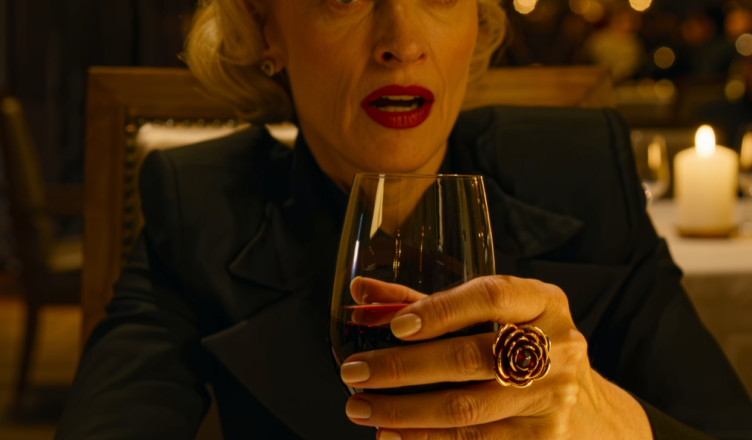
The restaurant was the kind of place where silence had a price tag. Crystal chandeliers hung low over white tablecloths, and the murmur of quiet conversation blended with the soft clink of wine glasses. It was the last place anyone would expect a little girl with a basket of roses to change the course of a woman’s life.
A Flower Girl’s Innocent Question
“Would you like a rose, ma’am?”
The woman in the black suit looked up from her wine glass. She was elegant, composed, the kind of woman who seemed to belong to rooms like this one — rooms with soft lighting and silverware that cost more than most people’s monthly rent. The little girl standing beside her table seemed impossibly out of place, her small hands wrapped around a basket overflowing with red roses.
“Of course,” the woman replied, reaching for her purse.
The girl smiled and held one of the roses closer. But her eyes weren’t on the flower. They had drifted, almost involuntarily, to the woman’s hand — to the gold ring shaped like a rose, its center set with a ruby that caught the restaurant’s warm light and turned it into something like fire.
The girl tilted her head.
“Ma’am, your ring looks a lot like my mom’s.”
It was such a small sentence. Said so gently, so innocently, that under any other circumstances it would have dissolved into the noise of the restaurant and been forgotten within the hour.
But the woman’s smile faltered — just slightly, just enough.
“No, darling,” she said, her voice sweet but suddenly careful. “This is a family ring.”
The Name No One Was Supposed to Know
The girl didn’t move. She studied the woman’s face the way children sometimes do — without pretense, without the social instinct to look away.
“Does it have a name engraved inside?”
The question landed like a dropped glass. The woman’s fingers tightened around the stem of her wine glass, knuckles paling against the crystal.
Then the girl said it.
“Rosewood.”
The restaurant didn’t actually go silent. The waiters kept moving, the string quartet in the corner kept playing, the couple two tables over kept laughing at some joke the woman would never hear. But for her, every sound seemed to fall away, swallowed by that single word.
Rosewood was not a brand. It wasn’t the name of a jeweler, or an engraving pattern some catalog had made fashionable a decade ago. It was a name that existed in exactly one place in the entire world — etched into the inner band of a ring that had belonged, seventeen years ago, to a sister who had vanished without a trace.
No one outside the family had ever known that name. No one alive should have been able to say it. Certainly not a child selling roses table to table in a restaurant where she clearly didn’t belong.
The woman leaned forward. When she spoke again, her voice had lost all of its practiced calm.
“W-where is your mom now?”
The girl blinked, startled by the sudden crack in the woman’s composure.
“At the hospital,” she said. “She told me to sell roses tonight.”
Tears rose in the woman’s eyes before she could stop them. Seventeen years of silence, of unanswered questions, of a name she’d never dared to say out loud — and here it was, spoken by a child who couldn’t have been more than eight years old.
“What is your name?”
A Chair Scrapes, and the Girl Disappears
The girl opened her mouth to answer.
She never got the chance.
At the next table, a man rose too quickly. His chair scraped hard against the floor, the sound cutting through the restaurant’s hum like a struck match. The girl’s eyes snapped toward him, and whatever color had been in her face drained away in an instant.
“I have to go,” she whispered.
She grabbed her basket, roses spilling over the rim, and ran.
The woman turned. The man was already moving — not toward her, but after the girl, weaving between tables with the kind of urgency that had nothing to do with catching a train. The woman rose from her seat, one hand still clutching the ring that had just cracked open a wound she’d spent seventeen years trying to close.
She didn’t know the girl’s name yet.
But she knew, with a certainty that settled cold and absolute in her chest, that she was about to find out exactly what had happened to her sister — and that whoever the man chasing that child was, he was the reason no one had found out sooner.
Meanwhile, Behind Prison Walls, an Old Man’s Secret Surfaces
Miles away, in a place with none of the restaurant’s warmth, another secret was being uncovered — this one etched not into gold, but into skin.
Bruno kicked at the dirt Rafael had spent nearly twenty minutes sweeping into a neat pile.
“Pick it up again, grandpa.”
Rafael said nothing. He simply picked up the broom and started again, his movements slow, deliberate, unbothered.
Bruno laughed and yanked the broom from the old man’s hands, letting it clatter against the cement.
“Here, you do what I say.”
Rafael raised his gaze slowly — not with fear, but with the kind of stillness that made the men nearby stop what they were doing to watch.
“Then try not to give me an order you’ll regret.”
The courtyard’s usual noise thinned into something tighter, more attentive. Bruno stepped closer, reaching for the old man’s shoulder.
Rafael raised his arm to block him.
His sleeve slipped down a few centimeters — just enough to reveal a symbol tattooed into his forearm, faded but unmistakable.
Captain Vega saw it from across the yard, and the color drained from his face.
“Bruno, don’t touch him!”
The entire courtyard went still.
Bruno turned, first to the guard, then back to the old man he’d just tried to humiliate.
“Who the hell is this old man?”
Vega didn’t answer. He didn’t need to. The silence that followed said more than any explanation could have — and that silence was exactly what made everyone in that courtyard, for the first time, genuinely afraid.
Two secrets. Two silences broken in the same breath of a single night — one by a child’s innocent question over a basket of roses, the other by a tattoo no one was supposed to see. What connects a missing sister, a hospital bed, and an old man the guards are too afraid to name? The story is only beginning.