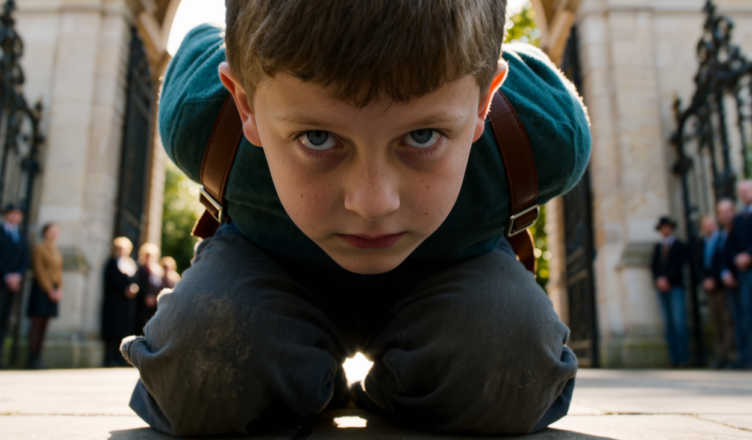
The gates of St. Aldric Academy were the kind that made people lower their voices without realizing it — wrought iron, twelve feet tall, flanked by hedges trimmed with surgical precision. It was the kind of place where reputations were built before a single class began, and where, on one particular morning, a single shove would unravel a lie that had been protected for years.
A Push That Wasn’t Supposed to Matter
Our SUV had barely cleared the entrance when it happened.
A woman in a beige coat shoved a young boy without warning. He hit the polished stone pavement hard, his palms scraping against the surface, his backpack sliding off his shoulder and skidding a few feet away. For a moment, the metal buckle on the strap caught the afternoon sun and flashed once, sharp and sudden, like a signal meant to be noticed.
The woman stood over him. Heels planted, spine rigid, one manicured finger pointed down at the boy still on the ground. Her face wore the kind of hard, composed expression that mistakes cruelty for discipline.
“Kids like you don’t belong at this school,” she said, stepping closer.
The boy on the ground didn’t cry.
He shook off the sting, absorbed the humiliation, but refused to give her the collapse she was clearly expecting. Instead, he simply looked up — past her, past the gathering onlookers — and found me.
A Boy Who Refused to Break
I moved through the crowd of parents and students and stopped three steps away from him. He was already sitting up straighter than most grown men manage under pressure. Dust clung to his trousers. His eyes carried an intensity that made it clear the fall had hurt him far less than anyone watching would have guessed.
“Lift your chin a little,” I said. “Young Master Castillo.”
The words landed heavier than any shout could have.
The boy exhaled once, settling, some invisible weight lifting from his shoulders at the sound of his own name spoken like it meant something.
“I’m fine, Mr. Vales,” he said.
The woman in beige took an involuntary step back. Whatever careful, constructed anger she’d been wearing seconds earlier dissolved instantly into recognition — and beneath that recognition, something closer to fear. It wasn’t my presence that unsettled her. It was the name.
Castillo.
The SUV idled at the entrance. Witnesses froze mid-motion, caught in that particular silence that falls over a crowd the moment everyone realizes, almost simultaneously, that they’ve misjudged the balance of power in the room. Whatever authority Whitmore’s arrogance had built for itself in that courtyard did not belong to her. It never had.
That was only the first moment.
The Real Reckoning Was Waiting Inside
Nothing that happened in the entrance courtyard could compare to what was unfolding, at that very same hour, inside the headmaster’s office.
There, spread across a mahogany desk, sat a stack of legal documents — papers that would quietly and permanently rewrite everything Whitmore’s family had spent a generation building. Ownership records. Founding trust agreements. Signatures dating back decades, all leading to a single, inevitable conclusion that no one inside those walls had been prepared to face.
Matteo Castillo was not simply a student who had been pushed to the ground by a woman who judged him by his clothes and his silence. He was the rightful heir to something far larger than a single morning’s humiliation — and after years of staying quiet, of enduring exactly the kind of treatment he’d just received at the gates, he was finally about to claim what had always, legally and unquestionably, belonged to him.
The woman in beige didn’t know it yet. Neither did most of the parents standing frozen in that courtyard, still processing the flash of a belt buckle and a boy who wouldn’t cry.
But by the end of that day, everyone at St. Aldric Academy would understand exactly whose name carried weight within those iron gates — and whose never truly had.
A single push in a courtyard. A stack of documents in an office no one thought to question. Two moments, one morning, and an entire institution about to learn who its founder’s family really was. The story is only beginning.