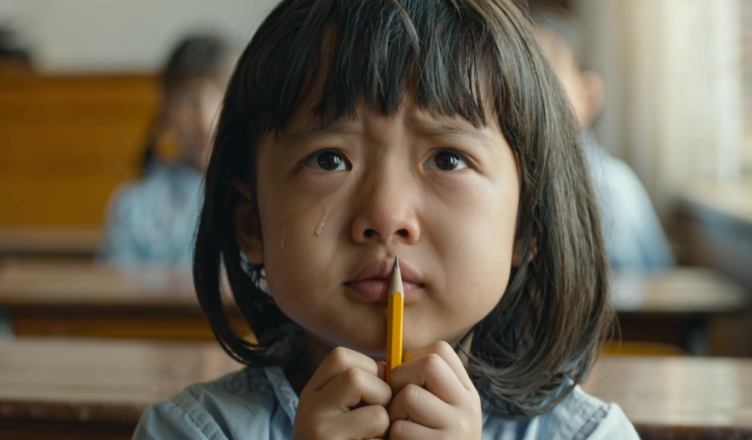
The classroom fell silent.
Twenty-two second graders sat frozen in their seats as Mrs. Linda Parker stood over a small girl in the front row.
Seven-year-old Maya Johnson gripped her pencil so tightly her knuckles turned white.
Mrs. Parker’s face was red with frustration.
“You don’t belong here,” she snapped loudly.
The room went dead quiet.
Maya looked up, confused.
Mrs. Parker wasn’t finished.
“Your dad should keep you at home.”
A few children gasped.
Maya’s lower lip trembled.
Her father had been raising her alone ever since her mother passed away three years earlier.
Everyone in the school knew that.
Everyone except Mrs. Parker seemed to care.
The little girl’s eyes filled with tears.
She tried to stay strong.
She really did.
But she couldn’t.
A tear rolled down her cheek.
Then another.
Soon she was crying quietly at her desk.
The other students looked uncomfortable.
One boy started standing up to defend her, but a firm voice cut through the room before he could get a single word out.
“Sit down, Ethan.”
Mrs. Parker’s eyes hadn’t left Maya.
Ethan hesitated, then slowly lowered himself back into his chair, his face burning with a mixture of fear and fury he was too young to fully understand.
A Knock That Changed Everything
What Mrs. Parker didn’t know was that the classroom door was propped open that morning — a small maintenance oversight that would end up meaning everything.
Just down the hallway, Principal Diane Foster was walking toward the teachers’ lounge when she heard raised voices spilling out of Room 14. She slowed her steps. Something about the tone made her stop entirely.
She reached the doorway just in time to hear the words that would replay in her mind for weeks afterward.
“Your dad should keep you at home.”
Principal Foster froze in the hallway, one hand still resting on the doorframe. She watched as a seven-year-old girl sat crying silently at her desk while twenty-one classmates stared at their hands, too afraid to move.
She stepped inside.
“Mrs. Parker,” she said, her voice calm but unmistakably firm. “A word, please. Now.”
The Truth Comes Out
In the hallway, away from the children, Principal Foster didn’t raise her voice — she didn’t need to.
“I heard what you said to Maya.”
Mrs. Parker straightened, already building her defense. “She wasn’t paying attention. Again. I’ve had it with —”
“You told a seven-year-old, in front of her entire class, that her father should keep her at home.” Principal Foster’s tone didn’t waver. “Do you understand what that little girl has been through this year?”
Mrs. Parker’s jaw tightened, but she said nothing.
“Her mother died three years ago. Her father works two jobs just to be able to pick her up from school most days. That little girl has never missed a single homework assignment, and you humiliated her in front of twenty-two children.”
The silence between them stretched long and heavy.
Back in the Classroom
Inside Room 14, a soft-spoken paraprofessional named Ms. Reyes had quietly stepped in to check on the students. She knelt beside Maya’s desk.
“Hey, sweetheart,” she whispered. “You okay?”
Maya wiped her face with the back of her sleeve and nodded, though it clearly wasn’t true.
Ethan, still red-faced from being told to sit down, leaned over from his desk. “That wasn’t fair,” he whispered. “What she said. It wasn’t true.”
A few other kids nodded quietly, too scared to speak louder but no longer looking away.
For the first time that morning, Maya managed a small, watery smile.
A Father’s Response
By the time school let out, word of what happened had already reached Maya’s father, David Johnson, through a phone call from the principal’s office.
He arrived to pick Maya up early, his work uniform still on, his face unreadable. When Maya ran to him, he knelt down and wrapped her in a hug before saying a single word to anyone else.
“I’m sorry, baby,” he murmured. “I’m so sorry.”
Only after Maya had climbed into the car, safely out of earshot, did David turn back toward the school entrance where Principal Foster was waiting.
“I work every day to make sure she has what she needs,” he said quietly. “I never thought I’d have to explain that to her own teacher.”
Principal Foster nodded. “You won’t have to again. I promise you that.”
What Happened Next
The following week, Mrs. Linda Parker was formally reassigned pending a full review by the district. Parents who had long quietly worried about her classroom demeanor finally felt comfortable coming forward. Several other families shared stories eerily similar to Maya’s.
Meanwhile, something unexpected happened in Room 14.
Ethan, the boy who had tried to stand up for Maya, wasn’t punished for his outburst — he was praised for it, gently, by the new substitute teacher who took over the class. “It takes courage to stand up when you’re scared,” she told him privately. “Don’t ever lose that.”
As for Maya, the tears in that classroom didn’t define her. In the weeks that followed, her classmates — the same ones who had once looked away — began sitting with her at lunch. Ethan saved her a seat every single day.
A Small Girl, A Big Reminder
What started as one teacher’s careless, cruel words became something bigger than anyone in that classroom could have predicted that morning: a reminder that a single moment of unkindness can ripple outward — and that sometimes, it takes a child’s tears to make the adults finally pay attention.
Maya Johnson never asked for any of it. She just wanted to sit in class like everyone else.
In the end, she got something more — proof that when she needed someone to stand up for her, more than one person eventually did.