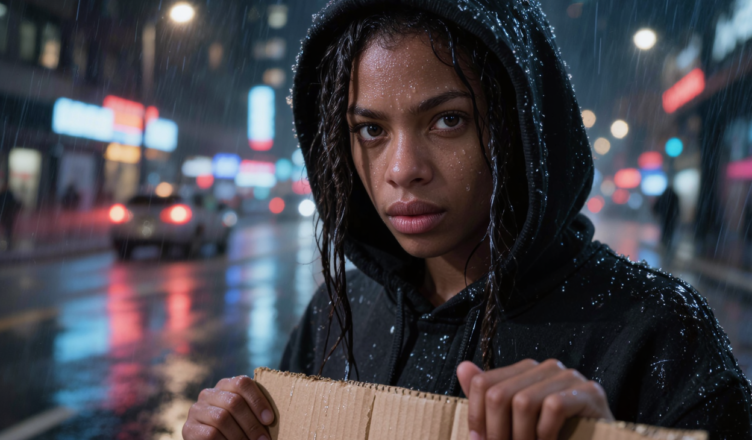
The rain had stopped an hour ago, but the streets of downtown Baltimore still looked wet and restless.
Puddles reflected neon signs. Tires hissed across the pavement. Somewhere in the distance, police sirens echoed through the city like a warning nobody listened to anymore.
Twenty-six-year-old Danielle Brooks adjusted the hood of her black sweatshirt and stared at the cardboard sign in her hands.
The words were simple.
BLACK LIVES MATTER
Nothing violent. Nothing hateful.
Just four words.
But in America, sometimes four words were enough to make strangers hate you.
Danielle swallowed hard.
Her best friend had begged her not to come alone.
“You saw what happened last month,” she’d warned. “People are angry right now.”
But Danielle was angry too.
Angry at headlines. Angry at funerals. Angry at watching videos of grieving mothers while politicians argued on television like human lives were debate topics.
Most of all, she was tired of silence.
So she stepped onto the sidewalk near Franklin Street and lifted the sign above her head.
“Black lives matter!” she shouted.
A few pedestrians glanced over.
Most ignored her.
That hurt more than she expected.
People had mastered the art of pretending not to see uncomfortable things. It was easier than choosing sides.
Danielle kept walking.
“Black lives matter!”
A truck passing by honked loudly. She couldn’t tell whether it was support or mockery.
A man exiting a coffee shop muttered something under his breath and shook his head.
Still, she kept going.
The cold wind stung her cheeks, but her voice grew louder with every chant.
She didn’t notice the group of men at first.
Four of them stood outside a convenience store smoking cigarettes and laughing over something on a phone. Mid-twenties maybe. Loud. The kind of men who took up more space than necessary.
One of them spotted her sign and nudged his friend.
“Yo,” he laughed. “Check this out.”
Danielle looked straight ahead.
Experience had taught her that eye contact could invite trouble.
“BLACK LIVES MATTER!” she shouted again.
The tallest guy smirked.
“Oh wow,” he mocked loudly. “Another activist.”
His friends laughed.
A Voice From Across the Street
Danielle kept her pace steady, refusing to slow down, refusing to look their way. She had learned a long time ago that the moment you gave men like that your fear, they fed on it.
“Hey, I’m talking to you,” the tallest one called out, stepping off the curb.
That’s when a voice cut through the noise from the other side of the street.
“She’s not talking to you, man. Leave her be.”
An older man — mid-fifties, wearing a faded Orioles cap and a reflective vest from what looked like a night shift job — had stopped on the opposite corner, a bag of groceries in one hand.
The group of men turned, momentarily distracted.
“Mind your business, old man,” one of them shot back, though with noticeably less confidence than before.
“This street is my business,” the man replied evenly. “Lived here thirty years. Watched this block go through worse than four boys running their mouths outside a corner store.”
A couple of the men chuckled — not at Danielle this time, but at their friend, whose bravado had visibly deflated.
A Crowd Begins to Gather
What happened next surprised everyone, including Danielle.
A woman waiting at the bus stop nearby had been recording the exchange on her phone, quietly at first, then more visibly once she realized others around her were watching too.
A young couple crossing the street slowed their steps.
Two more people stepped out of the coffee shop, drawn by the raised voices.
Within a minute, what had been an empty, indifferent sidewalk had a dozen sets of eyes on it.
Danielle stopped walking. For the first time since she’d left her apartment that evening, she turned to face the men directly, sign still raised.
“I’m not looking for trouble,” she said, her voice steady despite the pounding in her chest. “I’m just tired of pretending everything is fine when it isn’t.”
The tallest man opened his mouth to respond, but nothing came out. The crowd’s attention had shifted the balance of the moment, and he seemed to feel it.
The Moment Everything Changed
It was a teenage boy, maybe sixteen, who broke the tension completely. He’d been walking with his mother, phone in hand, and without a word, he crossed the street and stood beside Danielle.
Then he raised his own fist quietly into the air.
He didn’t say anything. He didn’t need to.
His mother hesitated only a second before joining him.
Then the man in the Orioles cap crossed the street too, groceries still in hand, and stood on Danielle’s other side.
One by one, strangers who had been watching from a distance began to close the gap — not with signs, not with shouting, just with presence. A silent, growing wall of people standing beside a woman who, minutes earlier, had been standing completely alone.
The four men outside the convenience store exchanged glances. The laughter was gone now. Whatever performance they had been putting on for each other clearly wasn’t landing anymore.
“Come on,” one of them finally mumbled, tossing his cigarette to the ground. “Let’s go.”
They disappeared around the corner, and just like that, the confrontation was over.
What The Video Showed
By the next morning, the video the woman at the bus stop had recorded was circulating locally — not because it showed violence, but because it showed the opposite. It showed a crowd of strangers, most of whom had never met Danielle before that night, choosing to stand beside her instead of looking away.
Local news picked up the story within days. Danielle, reluctant at first, agreed to a short interview.
“I didn’t do anything special,” she told the reporter. “I just didn’t want to be quiet anymore. I didn’t expect anyone to stand with me. I really didn’t.”
The teenage boy who had crossed the street first was asked why he did it.
“I don’t know,” he said, shrugging. “It just felt like the right thing. She was standing there by herself. Somebody had to.”
A Small Sign, A Bigger Message
Danielle Brooks never set out to become a local story. She wasn’t trying to go viral, and she certainly wasn’t expecting a crowd to form around her on a random Tuesday night in Baltimore.
But in a city — and a country — often defined by division, what happened on that wet, neon-lit street corner became something else entirely: proof that indifference isn’t as unshakable as it sometimes seems, and that sometimes, all it takes is one person willing to stand still long enough for others to decide they don’t want to look away anymore.
Danielle still walks that same street some evenings. She doesn’t always carry a sign.
She doesn’t need to anymore. People remember.