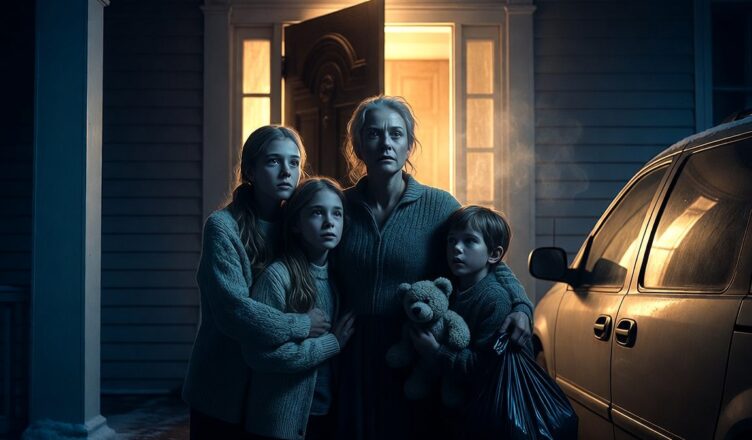
Two years after the door slammed shut behind us, I stood in my own kitchen, watching Noah do homework at a table I’d bought with my own paycheck, when my phone rang with a number I hadn’t seen in longer than I could remember.
Eric.
My unemployed brother, the one who used to smirk from the staircase of my parents’ house while I stood on their porch with a trash bag and three shivering kids, was calling me for the first time in two years.
I almost didn’t answer. Then curiosity won.
“Natalie.” His voice was different — thinner, careful, the smugness scraped clean off it. “I need to talk to you about Mom and Dad.”
“There’s nothing to talk about, Eric.”
“Dad’s sick,” he said quickly, like he had to get the words out before I hung up. “It’s his heart. They need money for the surgery, and insurance isn’t covering all of it. I know things are… good for you now. I saw the townhouse. I saw your promotion on LinkedIn.”
There it was. Not an apology. Not even a real hello. Just an itemized bill, delivered by the brother who’d never worked a job long enough to understand what a paycheck cost.
“You’ve been checking on me,” I said slowly, “for two years, without a single phone call, and the first time you reach out, it’s for money.”
“Natalie, he’s our father.”
“He watched me leave with three kids and a garbage bag and said nothing,” I said. “Not one word, Eric. I remember exactly how loud that silence was.”
There was a long pause on the line. Then, quieter: “Mom doesn’t know I’m calling you. She’d never ask. But I didn’t know who else to call. We don’t have it, Natalie. We really don’t have it.”
I looked over at Mia doing her spelling words at the counter, at Avery laughing with a friend on video call in her own bedroom with a door that locked, at Noah’s stuffed bear propped against his lamp — the one thing we’d carried out of that house in a single garbage bag. Every one of them safe. Every one of them home.
And I thought about the four-bedroom colonial with two empty guest rooms that had never, not once, been offered to us.
“I’ll think about it,” I said, and I meant it — not because I owed them anything, but because I refused to become the kind of person who slammed doors the way my mother had slammed hers. “But Eric — I need you to understand something first.”
“What?”
“I’m not the daughter who showed up on that porch anymore,” I said. “I don’t need anyone’s permission to be okay. Not yours. Not Mom’s. Not Dad’s. Whatever I decide to do next, I’m doing it because it’s who I choose to be — not because anyone in that house ever apologized for who they were.”
I hung up before he could answer, and for a long moment I just stood there in my kitchen, in the townhouse with my name on the lease, surrounded by children who had never once doubted that we would be okay.
Then I picked up the phone again — not to call Eric back, but to call my attorney. Because whatever I decided about my father’s surgery, it would happen on paper, with terms, with boundaries, the way every good decision in my new life had been built: carefully, deliberately, and never again at the mercy of people who had shown me exactly who they were the night they chose an oak door over their own grandchildren.
Two days later, an envelope arrived at my parents’ house. Inside was a cashier’s check for exactly half of what the surgery would cost — and a single typed page my lawyer had drafted at my request, outlining precisely what I would and would not be responsible for going forward.
No note. No forgiveness. Just a door, opened exactly as far as I chose to open it, and not one inch further.
To be continued…