Derek’s eyes moved down the screen, and I watched twenty years of smug certainty drain out of his face in real time.
Lieutenant Colonel Laurel Bennett, United States Marine Corps, recipient of the Bronze Star with Valor device for actions during a 2011 convoy ambush in Helmand Province. Bennett is credited with personally extracting three wounded service members under sustained enemy fire, including retired Corporal Silas Mercer.
“Bronze Star,” Derek said quietly, like the words tasted wrong in his mouth. “With a V.”
“For Valor,” Caleb said, still staring at the phone like he’d found a stranger living inside his mother. “Mom. You have a Bronze Star.”
I hadn’t planned on this conversation happening in front of the entire family, over cold hamburger buns and dying fireworks, but there was no version of today where I could put it back in the box now.
“It’s just a medal, Caleb.”
“It’s not just anything,” Silas said, still standing by the gate, his cane steady beneath him. “I’m alive because of what’s in that box in her closet. My daughter has a father because of it. My grandchildren know their grandfather because a twenty-eight-year-old captain refused to leave four wounded Marines in a burning convoy while insurgents closed in from two directions.”
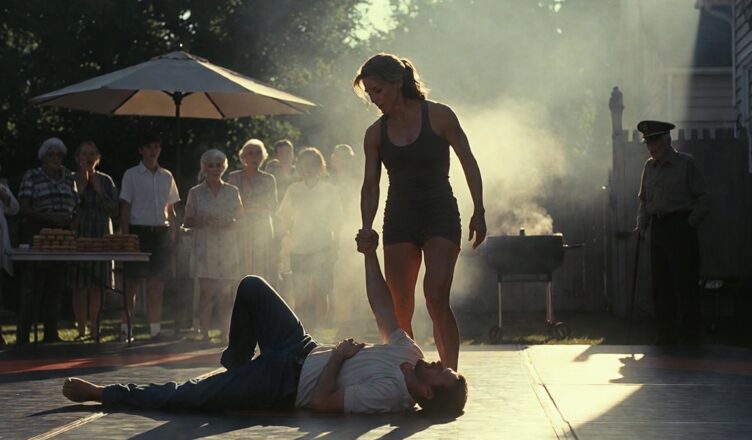
The backyard had gone so quiet I could hear the grill ticking as it cooled.
My mother rose slowly from her seat under the umbrella, one hand pressed to her chest. “Laurel. Twenty-two years, and you never once—”
“You never asked,” I said, and I didn’t say it cruelly, just honestly. “Nobody in this family ever asked what those years actually contained. It was easier to let ‘office Marine’ be the joke than to make everyone uncomfortable at Thanksgiving.”
Mallory finally looked up from the buns, her voice small. “We didn’t know.”
“You didn’t want to know,” I said. “There’s a difference, and today made it very clear which one this family chose.”
Derek’s jaw worked like he was searching for a comeback that no longer existed. He found nothing. For the first time since I’d known him, Derek Vaughn had no joke, no story, no correction to offer.
“I served four years,” he finally muttered, quieter than I’d ever heard him speak. “Motor pool. Stateside.”
“I know,” I said. “You mentioned it at every barbecue for a decade.”
The silence that followed wasn’t triumphant. It was just true, sitting in the open air where it had always belonged.
Then Caleb did something that undid me more than any medal ever could. He walked across the mat, past Derek, past the entire frozen audience of aunts and uncles, and wrapped his arms around my waist the way he hadn’t since he was Emma’s age.
“You carried him,” Caleb said into my shirt, “when his leg gave out. Under fire. And you never told anyone.”
“I didn’t need anyone to know, baby,” I said, my hand finding the back of his head. “I needed you to know you’re allowed to stand back up. That’s the only medal that ever mattered to me.”
Behind us, Silas cleared his throat. “Derek.”
Derek looked up, still pale.
“You put your hands on a thirteen-year-old to make yourself feel large,” Silas said, each word deliberate. “In front of the woman who carried grown men out of gunfire so their sons would still have fathers. I’d think very carefully tonight about the difference between the two of you, and about whether you’re welcome back on this mat, or in this yard, until you understand it.”
Nobody argued with him. Not my mother, not Mallory, not even Derek.
He gathered his things twenty minutes later without another word to anyone, and as his truck pulled out of the driveway, my mother finally turned to me with an expression I hadn’t seen from her in years — not pride exactly, but something close enough to it that it stung.
“There’s so much I never asked you,” she said.
“Then ask now,” I said, and for the first time that afternoon, I meant it as an invitation instead of an accusation.
Emma tugged my sleeve, my watch still clutched in her small hand. “Mom, can you teach me that move? The one you did to Uncle Derek?”
I looked at my daughter’s wide, fearless eyes, then at Caleb standing taller than he had all afternoon, and I felt twenty-two years of silence finally settle into something that looked, at last, like peace.
“Someday,” I told her. “When you’re ready.”
But some part of me already knew — watching both my children stand a little straighter in that backyard — that the real lesson had already been taught, and it had nothing to do with wrestling at all.
To be continued…