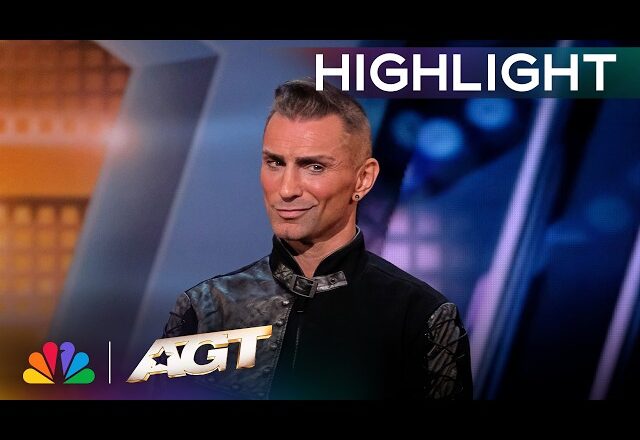
Aaron Crow has never been the kind of performer who needs a lot of words to command attention. Dressed in his unmistakable dark costume and hiding his face behind a mask, he walks onto the *America’s Got Talent* stage and immediately creates an atmosphere unlike any ordinary magic act. There is no long introduction, no cheerful conversation, and no attempt to explain what is about to happen. Instead, Crow lets silence, suspense, and carefully controlled movements do the work. But during this unforgettable performance from the AGT archives, that mysterious style takes an especially intense turn when judge Howie Mandel finds himself at the center of a stunt that looks dangerously close to going wrong.
From the very beginning, the tension builds as Crow prepares the stage and makes it clear that this will not be a simple card trick or traditional illusion. Every movement feels deliberate. The audience watches closely, waiting for the next step, while the judges try to figure out where the performance is heading. Crow’s expression is hidden, making even the smallest gesture feel more dramatic. With no spoken explanation to give away the secret, the audience is forced to watch his hands, follow the objects onstage, and wait for the moment when everything will finally come together.
Then Howie Mandel becomes part of the act, and the mood in the room changes instantly. What had been an intriguing demonstration suddenly feels much more personal. Mandel is no longer simply sitting behind the judges’ desk and watching the action from a safe distance. He is close to the danger, surrounded by the strange equipment and unpredictable movements that make Crow’s performance so unsettling. The other judges watch carefully as the stunt develops, while the audience reacts to every sudden movement.
The most unforgettable moment comes when the illusion appears to go dangerously close to Mandel. The reaction from the room is immediate. People flinch, voices rise, and Mandel reacts with a mixture of surprise and alarm as the stunt unfolds. Crow, meanwhile, maintains his controlled presence, continuing the performance with the same calculated movements that made the entire act so mysterious in the first place. It is the kind of television moment that makes viewers instinctively lean closer to the screen because, for a split second, it seems as though something has genuinely gone wrong.
That uncertainty is a huge part of what makes Aaron Crow’s performances so compelling. Magic depends on controlling what the audience sees, but Crow takes that principle much further by controlling the atmosphere itself. His mask, silence, posture, and slow movements create an almost cinematic sense of suspense. Instead of laughing along with the audience or explaining his technique, he allows the tension to sit in the room. Every pause becomes important, and every movement seems to suggest that something unexpected could happen at any moment.
Howie Mandel’s reaction adds another layer to the performance because viewers can see the human response to a stunt that looks extremely risky. Even when audiences know they are watching a carefully constructed television performance, the physical reactions of the people onstage make the moment feel immediate. Mandel’s movements, the judges’ expressions, and the audience’s collective response all reinforce the same question: **How close was that?** It is precisely this uncertainty that turns an ordinary magic demonstration into a moment people remember long after the performance ends.
What makes the performance even more fascinating is Crow’s ability to remain composed while everyone around him reacts. His act depends heavily on contrast. The audience becomes louder as the tension increases, while Crow becomes even quieter and more controlled. The judges react visibly, but the mysterious performer gives almost nothing away. That contrast makes him seem even more unpredictable. Viewers are left watching for tiny clues, trying to understand how the illusion works and whether every frightening moment was planned from the beginning.
Performances like this also demonstrate why *America’s Got Talent* has produced so many memorable moments over the years. The show is not simply about finding technically impressive performers; it is about creating moments that make millions of people react at the same time. Aaron Crow’s act does exactly that. It combines mystery, danger, theatrical presentation, and psychological suspense into a performance that keeps the audience guessing. And when one of the judges becomes directly involved, the stakes appear to rise dramatically.
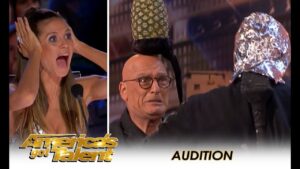
The moment involving Howie Mandel is particularly memorable because it captures the strange relationship between trust and illusion. A magician asks the audience to believe that everything is under control, even while creating the appearance that control could disappear at any second. Crow pushes that idea to the extreme. The closer the stunt seems to come to disaster, the more intensely viewers watch. The audience knows there is an illusion behind the performance, yet the physical reactions onstage make the danger feel real enough to trigger an instinctive response.
Years later, this AGT archive performance remains the kind of clip that can instantly pull viewers back into the excitement of the original show. Aaron Crow does not need a long speech or flashy personality to make an impression. His silent, mysterious presentation creates its own language, and his interaction with Howie Mandel produces one of those unforgettable moments where the entire room seems to hold its breath. **Was it perfectly planned from the start, or did Crow really come dangerously close to taking out Howie Mandel?** Watch the full performance and pay close attention to every movement—you may notice details that are easy to miss the first time around.