The chandeliers in the Reed Mansion had been polished so high they cast rainbows across the marble. The wine was older than two of the guests. And the three women seated at Adrian Reed’s table had spent the entire afternoon being styled by professionals for this one golden night.
Everyone in that room believed the same thing: before midnight, one of them would become the next Mrs. Reed.
Vanessa wore red, a warning. Camille wore silver and a smile she’d practiced in front of the mirror. Sophia wore a pale blue dress, the kind that whispers of innocence, sweetness, and maternal tenderness. They had been invited under a polite pretense: “a dinner to meet little Leo.” But they all understood the real game. Adrian Reed, thirty-six years old, a widower for over a year, the richest man three counties could name, was looking for a mother for his son.
And then Adrian did something no one expected.
He placed his glass on the table, lifted eighteen-month-old Leo from the nanny’s seat, and gently set the child on the antique rug in the center of the room. Leo had barely learned to stand. He wobbled unsteadily, his tiny fists clenched, his eyes wide.
“Come on,” Adrian said gently, crouching a short distance away. “Go to the person you love most.”
It was supposed to be a charming little game. A father showing off his son. A baby waddling toward the beautiful stranger who smiled the brightest.
Vanessa was already smiling, confident. Camille opened her arms like wings. Sophia looked at Adrian as if victory was already decided.
Leo took an uncertain step. Then another. The whole room leaned forward. The glasses stopped clinking. Somewhere, a waiter held a motionless tray in the air.
And then the boy stopped.
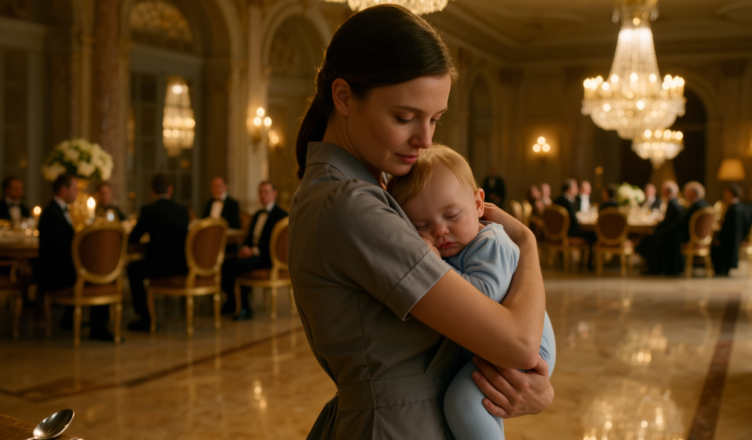
He turned away from the red dress, away from the open arms, away from the rehearsed sweetness. He turned toward the back wall, where a young woman in a simple gray uniform stood by the dessert table, holding a silver spoon she was about to place down.
The maid.
Leo’s face changed completely. It opened up like a window. He laughed, a wet, delighted laugh with visible gums, and ran with the clumsy three-step stride of a baby toward her, arms raised, confident.
The silver spoon slipped from the maid’s fingers and clattered against the floor.
She caught him instinctively, kneeling so he pressed against her chest, and Leo buried his face in her neck like only a child does with the one person who means home. He sighed. His small body relaxed, trusting and calm.
The mansion fell completely silent.
Part Two: The Year No One Was Watching
To understand what happened on that rug, one had to understand the fourteen months that came before it — months Adrian Reed had spent convinced he was doing everything right.
After his wife’s death, he had done what men like him were taught to do with grief: he buried it in work. Acquisitions. Board meetings. Overseas negotiations that stretched from breakfast to midnight. He told himself it was for Leo — building an empire the boy would one day inherit, ensuring his son would never want for anything.
What he hadn’t accounted for was that a child doesn’t need an inheritance at eighteen months old. He needs someone who shows up.
Grace Bennett had been hired through an agency, one name on a list handed to him by his assistant during a week he could barely remember for the exhaustion. She wasn’t chosen for any particular reason beyond her clean record and her availability to start immediately. Adrian had shaken her hand once, in the entryway, and hadn’t thought of her again except as a line item — “household staff, nursery.”
He didn’t know that Grace had stayed two hours past her shift nearly every night that first month, rocking Leo through the fevers no one else noticed because no one else was there at 2 a.m. He didn’t know she’d learned his son’s cries the way a mother learns them — the hungry cry, the tired cry, the cry that meant nothing was wrong except that he wanted to be held. He didn’t know that when Leo said his first word, it hadn’t been “Dada.”
It had been “Gace.”
Grace had cried that night, alone in the nursery, and never told anyone.
Part Three: The Dinner That Was Never About Leo
The three women at the table that evening had not been invited to meet a baby. They had been invited to audition for a life — the Reed name, the Reed fortune, the Reed mansion with its rainbow chandeliers and its empty side of the bed.
Vanessa Cole came from old money and older ambition; she had been circling Adrian since the funeral reception, careful never to seem impatient. Camille Foster ran a boutique PR firm and had rehearsed exactly how to hold a baby for the cameras that would inevitably follow an engagement announcement. Sophia Marsh was, by every account, the kindest of the three — genuinely fond of children, if a little too aware of how fondness photographed.
None of them had asked Leo’s nanny what he liked for breakfast. None of them had asked what made him laugh, or what song helped him sleep. They had asked about Adrian’s schedule, his properties, his five-year plans.
It hadn’t occurred to any of them that the person best equipped to answer those questions about Leo was standing quietly by the dessert table in a uniform no one had bothered to notice.
Part Four: The Question That Changed Everything
Adrian crossed the room slowly. The women watched him pass like wind moving through furniture, and none of them said a word. He stopped in front of Grace, looked at his son clinging to her as though she were the only solid thing in a tilting world, and asked the question that would unravel everything he’d believed about his own house.
“How often,” he said, his voice barely steady, “does my son cry for you instead of for me?”
Grace’s lips parted. Her eyes filled with tears. She didn’t answer.
She didn’t have to. The silence spoke for her.
Adrian felt the ground of his certainty give way. He had spent a year telling himself that hiring good help and providing well were the same as being present. That night, he had interviewed strangers to become a surrogate mother for his child — and his son had just voted, publicly, with all his defenseless honesty.
“What is your name?” Adrian asked. He hated that he had to ask. He hated that he hadn’t already known.
“Grace,” she whispered. “Grace Bennett.”
“How long have you been working here, Grace?”
“Fourteen months, sir.”
Fourteen months. Almost exactly as long as he’d been a single father. Almost exactly as long as he’d been absent from his own son’s life without ever leaving the house.
Part Five: The Unraveling
Vanessa stood abruptly, her chair scraping against the marble. “This is absurd,” she said, laughing a thin, fragile laugh. “He’s a baby. Babies don’t know anything. He went to the staff because she probably bribes him with candy.”
But her voice grew weaker with every word, because everyone in the room could see the truth plainly. They could see a boy who, after an evening surrounded by strangers dressed for a competition, had reached the one safe place in the world and refused to leave it.
Adrian didn’t turn to answer her. He was watching his son’s small, exhausted, quiet figure settle against Grace’s shoulder, eyes already closing.
“It’s late,” he said quietly to the room. “Thank you all for coming. The car will take you home.”
Camille gasped softly. Sophia’s face fell, though she said nothing — some part of her, perhaps, had already suspected how the night would end. Vanessa opened her mouth to protest, but the look Adrian gave her wasn’t the look of a man choosing a wife.
It was the look of a man who had just woken from a long, comfortable sleep and discovered he’d missed the most important year of someone’s life.
The three women left within the hour, the mansion’s grand front doors closing behind them one after another, each departure quieter than the last.
Part Six: What the House Learned After Midnight
Adrian Reed sat on the top step of his grand staircase well past midnight, watching the soft glow of the baby monitor from the nursery, listening to a woman named Grace hum a lullaby he had never once sung to his own son. Shame sat heavy in his chest — not the sharp, public kind, but the slow, private kind that comes from realizing exactly how much you outsourced without ever calling it that.
In the weeks that followed, the household changed in ways the staff noticed before Adrian said a single word about it. Board meetings that once ran until nine ended at five. Overseas calls were rescheduled around bath time. Adrian learned, clumsily at first, the difference between Leo’s hungry cry and his tired one — the same lesson Grace had learned alone, in the dark, months before he’d ever asked her name.
He didn’t propose to Grace. Not that year, and not out of guilt, though the whispers among the Reed family’s social circle assumed otherwise for months. What he did instead was quieter, and in its way more difficult: he asked her to keep teaching him. Not how to run a household, but how to be the person a child ran toward.
Grace stayed. Not because a fortune had noticed her, but because a little boy, in the one moment that mattered, had already chosen who was home.
This is the story of the night a father asked his son to choose — and learned, in front of a room full of strangers, exactly how much of his own life he had quietly handed to someone else.