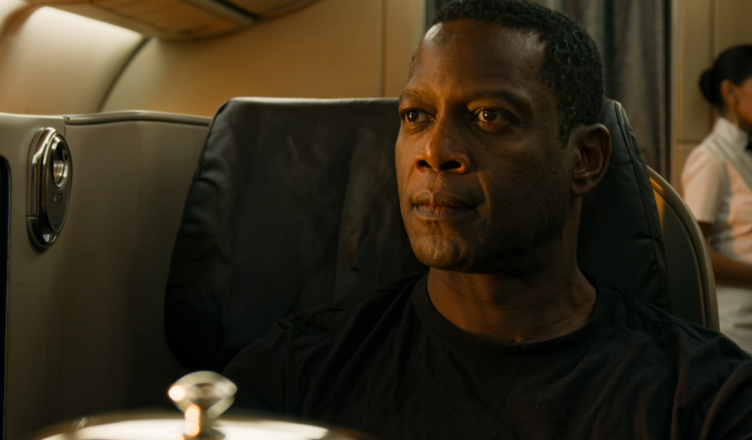
“Excuse me, this bread has mold on it. Could I get the same meal as everyone else?”
Sandra Keene looked him over slowly, head to toe, and smiled with open contempt.
“Mold? You should feel right at home. After all, cockroaches don’t complain about what they eat.”
“I’d like to speak with the captain.”
“The captain? He doesn’t deal with filthy vagrants.”
The last plate, Mr. Pratt, saved just for you — same cabin, completely different treatment. He didn’t argue. Three photographs, timestamped, at 36,000 feet. What happened before that plane landed would end her career forever.
Let me take you back three hours, before the mold, before the photos, before eighteen years of Sandra Keene’s career began quietly collapsing at cruising altitude.
The Man in the Black T-Shirt
Byron Mitchell woke up at 5:00 AM in a hotel suite in Buckhead, Atlanta. The room was still dark, the air conditioning humming its flat, steady tone. On the nightstand sat a phone, a watch, and a conference badge that read: Byron Mitchell, Closing Keynote, Defense Industry Summit.
He’d spent the last two days in rooms full of Pentagon officials, defense contractors, and NATO procurement officers. He’d delivered the closing keynote on next-generation aerospace manufacturing innovation to three hundred people who collectively controlled billions of dollars in decision-making power. He received a standing ovation. Two generals shook his hand. A NATO liaison asked for a follow-up meeting in Brussels.
But that was yesterday. This morning, Byron was just a man catching a flight home.
He packed his own bag, dressed in a plain black t-shirt, jeans, and white sneakers. On his wrist sat a Lange & Söhne watch worth forty-five thousand dollars — though it looked like nothing special, and that was entirely by design. Byron had spent twenty years in the Air Force. He didn’t care for flash or noise. He cared about precision.
He flew commercial by choice. Mitchell Aerospace Industries — his company — manufactured components for the very aircraft he traveled in: navigation systems, cabin interfaces, emergency lighting. He liked sitting in the passenger cabin, feeling the engines, listening to the hum of the plane. It kept him connected to the product. It kept him honest.
This morning, on Crestline Airways Flight 320 from Atlanta to Los Angeles, he was seated in first class — 2A, window seat. The aircraft was an MA9 wide-body, Crestline’s flagship for long domestic routes. Byron knew it intimately: his company’s navigation system charted the flight path, his cabin interface displayed the data, and his emergency lighting lined every aisle on board. His name sat quietly in the maintenance manual stored two hundred feet ahead in the cockpit.
He never mentioned this. Not once. Not to anyone.
He took the hotel shuttle to Hartsfield-Jackson International Airport, the bus smelling faintly of vinyl and stale air freshener. He scanned his phone — two emails from board members, a Pentagon contract update, a message from his assistant confirming Monday’s schedule. He closed them all. Today was just a flight home.
Hartsfield-Jackson, the busiest airport in the world, unfolded around him — concrete, glass, endless corridors, the smell of fast food and jet fuel, rolling suitcases thundering low and steady across the tile floors.
Byron boarded with Group One, carrying only a leather duffel bag and a paperback novel. No briefcase. No laptop bag. No suit. He reached seat 2A, stowed his bag, and opened his book.
Two Faces Under One Uniform
The first-class cabin held twelve wide leather seats, the air smelling of fresh linen and coffee under soft lighting and the quiet hum of money and expectation.
Sandra Keene stood at the front of the cabin running her pre-flight checks. She was the lead flight attendant, eighteen years of service behind her, somewhere in her forties, blonde hair pulled tightly back, uniform pressed to perfection. She moved through first class the way a hotel manager moves through a lobby — evaluating, categorizing, deciding who deserved what before a single word was exchanged.
She spotted Byron. The scan took her two seconds. Black t-shirt. Jeans. Sneakers. No suit. No briefcase. No laptop open to a Bloomberg terminal. Her lip tightened, just barely.
She began her greetings at 1A, welcoming the white passenger aboard with a bright smile, offering champagne, sparkling water, or fresh juice, warm eye contact included at no extra charge. She moved to 1C — Owen Pratt, a white man in his fifties in a tailored suit, an investment banker — welcoming him back and offering his usual Merlot. She moved past Byron’s seat entirely and continued to 2C, a white woman in a cashmere jacket, welcoming her and offering something before takeoff.
Every white passenger greeted. Every white passenger offered a drink.
Byron sat in 2A with his book open, no greeting, no acknowledgment, entirely invisible — despite being the man who had built the brain of the very aircraft he was sitting in.
What Byron didn’t know was that Sandra had already prepared for him — long before he ever boarded.
The Tray Marked at 8:42 AM
During pre-flight setup in the galley, Sandra had reviewed the manifest. One passenger in first class carried no frequent flyer status, no corporate account, no loyalty tier — seat 2A. She’d pulled up the boarding gate camera and watched him walk through in his black t-shirt and jeans. She made her decision before he ever stepped onto the plane.
She walked to the galley, opened the expired-stock container — food already tagged for disposal — and pulled out bread already spotted with green and black mold, alongside chicken two days past its expiration date. She plated it, slid it onto the cart behind eleven perfectly prepared filet mignon dishes, and marked the tray for seat 2A.
The time was 8:42 AM. Forty-five minutes before boarding even began.
The galley’s security camera recorded every second of it.
Behind the first-class curtain, in seat 3A of economy plus, a woman adjusted her reading glasses and glanced through the gap in the fabric. Loretta Sims, sixty-two years old, a retired public school teacher with thirty-eight years of service in Atlanta. She noticed Byron. She noticed Sandra ignoring him. She noticed everything — teachers always do.
Twenty Minutes of Invisibility
The seatbelt sign switched off with a soft chime. The cabin settled into cruising altitude, engines humming steadily through the floor, recycled air drifting from the overhead vents, the faint smell of coffee rising from the galley.
Byron pressed his call button. He’d been sitting for twenty minutes — no greeting, no drink, no acknowledgment that he existed — while every other first-class passenger had been served before the wheels ever left the ground.
Sandra took her time. She appeared at his row forty seconds later, unhurried, unconcerned, wearing the expression she reserved for inconveniences.
She asked what he wanted, sharp and clipped. Byron asked politely for some water. Sandra tilted her head, informed him that full service would begin shortly and that he could wait, then turned and walked away. In that exact moment, the white passenger in 2C, across the aisle, pressed her own call button. Sandra spun around instantly, her entire posture transforming — spine straight, wide smile, a voice smooth as butter — immediately offering water, juice, or warm nuts from that morning’s preparation.
Byron watched all of it. The contrast needed no narration; it spoke entirely for itself. Two call buttons. Two passengers. Two completely different human beings, evaluated under the exact same uniform.
He closed his book, opened his phone, and began typing notes — the time, the call button pressed, the order to wait, and how the passenger in 2C had been served instantly, wrapped in total warmth. He didn’t know yet how important those notes would become. But his military instincts told him to start writing anyway.
The Spilled Ginger Ale
Drink service began twenty minutes later. Sandra worked the cabin showing two faces under one uniform. White passengers received the full performance — eye contact, first names, warm conversation. When she reached Byron, she said a single word without looking at him, asking what he’d like.
Byron ordered a ginger ale.
She poured it behind the cart, carried it out on a small tray, set it on his table, and tilted it — deliberately. The entire glass slid off the tray and spilled across his table, his jeans, and his paperback novel. Ice cubes landed in his lap. Soda soaked through the pages, ink bleeding across the cover, three weeks of reading destroyed in seconds.
Sandra looked at the mess. She didn’t reach for a napkin. She didn’t signal for cleanup. She didn’t apologize. She simply said “oops” and walked back toward the galley.
Jill Harmon, the most junior flight attendant on the crew, in her mid-twenties, saw everything from the galley doorway. She grabbed a stack of napkins and rushed to Byron’s seat, whispering that she was so sorry, her hands trembling slightly as she helped him dry off his jeans. Her concern was genuine. But she didn’t report the incident. She didn’t mention Sandra’s name. She simply returned to the galley and said nothing to anyone.
Byron dried his jeans, set his ruined novel on the table, and added the timestamp of the spill, the lack of any apology from the lead attendant, and the fact that only the junior attendant had brought napkins — entirely on her own initiative — to his growing collection of notes.
The Tray Beneath the Silver Dome
Ninety minutes into the flight, meal service began. Sandra and Jill rolled the galley cart through first class, and the ritual unfolded — silver domes, white linen, the smell of roasted meat filling the cabin like a warm cloud.
Every white passenger received the same plate: filet mignon cooked medium, pink at the center, roasted vegetables, a warm roll, butter in a small ceramic dish, salad with vinaigrette, all beautifully arranged on white porcelain with polished silverware. Sandra delivered each one with a smile and a personal touch.
When she reached row two, she set a tray in front of Byron and lifted the silver dome with a small, tight, deliberate smile, wishing him a good meal.
What sat beneath it didn’t belong on an airplane, didn’t belong on a table — it barely belonged in a trash bin. Bread marked with three distinct patches of green and black mold, fuzzy and unmistakably spreading. A salad with browned, wilted edges and a yellowish film glistening under the cabin lights. Chicken that was pale, gray, and visibly spoiled. A sharp, sour smell of rotting poultry rose immediately, catching in the back of the throat. The plate itself was scratched and stained — not the same white porcelain everyone else had received.
Different plate. Different meal. Same price. Same cabin.
Byron looked at the mold. He picked up the roll and noticed the stains were visible from a foot away. He lifted the chicken with his fork and saw the underside tinged green, the smell intensifying. He looked up and saw Sandra three rows ahead, serving a white passenger a perfect filet mignon with a radiant smile.
Sixty Centimeters Between Two Worlds
Byron pressed his call button. The light blinked above his seat. Thirty seconds passed. A minute. Two minutes. Sandra walked past his row twice without stopping.
Jill finally approached, and Byron tilted the tray toward her, pointing out the mold. Her face went completely pale as she looked and smelled the chicken. Her eyes darted toward Sandra, who was laughing up front with a passenger over a glass of champagne. Jill began stammering an apology — but at that exact moment, Sandra appeared behind her, glanced at the tray, glanced at Byron, and with total indifference declared that it looked fine, that meals sometimes varied, that not every plate could be five stars, suggesting with a smile that perhaps he’d prefer something more suited to economy class, like a sandwich.
Byron responded firmly: he wanted a replacement plate — the same meal every other passenger in the cabin had received.
Sandra didn’t bring him a replacement. She did something far worse. She sat down in the empty seat beside him, crossed her legs, looked him directly in the eyes, and spoke in a low voice that — in the closed quarters of first class — reached every single row.
She told him she’d worked first class for eighteen years, that she knew exactly who belonged in these seats and who didn’t. She told him he didn’t belong there. That he smelled like economy, dressed like economy, and that this meal was exactly what someone like him deserved. She finished by telling him to eat it or go hungry — she didn’t care either way.
She stood, smoothed her uniform, walked to the cart, and picked up the very last filet mignon — steaming, perfectly seared, garnished with rosemary. She carried it past Byron, close enough for the heat of the plate to brush his arm, and set it down in front of Owen Pratt across the aisle with a wide, warm smile, telling him it was the last one and she’d saved it just for him.
Owen Pratt looked at his plate. Then he looked at Byron — the moldy bread, the gray chicken, the tray radiating the smell of decay. Sixty centimeters separated the filet mignon from the garbage, first class from contempt, a human being from invisibility.
Owen picked up his knife and fork, cut into his steak, and said nothing. He avoided looking at Byron again, focusing entirely on his plate.
Byron sat motionless, the mold in front of him, Sandra’s words still ringing in his ears, while across the aisle a man who had witnessed everything pretended the world was just fine as he ate his dinner.
Three Photographs at 36,000 Feet
Byron picked up his phone. Before anything else could happen, he took three photographs.
A close-up of the mold on the bread, the green and black patches sharp and unmistakable. A close-up of the gray-green chicken underneath. A wide shot of the full tray — his rotten plate in the foreground, Owen Pratt’s untouched filet mignon visible in the background.
Every image carried a timestamp. Every image was geotagged, thirty-six thousand feet above the southern United States.
He didn’t know it yet, but those three photographs — along with the notes he’d been quietly typing since the very first ignored call button — were about to end an eighteen-year career before the plane’s wheels ever touched the ground in Los Angeles.
What do you think happens when the plane lands? Does Byron confront the captain directly, or does he let those photographs speak for themselves through Crestline’s corporate office? Drop your predictions below — the next part of this story is coming, and Sandra Keene has no idea what’s waiting for her at the gate.