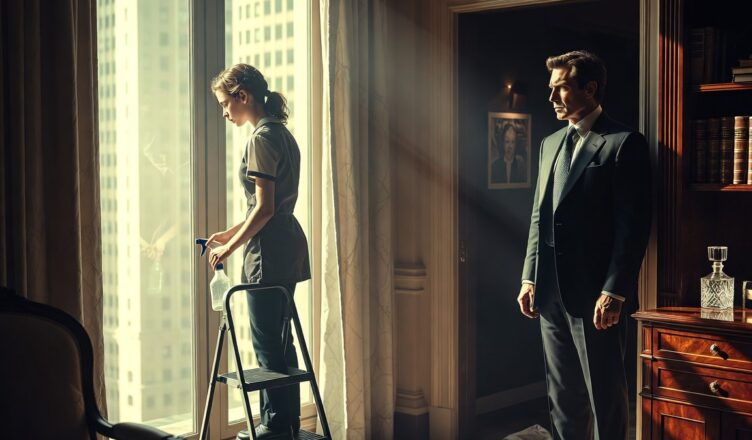
My hand froze against the glass.
I turned slowly on the ladder, and there he was. Vincenzo Russo, Chicago’s most feared name in a business nobody said out loud, stood in the doorway of his River North penthouse, watching me as though I’d just woken up something that was supposed to stay buried for good.
Every beautiful woman in Chicago seemed to want a piece of his attention. Models. Actresses. Socialites in perfect dresses with perfect smiles who’d trained their whole lives to hold a room. None of them, from what I’d overheard in six months of cleaning his home, had ever managed to hold his gaze for longer than it took to order a drink.
And somehow, a cleaning woman humming an old Sicilian lullaby to herself while she wiped down his windows had made him stop breathing.
“What song was that?” he asked.
“Something my grandmother taught me,” I said, my voice smaller than I wanted it to be.
“Sing it again.”
A nervous laugh slipped out before I could stop it. “I don’t sing in front of people.”
“You were singing in my home.”
“I was humming.”
Something almost human touched the corner of his mouth — not quite a smile, but close enough to unsettle me more than his usual silence did. “Are you always this brave with dangerous men?”
“No,” I whispered. “Only when I’m terrified.”
His eyes sharpened at that, studying me a beat too long.
Six Months in the Most Frightening House in Chicago
My name is Lucia Marino. I’m twenty-four, a community college dropout, and I clean luxury homes for a living because my seventeen-year-old brother, Mateo, has severe asthma, and his medication costs more some months than our rent does.
For six months, Vincenzo Russo’s penthouse had been the most frightening job on my rotation. Cameras tracked every hallway. Armed men stood at the elevators without pretending to be anything else. Visitors came and went in suits that cost more than my car, wearing the kind of expression money can’t quite disguise — fear, carefully managed.
Vincenzo himself was worse than all of it combined. Quiet. Contained. Unreadable in a way that made you choose your words twice before saying them once.
But that afternoon, for the first time in six months, he was looking at me like I was something other than furniture.
“Lucia.” The way he said my name sent a chill straight down my spine — as though he’d already known it, long before I’d told him.
“After the windows, clean my office,” he said.
“Yes, sir.”
He turned to leave, then stopped in the doorway without fully facing me again. “That lullaby,” he said, quieter now. “It’s Sicilian.”
Before I could answer, he was already gone down the hallway.
The Photograph
Every instinct I had told me to quit that job on the spot. But quitting meant falling behind on rent within a month. It meant choosing, again, between groceries and Mateo’s inhaler. So I picked up my supplies and walked into Vincenzo Russo’s office, because I didn’t have the luxury of listening to instinct.
His office looked less like a workspace and more like a private chapel — mahogany desk, leather-bound books arranged with unsettling precision, a crystal decanter that had probably never been touched by anyone but him. Nothing out of place. No family photographs anywhere in the room.
Except one.
A black-and-white photograph lay facedown on a shelf near the window, slightly apart from everything else, as if it had been placed there and then deliberately left untouched. I should have left it exactly where it was. I told myself that even as I picked it up.
Maybe it was curiosity. Maybe it was something closer to instinct than curiosity — the kind that doesn’t listen to reason.
I turned the photograph over.
My breath left me entirely.
The young woman staring back at me from the faded photo was unmistakable, even decades younger than I’d ever known her, even in black-and-white, even standing beside a man I didn’t recognize in front of a stone building that looked like it belonged in a Sicilian village rather than anywhere near Chicago.
It was my grandmother.
And suddenly, I understood exactly why Vincenzo Russo had frozen the moment he heard her lullaby drifting through his own penthouse.
Then the office door clicked shut behind me.
What the Photograph Actually Meant
I spun around, photograph still in hand, heart slamming against my ribs. Vincenzo stood just inside the closed door, watching me with an expression I hadn’t seen from him before — not anger, exactly. Something closer to exposure. Like I’d walked in on something private that had nothing to do with the room itself.
“Where did you get this,” I managed, my voice barely steady.
He crossed the room slowly and took the photograph from my hands, looking down at it for a long moment before he answered.
“That woman,” he said quietly, “was engaged to my father. Before my grandfather forced him to marry someone else — someone with the right family connections, the right last name. It’s an old story. Sicily, sixty years ago. Marriages were arranged like business mergers, and love didn’t factor into the math.”
I stared at him, pieces sliding into place faster than I could process them. “That’s my grandmother.”
“I know,” he said. “I recognized her the moment I heard that lullaby. My father used to hum it, late at night, when he thought no one could hear him. He never told me where he learned it. He never had to. I found this photograph in his things after he died, and I’ve known her face for fifteen years without ever knowing her name.”
“Rosa,” I said quietly. “Rosa Marino.”
Something shifted in his expression — recognition, and underneath it, something that looked almost like relief, the particular kind that comes after carrying an unanswered question for far too long.
“She never married the man in that photograph,” I said. “She left Sicily a few years later. Married my grandfather instead, moved to Chicago, had my mother. She used to tell us there’d been someone before him, back home, but she never said a name. She said it wasn’t a happy story, so there wasn’t much point telling it.”
Vincenzo was quiet for a long moment, still holding the photograph like it might disappear if he set it down. “My father never really recovered from losing her,” he finally said. “He built an empire he didn’t particularly want, married a woman he respected but never loved, and hummed a lullaby he never explained to anyone. I think, in his own way, he was still trying to find his way back to that photograph his entire life.”
What Happened After
I’d like to say I quit that job the next day and walked away from all of it — the penthouse, the armed men at the elevators, the particular danger of being tangled up, even accidentally, in Vincenzo Russo’s world. That would have been the sensible thing.
I didn’t.
Over the following weeks, something began to shift between us that had nothing to do with cleaning schedules. He started finding reasons to be in the rooms I was working in. I started finding reasons to hum, quietly, the same lullaby my grandmother had taught me, because I’d noticed it was the only thing that ever made his shoulders drop half an inch from their usual rigid line.
He never asked me to keep cleaning his home once he learned who I actually was to him — some tangled, complicated echo of a woman his father had loved and lost sixty years earlier. But I kept coming anyway, for a while, because leaving felt like walking away from the one unfinished thread of my grandmother’s story that had ever surfaced in my lifetime.
Vincenzo quietly arranged, without ever mentioning it directly, for Mateo to see a specialist his own family had used for years — the kind of doctor whose waiting list normally ran eight months long, suddenly available the following week. I never asked him to. I found out only when the bill, when it finally came, read a fraction of what we’d been paying for a year.
I won’t pretend I understood, or fully forgave, the world he lived in. Some of it still keeps me up at night, the same way it should. But six months after that afternoon on the ladder, my grandmother — eighty-one years old, sharp as ever — sat across from Vincenzo Russo at her own kitchen table, studying his face for a long, silent moment before she finally spoke.
“You have his eyes,” she said. “I always wondered if I’d ever see them again.”
Vincenzo didn’t say much in response. He didn’t have to. He just reached over and, very quietly, hummed the first few notes of the lullaby he’d been carrying, unexplained, for fifteen years — and for the first time since I’d known him, I watched him look completely at peace.