Title: “Step Back.” A Night at the Hospital That Froze an Entire Corridor
Article
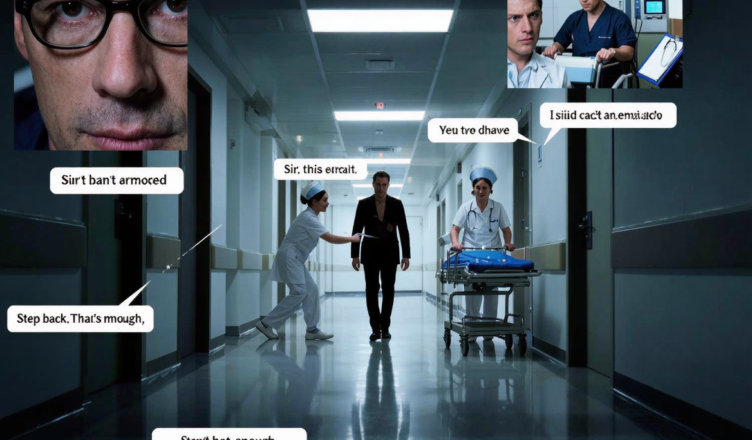
It was 2:17 in the morning, the hour when hospitals settle into their quietest rhythm. The corridor lights were dimmed to a soft amber, and the only sounds were the distant hum of monitoring equipment and the faint squeak of rubber wheels against polished linoleum. A nurse moved calmly through the hallway, pushing a medication trolley, her steps measured and unhurried — the practiced calm of someone who has walked this same stretch of floor hundreds of times before. Nothing about the night suggested it would be any different from the ones that came before it.
Then, from the far end of the corridor, a silhouette emerged. At first it was just a shape in the dim light, but the sound reached the nurse before the figure did — sharp, deliberate footsteps, each one striking the floor with an unsettling rhythm, too controlled to be casual. As the figure drew nearer, details sharpened: a man in a black suit, collar open, no tie, moving with a kind of cold purpose. His eyes were fixed straight ahead, unblinking, betraying no emotion, no hesitation — as if the corridor, the hour, and everyone in it simply did not register to him.
Sensing that something was wrong, the nurse stepped forward and raised her hand slightly, placing herself between the man and the ward behind her. “Sir, this area is restricted,” she said, her voice even, authoritative — the voice of someone used to being listened to. But the man did not slow down. He did not so much as glance at her. His expression remained completely unchanged, as though she hadn’t spoken at all.
What happened next took less than a second, yet somehow felt like it stretched on forever. His hand shot out in a swift, controlled motion, striking her shoulder and shoving her aside. Captured in slow motion, the moment revealed every detail — the impact, the recoil, the flicker of disbelief crossing her face. “Get out of my way,” he said, his voice low, flat, almost bored, as if the encounter barely registered as an inconvenience. The nurse stumbled backward, and the trolley rattled loudly against the silence, medication bottles clinking together in the aftermath.
The corridor seemed to freeze in that instant. In a series of rapid cuts, the reactions of witnesses flashed by: a young intern caught mid-step, his body locked in place, eyes wide with disbelief. A patient in a wheelchair, watching the scene unfold with visible fear, unsure whether to look away or intervene. A doctor’s clipboard slipping from suddenly numb fingers, clattering against the floor — the sound unnaturally loud in a silence that had turned heavy, almost suffocating. No one moved. No one spoke. It was as though the entire hallway was holding its breath.
Then, against all odds, the nurse straightened herself. Her hand trembled slightly as she smoothed her uniform, but her voice, when it came, was steady despite the fear clearly running through her. “You can’t do that,” she said, standing her ground. The man turned back toward her, slowly, deliberately, his expression carrying open contempt for the interruption. “I said move,” he repeated, his tone leaving no room for negotiation.
It was in that exact, suspended moment — just as the tension in the corridor felt like it might snap — that a new voice cut through the silence from somewhere behind him. Firm, calm, and utterly certain: “Step back. That’s enough.” The camera, which had held steady on the standoff until now, whipped suddenly toward the direction of the voice, chasing the sound rather than anticipating it — and yet, just as the source was about to come into view, the screen cut hard to black.
Who had spoken? The corridor holds the answer, but for now, it remains just out of reach — and the tension lingers long after the screen goes dark.