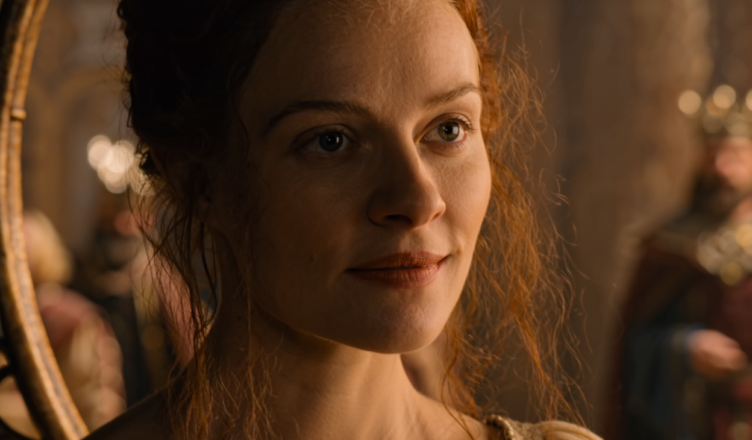
For three years, the kingdom watched a prince who seemed determined to remain unmarried forever. And for three years, everyone was wrong about why.
A King’s Patience, A Prince’s Silence
Every morning for three years, King Aldric climbed the same worn steps to his son’s chambers and delivered the same quiet plea.
“You are the future of this kingdom,” he would say, watching the young man at the window, always looking out at something no one else could see. “A crown needs a queen beside it. It’s time to stop delaying the wedding.”
And every morning, Prince Elian answered with the same calm, unshakable resolve.
“I won’t marry simply because it’s expected of me,” he said. “I’ll do it only when I find a woman I truly love.”
The king would sigh — not in anger, but in the particular exhaustion of a father who suspected his son might be right, even as the kingdom’s patience wore thin around them both.
Word of the prince’s stubbornness spread far beyond the palace walls. Neighboring kingdoms, sensing opportunity, began offering their own daughters — princesses raised on promises of alliance and trade routes disguised as romance. Wealthy families across the land dreamed aloud of what it would mean to marry into the crown. Elian turned every one of them away, gently but without exception, until the rejections themselves became a kind of legend.
The Trial No One Understood
It was Elian himself who eventually proposed something the kingdom had never seen before — an idea so unusual that even the king hesitated before agreeing to it.
Once a year, the most beautiful young women from every corner of the country would be summoned to the palace. But beauty alone would not be enough to earn an invitation. Each candidate first had to survive a brutal gauntlet of scrutiny: her health examined, her education tested, her upbringing investigated, her knowledge of court affairs measured, her conduct, her posture, even the way she walked across a room — all of it weighed and recorded by the palace’s most exacting advisors. Many of the women spent months preparing for that single day, rehearsing their curtsies in mirrors, memorizing court etiquette until it became instinct.
But it was the final trial that no one could explain.
In the center of the throne room stood a large wooden frame, carved in the rough shape of a human figure — ancient, unadorned, strangely out of place amid the palace’s gilded splendor. No one, not even the king’s most trusted counselors, understood its purpose. Only the prince knew what it meant, and he told no one.
By his order, every young woman who reached the final stage had to step through the frame and stand within it for a few brief seconds. Elian would watch each of them closely, his expression giving nothing away, and then he would speak a single word.
“Next.”
This went on, year after year, candidate after candidate. Hundreds of hopeful young women passed through that strange wooden frame. Not one of them held the prince’s attention long enough for him to ask her name twice.
Rumors began to spread through taverns and marketplaces alike, whispered with equal parts amusement and pity: the future king, they joked, would die a bachelor, forever unsatisfied, forever searching for something that didn’t exist.
The Day Everything Changed
Another selection day arrived, and once again the palace filled with dozens of radiant young women in silks and jewels, laughing and chatting nervously among themselves, each one trying — and failing — to hide the tension coiled beneath her composure.
Then the great doors swung open.
A young woman walked in wearing a plain but carefully made dress, her posture steady, her expression unreadable. She looked nothing like the others. Her frame lacked the delicate refinement that court beauty usually demanded; her presence was solid, grounded, entirely unlike the practiced elegance surrounding her.
A ripple of glances passed between the other candidates.
“Is she lost?”
“She must have wandered in by mistake.”
“Does she honestly believe the prince will even look at her?”
Within moments, quiet laughter spread across the room like a current. Even a few of the visiting foreign dignitaries struggled to keep straight faces.
The woman heard every word. She said nothing. She kept walking forward, calm and unhurried, her eyes fixed ahead, never once glancing toward the whispers around her.
When her turn finally came, the palace steward stepped forward to wave her aside before she could even approach the frame.
“I’m terribly sorry, my lady,” he said, not unkindly, but with the practiced dismissal of a man who had turned away hundreds before her. “This trial isn’t meant for someone like you. You should return home.”
And then, for the first time in three years, Prince Elian raised his hand.
“No,” he said, his voice cutting cleanly through the murmuring crowd. “Let her through.”
The entire hall fell into absolute silence.
What the Frame Revealed
The woman stepped forward without hesitation, her chin lifted, and walked directly into the wooden frame that had rejected — or perhaps simply waited for — hundreds before her.
She stood there for a moment, just as every candidate before her had stood.
But this time, something was different. This time, the prince did not sit back in silent observation. This time, he rose slowly from his throne, his eyes fixed on her with an intensity the court had never once witnessed in three long years of trials.
What happened in the next few seconds left every noble, every servant, every skeptical whisperer in that room utterly speechless — a truth about the frame, about the woman, and about exactly what the prince had been searching for all along, hidden in plain sight while an entire kingdom laughed at the one person who was never meant to be laughed at.
(To be continued — the revelation that silenced the court.)