Daniel had spent three years convincing himself that grief was something you eventually finished with. At first, he thought it would take weeks. Then months. Eventually, he stopped putting a number on it. He simply learned how to carry it.
Every morning, he took the same train at 7:14.
Not because it was the fastest route to work.
Not because he liked the train.
He took it because it was the last train his daughter had ever ridden.
Her name was Lily.
She had been six years old.
Three winters earlier, Daniel had promised her that he would pick her up from school on Friday afternoon. He remembered the promise clearly because Lily had made him repeat it three times before letting him leave that morning.
“Promise?”
“Promise.”
“Really promise?”
Daniel had smiled and held out his little finger.
“Really promise.”
But that afternoon, work had gone wrong. His manager had kept him late. Daniel had looked at the clock again and again, telling himself he still had time. When he finally left, traffic was almost completely stopped.
Lily never made it home.
There had been an accident at the railway crossing near the school.
Daniel arrived minutes too late.
For years afterward, he remembered one thing more clearly than anything else: the red scarf Lily had been wearing that morning.
It was the scarf he had bought her because she kept complaining that the winter wind hurt her ears. She had hated wearing it at first. She said it made her look like a little tomato.
That morning, however, she had wrapped it around herself without complaining.
Three years later, Daniel still couldn’t understand why.
Then, one freezing morning, he found the scarf sitting on the seat opposite him.
At first, he thought it was impossible.
He touched it.
Warm.
Not slightly warm from the heating system.
Warm as if someone had been wearing it moments before.
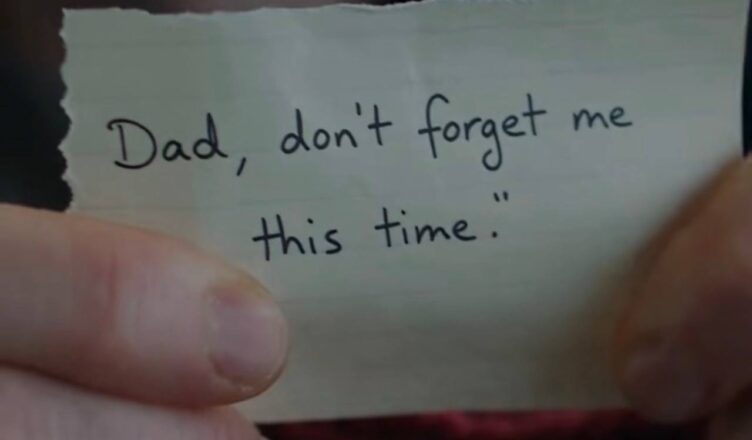
His hands began to shake when he found the note hidden inside.
*”Dad, don’t forget me this time.”*
Daniel knew the handwriting immediately.
He had kept hundreds of Lily’s drawings in a box beneath his bed. He knew every crooked letter, every oversized capital, every way she wrote the letter “e.”
It was hers.
He looked through the carriage.
Nobody was there.
Then the train stopped.
An elderly woman standing on the platform stared at the scarf through the window.
Her face changed.
She whispered something Daniel couldn’t hear.
The doors closed.
Daniel pressed his hand against the glass.
The woman ran alongside the moving train for several steps before stopping.
And then he saw her mouth the words:
“She waited for you.”
That night, Daniel couldn’t sleep.
He searched through the old box beneath his bed until he found Lily’s school notebook.
Most of the pages contained drawings, spelling exercises, and childish stories.
But near the back, there was something he had never seen before.
A drawing of a train.
Two people were sitting opposite each other.
A little girl had drawn herself on one side and a man on the other.
Above them, in uneven handwriting, she had written:
*”When Daddy comes back, I have something to tell him.”*
Daniel stared at the sentence for a long time.
The next morning, he took the 7:14 train again.
The same carriage.
The same seat.
Nothing.
He returned the next morning.
Nothing.
And the morning after that.
Nothing.
For seven days, he searched.
On the eighth morning, the elderly woman from the station entered the carriage and sat beside him.
“My name is Margaret,” she said.
Daniel looked at her.
“You know my daughter?”
Margaret shook her head.
“No. But I knew Lily.”
Daniel couldn’t breathe.
Margaret explained that she had worked at the bakery beside Lily’s school. Lily used to wait there when her father was late. She would sit by the window and watch the trains.
“She talked about you constantly,” Margaret said. “She always said her daddy worked too much, but that he always came back.”
Daniel lowered his eyes.
“I didn’t come back that day.”
Margaret reached into her coat and pulled out a small envelope.
“I was supposed to give you this a long time ago.”
Inside was a child’s drawing.
It showed Daniel holding Lily’s hand.
There was a huge yellow sun above them.
On the back, in Lily’s handwriting, were four words:
*”Daddy, I forgive you.”*
Daniel finally broke.
Not the quiet kind of crying he had learned to do alone.
He cried the way he had wanted to cry three years earlier but couldn’t.
He cried until his chest hurt.
Until the train stopped.
Until Margaret placed a hand on his shoulder and simply stayed beside him.
For the first time since Lily died, Daniel understood something.
He had spent three years punishing himself for the promise he had broken.
But Lily had never asked him to spend the rest of his life being sorry.
She had only wanted him to remember her.
That evening, Daniel went home and opened the box beneath his bed.
He took out every drawing.
Every photograph.
Every little piece of Lily’s childhood he had been too afraid to touch.
He placed them on the living-room floor.
Then he smiled.
It hurt.
But he smiled.
The next morning, Daniel boarded the 7:14 train one final time.
He sat in his usual seat.
Across from him was an empty seat.
For a few seconds, nothing happened.
Then he noticed something lying on the floor.
A small red thread.
The same shade as Lily’s scarf.
Daniel picked it up and held it between his fingers.
He looked at the empty seat.
“I didn’t forget you,” he whispered.
The train began moving.
For a moment, sunlight passed through the window and illuminated the empty seat opposite him.
Daniel thought he saw Lily sitting there.
Not frightened.
Not sad.
Just smiling.
He closed his eyes.
When he opened them, the seat was empty.
But for the first time, Daniel didn’t feel abandoned.
He stood up, walked toward the train doors, and stepped off at the next station.
He never took the 7:14 again.
Instead, every Friday afternoon, he went to the bakery beside Lily’s old school.
He would sit by the window with a cup of hot chocolate.
Sometimes children passed outside wearing red scarves.
Sometimes Daniel cried.
Sometimes he smiled.
And whenever someone asked why he came there every week, he would simply say:
“I promised my daughter I’d come back.”
And this time,
he kept his promise.