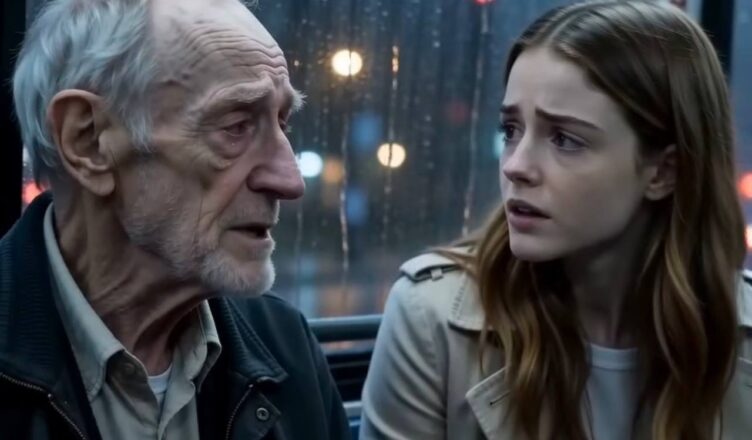
Every Thursday at 5:40 p.m., an elderly man named Thomas boarded the number 17 bus and sat in the same seat. He always sat beside the window, always placed a small red backpack on the seat next to him, and always got off at the final stop. The other passengers had begun to recognize him, although nobody knew his name or why he followed the same strange routine. Some assumed he was waiting for someone. Others thought the backpack belonged to a grandchild who would eventually appear. Thomas never explained. He simply rode the bus in silence, staring through the rain-covered window as the city passed by. One cold afternoon, a young woman named Emma boarded the bus carrying a coffee and looking for somewhere to sit. She noticed the empty seat beside Thomas and approached it. Before she could sit down, Thomas gently moved the backpack onto his lap and said, “Would you mind sitting here? My daughter always sat beside me.” Emma smiled politely and sat down. After a few minutes, she noticed that Thomas wasn’t looking at the road anymore. He was staring at the backpack. “Are you waiting for someone?” she eventually asked. Thomas shook his head. “No,” he said quietly. “Not anymore.”
Emma didn’t know what to say. She looked down and noticed a small name tag attached to the backpack. It said Lucy. There was something about the way Thomas said those words that made her regret asking. Then the bus stopped at a red light, and the movement of the vehicle caused a folded piece of paper to slip from the backpack’s side pocket. Emma instinctively picked it up and handed it to him, but Thomas stared at it for several seconds without taking it. “You can read it,” he said. Emma unfolded the paper. It was written in a child’s handwriting. “Dad, when we get there, promise you won’t cry.” Emma looked at Thomas. His eyes were wet. “How old was she?” she asked. Thomas looked toward the rain-covered window. “Nine.” Emma’s expression changed. “Where is she now?” Thomas didn’t answer immediately. Instead, he opened the backpack and took out an old photograph. It showed a little girl with a red backpack standing beside Thomas at a bus stop. She was smiling at the camera, holding a paper cup of hot chocolate in both hands. On the back of the photograph was a date from three years earlier.
“That was the last picture I ever took of her,” Thomas said.
Emma waited.
Thomas finally told her that Lucy had been diagnosed with leukemia when she was seven. For almost two years, she spent more time in hospitals than she did at home. But Lucy hated being treated like she was sick. She wanted to go to school, eat ice cream, complain about homework, and ride the bus with her father like every other child. During one of her final months, the doctors allowed her to spend a weekend at home. She had one request: she wanted to take the number 17 bus all the way to the final stop with her father. It was something they had done together since she was little. Thomas had promised her they would do it as soon as she felt strong enough. She never did.
The last time they had spoken, Lucy was lying in a hospital bed. Thomas had tried to hide how frightened he was, but children notice things adults think they can hide. Lucy reached for his hand and said, “Dad, when I get better, we’ll take the bus again, okay?” Thomas had nodded even though he already knew there might not be another chance. Then Lucy smiled and said, “And when we get there, promise you won’t cry.” Three days later, she died.
Thomas stopped speaking for a moment. The bus continued through the rain. Emma didn’t interrupt him. She simply listened.
“For two years,” Thomas continued, “I couldn’t get on this bus. Every time I saw number 17, I felt sick. Then one day I realized something.” He looked down at the red backpack. “Lucy didn’t want the bus to be the last thing I remembered. She wanted it to be something we shared.”
So Thomas bought a small red backpack identical to the one Lucy had carried. Every Thursday, he took the same route they had planned to take together. He would sit beside the window, place the backpack beside him, and imagine that Lucy was there complaining about the rain and asking how much longer until they reached the last stop.
Emma listened quietly.
Then she noticed something.
“You said she never made it to the final stop,” she said.
Thomas nodded.
“But you still come here every Thursday.”
“Yes.”
“Why?”
Thomas looked at the backpack.
“Because she never got to see what was there.”
The bus continued toward the final stop.
Emma looked out the window. The rain had begun to weaken. The city lights reflected across the wet streets.
When the bus finally arrived at the last stop, Thomas stood slowly.
He picked up Lucy’s backpack.
Emma expected him to leave.
Instead, he looked at her.
“Would you come with me?”
Emma hesitated, then nodded.
They stepped off the bus.
The final stop was beside a small park overlooking the river. There were trees, benches, and a narrow walking path covered with wet leaves. Thomas walked to the end of the path and sat on a bench.
For a while, neither of them spoke.
Then Thomas opened the backpack.
Inside was a small child’s raincoat, a half-used box of colored pencils, a photograph, and a sealed envelope.
Emma looked at the envelope.
“What’s that?”
Thomas smiled sadly.
“Something I’ve been afraid to open.”
“Why?”
“Because Lucy wrote it for me.”
Emma looked away to give him privacy.
Thomas held the envelope in both hands for several seconds before finally opening it.
Inside was a single sheet of paper.
He read silently.
Then he began to cry.
Not quietly this time.
Not the way he had cried on the bus when he thought nobody was watching.
He cried like a father who had spent three years trying to hold himself together.
Emma didn’t ask what the letter said.
She didn’t need to.
Thomas eventually handed it to her.
There were only a few lines.
Dad,
If you’re reading this, I’m probably not going to get better. I’m sorry.
But I don’t want you to stop taking the bus because of me.
Remember the last stop. You always told me there was a beautiful view there.
So when you go without me, don’t be sad. Pretend I’m sitting next to you.
And Dad…
You don’t have to keep waiting for me.
You can go home.
Emma’s eyes filled with tears.
Thomas looked toward the river.
“I’ve been coming here for three years,” he whispered. “But I never got off the bus.”
Emma understood.
Thomas had been repeating the journey because finishing it meant accepting that Lucy wasn’t coming back.
For three years, he had sat beside an empty seat because leaving it empty was the closest thing he had to keeping his daughter with him.
He folded the letter carefully and put it back inside the envelope.
Then he stood.
For the first time in three years, Thomas left the red backpack on the bench.
Emma looked at him.
“Aren’t you taking it?”
Thomas shook his head.
“No.”
He looked toward the empty seat on the bus in the distance.
“She wanted me to stop waiting.”
Thomas took one final look at the backpack.
Then he walked away.
Emma followed him.
They reached the end of the path just as the rain stopped completely.
Thomas looked back toward the bus.
And for the first time, there was no sadness on his face.
There was pain, certainly.
But there was also peace.
He whispered something too quietly for Emma to hear.
She asked, “What did you say?”
Thomas smiled.
“I told her we finally made it.”
Then he turned toward the river and continued walking.
The following Thursday, Thomas did not board the number 17 bus.
Neither did he come the Thursday after that.
But several weeks later, Emma happened to take the same route.
When she reached the final stop, she noticed something sitting on the bench.
It was the little red backpack.
Beside it was a handwritten note.
Emma opened it.
There was only one sentence.
“Thank you for sitting beside me when I couldn’t bear to sit alone.”
And beneath it, in smaller handwriting:
“Tell Lucy I finally stopped waiting.”