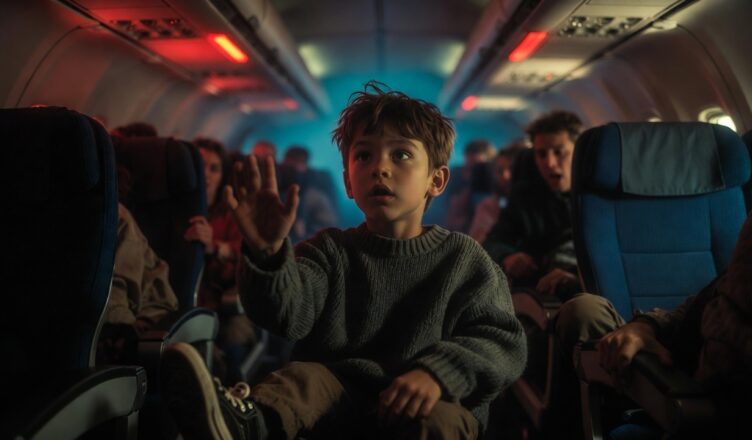
For three full seconds, no one on that aircraft breathed.
The flight attendant’s question hung in the recycled cabin air like smoke that wouldn’t clear. Is there an engineer on this flight? It was the kind of question passengers only ever heard in movies — never meant for them, never meant for a Tuesday evening flight with cramped legroom and a bag of pretzels waiting in seat-back pockets.
Rows of adults — accountants, a man in a rumpled business suit, a woman clutching a paperback she’d stopped reading twenty minutes ago — all did the same thing. They looked at each other. Then at their laps. Then at the flickering lights above them, as if the answer might be written there instead.
No one raised a hand.
And that was when the boy in seat 14A did.
Part Three: The Boy Who Wasn’t Playing
His name — we would all learn later — was Micah Ortiz. Nine years old, traveling alone on an unaccompanied-minor pass, headed to visit his grandmother two states away. He had spent the first hour of the flight quietly building something out of napkins and a plastic fork, ignoring the in-flight movie entirely.
When his hand went up, the flight attendant blinked at him the way adults do when they assume a child has misunderstood.
“Sweetheart, I mean a real engineer,” she said gently, already turning to scan the rest of the cabin.
Micah didn’t lower his hand.
“I know what you mean,” he said. “I build flight control systems for a robotics program. I’ve read the Boeing systems manual twice. I know what that alarm sound means.”
A ripple of stunned laughter moved through nearby rows — the nervous kind, the kind people make when they don’t know whether to be amused or afraid.
The flight attendant hesitated. Behind her, through the galley curtain, another muffled alarm chimed.
“Please,” Micah added, quieter now, “I really do know what’s wrong.”
Part Four: What the Boy Understood That No One Else Did
It turned out Micah wasn’t exaggerating.
For the past two years, he had spent every weekend at a youth aerospace program run out of a community college near his home — the kind of program most people don’t know exists until their child refuses to stop talking about hydraulic systems at the dinner table. His mother later told reporters that Micah had memorized entire diagrams of aircraft electrical systems the way other nine-year-olds memorized baseball stats.
When the flight attendant finally crouched beside his seat — more out of desperation than confidence — Micah calmly explained what he’d noticed: the pattern of the flickering lights, paired with the specific tone of the alarm, matched a secondary hydraulic pressure warning he’d studied in a training simulator. Not catastrophic. Not immediately dangerous. But something the flight crew needed to relay to the cockpit immediately, in the correct technical language, so the pilots could cross-check it against their own instruments without wasting critical minutes.
He wasn’t fixing the plane. He was translating fear into information — and in that moment, that was worth more than anyone else in the cabin had to offer.
Part Five: The Longest Nine Minutes
The flight attendant relayed Micah’s words to the cockpit over the intercom, her voice steadier now that she had something concrete to say instead of panic to pass along.
The plane didn’t stop shaking. The lights flickered twice more. But something in the cabin’s atmosphere shifted — passengers who had been frozen moments before began instinctively looking toward seat 14A, as though the small boy with his sneakers dangling above the floor had become, without asking for it, the only calm point in the entire aircraft.
Nine minutes later, the captain’s voice came over the speakers, measured and controlled: they were adjusting altitude, a precaution, nothing more. The turbulence began to ease. The overhead lights steadied. The coffee cart in the aisle was quietly set upright by a passenger no one thanked, because everyone’s eyes were still on the boy who’d raised his hand.
Epilogue: What We Learned at 30,000 Feet
When the plane landed safely two hours later, passengers didn’t rush for the exits the way they usually do. Several stopped by seat 14A. A man in a business suit shook Micah’s small hand like he was closing a deal. The woman with the paperback finally opened it again, smiling for the first time since takeoff.
Micah’s grandmother was waiting at the gate, unaware that her grandson had spent the flight doing anything more remarkable than watching a movie.
The story spread online within hours — grainy phone videos of a boy with an oversized sweater and dangling sneakers, calmly saying four words that no adult in that cabin had been able to say themselves: I’m an engineer.
What none of the headlines captured, though, was the quieter truth underneath it all: sometimes the person capable of staying calm isn’t the one with the most experience in the room. It’s the one who was never taught to be afraid of not knowing — because he actually did.
— as told to passengers of Flight 2247