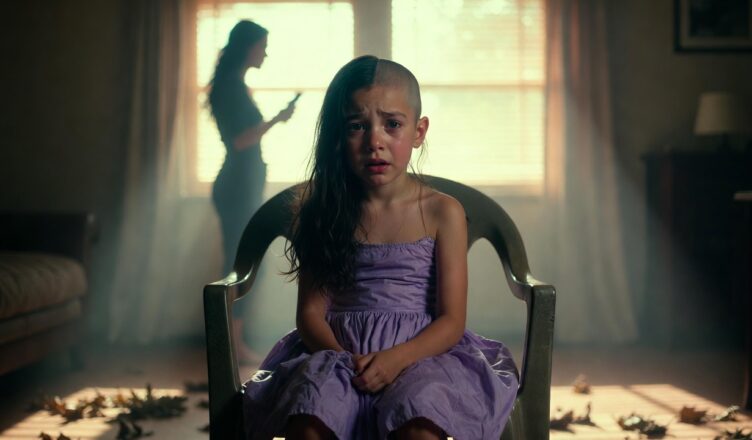
Selene set the clippers down on the side table with the calm of someone finishing a chore, not someone who had just taken a pair of blades to an eight-year-old’s scalp. That stillness — that terrible, unbothered stillness — told me more than any scream could have.
“Say something,” I managed. My voice didn’t sound like mine.
She looked at me the way she used to look at our mother when we were children and she’d been caught lying: chin lifted, eyes narrowed, already rehearsing her defense.
“She was being vain,” Selene said. “Flipping her hair around in front of my girls like she’s better than them. Someone needed to teach her a lesson.”
Aurora and Nova had stopped laughing by then. Even they seemed to understand, for the first time, that this wasn’t a joke that would blow over by dinner.
“She’s eight,” I said. “She’s eight, Selene.”
“And my daughters are fourteen and sixteen and they don’t have a father who pays for everything they touch,” she snapped back. “Do you know what it’s like to watch your brother hand his perfect little princess a life you’ll never be able to give your own kids?”
There it was. Years of resentment, unloaded in a single sentence, dropped onto the floor next to my daughter’s hair.
I didn’t answer her. I couldn’t. I just held Elara tighter and carried her out of that house, past the plastic chair, past the clippers, past the sister I no longer recognized.
Part Three: The Diagnosis Ivy Never Wanted to Say
Ivy met us in the driveway. I will never forget her face when she saw Elara’s head — the way all the color left it in an instant, the way her hands went to her mouth and then, just as quickly, dropped to gather our daughter into her arms.
“What did she do,” Ivy whispered. It wasn’t a question. It was an accusation aimed at me.
That night, after Elara finally cried herself to sleep between us — she refused to sleep alone for the first time since she was four — Ivy said the words that broke something open in me.
“This isn’t the first warning sign, Rowan. I told you. I told you what she was capable of, and you kept making excuses for her.”
She was right, and I hated that she was right.
Part Four: The Cost of Loyalty
In the weeks that followed, Elara wouldn’t go to school without a hat. She flinched when anyone touched her head, even to check for lice, even during a routine haircut appointment meant to even out the damage. The hairdresser had to stop twice because Elara started shaking.
The financial arithmetic of my “loyalty” to Selene came into sharp, humiliating focus once Ivy sat me down with a folder of bank statements. Four years of mortgage assistance. Two vehicle repairs. School supplies, class trips, a broken refrigerator, a security deposit on an apartment Selene never even ended up renting.
“I did the math,” Ivy said quietly. “It’s over sixty thousand dollars, Rowan. Sixty thousand dollars, and she paid us back with this.”
I had no defense left. I had spent years telling myself blood meant something unconditional. What I hadn’t understood — what I was only beginning to understand — was that unconditional support without consequence doesn’t build loyalty. It builds entitlement.
Part Five: The Choice
Selene called four days later, expecting an apology.
“She’ll get over it,” she said, when I finally picked up. “Kids bounce back.”
“She’s in therapy, Selene.”
Silence on the line. Then, quieter: “You’re being dramatic.”
That was the moment I stopped being her brother and started being, simply, Elara’s father. I told Selene the money stopped that day. I told her the relationship stopped that day. I told her that if she ever came near my daughter again, it would be the last mistake she made in this family.
She laughed — that same cold laugh I’d heard through the door before I ever saw what she’d done.
“You’ll come crawling back,” she said. “You always do.”
I hung up, and for the first time in years, the silence on the other end of the phone felt like relief instead of guilt.
Epilogue: What Grows Back
Elara’s hair is growing back now, slowly, in soft uneven patches under the beanies she still prefers to wear most days. Some things are healing faster than others. The nightmares have started to space out. The flinching has mostly stopped.
Selene has not spoken to any of us since that afternoon. Her daughters, I’ve heard, ask about their cousin sometimes. I don’t know what Selene tells them.
What I know is this: loyalty without boundaries isn’t love. It’s a debt that someone, eventually, always collects — and sometimes the person who pays for it isn’t you at all. It’s the child sitting in the plastic chair, watching the only thing she couldn’t get back fall to the floor around her feet.
I used to believe family could survive almost anything.
Now I believe some things should never have to be survived in the first place.
— Rowan Hale