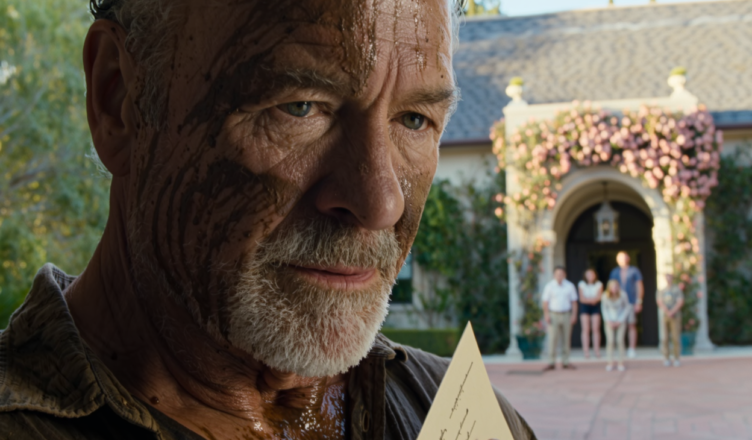
There are mornings that seem ordinary right up until the moment they aren’t. This was one of them — a quiet Beverly Hills street, a rose-covered archway catching the first light of day, and an old man on a ladder who understood something the people around him hadn’t yet figured out: that dignity has nothing to do with what you’re wearing, and everything to do with what you actually own.
A Quiet Morning, Interrupted
I like to work before a house wakes up. Plants are honest that way. People aren’t.
The roses climbing the front arch had grown too fast, reaching further than the structure could hold, so I’d arrived early to shape them before the sun climbed too high. I was halfway through trimming a stubborn white climbing rose when the front doors of the estate flew open, and she stepped out like she was walking onto a movie set.
Cream silk dress. Diamond earrings. Phone in one hand. The kind of look in her eyes that told you she had never once had to distinguish between money and character, because in her world, they’d always been the same thing.
She looked at me for exactly three seconds before her lips curled.
“Why is there an old man in my garden?”
Not “who.” What. As if I were a piece of furniture someone had forgotten to remove.
Mud, Witnesses, and a Woman Who Didn’t Know Better
I kept working. I’ve learned over the years that arrogant people despise nothing more than not being treated as the center of the universe — and my continuing to trim the archway apparently qualified as an offense.
“Did you hear me?” she snapped, heels clicking across the stone path.
“I’m almost finished with this arch,” I said, and kept going.
That was enough to send her storming back toward the doors. “Dylan!” she shouted.
Her husband appeared a moment later — expensive loafers, an expensive watch, an inexpensive haircut that had clearly cost a great deal of money to look that unremarkable. He glanced between the two of us and already looked exhausted by whatever inconvenience morality was about to demand of him.
“This man is ruining the look of the house,” she told him, pointing at my work gloves like they were a personal insult. “I have people coming for lunch. Why is he still here?”
Dylan gave her the practiced, gentle smile rich people use when they want to sound reasonable without giving up any authority. “He’s just finishing up,” he said.
“No,” she said. “He’s leaving. Now.”
“The roses won’t keep their shape if I stop halfway,” I told her.
She laughed. A genuine, delighted laugh — the kind people give when they believe an audience is watching and rewarding their cruelty. And an audience was watching. A valet on the curb shifted uncomfortably. A delivery driver near the entrance slowed his cart. A woman walking a golden retriever stopped on the sidewalk. Landscapers across the street paused their own work to watch.
She saw the attention, and instead of softening, she got worse. That’s the thing about people like her — public space doesn’t restrain them. It performs for them.
She walked to the clay bucket by the hedge, the one holding irrigation runoff and roots I’d pulled that morning, looked at me with total certainty, and said, “Let me help you understand where you belong.”
Then she threw it.
The mud hit my chest and exploded across my shirt, my neck, my face, even the ladder behind me. Someone on the sidewalk gasped audibly. My shears slipped from my hand and landed in the grass. For a moment, all that could be heard was water dripping off metal and rose petals.
Then she smiled. “Now get off my property,” she said. “My husband didn’t marry me to look at the hired help.”
Dylan didn’t move to help me. He didn’t apologize. He just rubbed the back of his neck and muttered, “Please don’t make a big deal out of this.”
That single sentence told me everything I needed to know about him — not because I was hurt, but because he still believed he was the one entitled to decide how large the consequences of his wife’s actions would be.
The Envelope That Changed Everything
I climbed down slowly. I leaned the ladder against the hedge, picked up my shears, and peeled off my wet gloves finger by finger, setting them carefully on the stone beside the roses. The neighbors kept watching. The valet kept watching. Even she went still, because something about my calm was starting to unsettle her — I wasn’t screaming, and that wasn’t the reaction she’d been expecting.
I reached into my waxed jacket and pulled out a legal envelope.
Dylan’s face changed the instant he saw it. Cream stationery. Embossed black letterhead. The law firm that administered the property trust he lived under.
“What is that?” his wife asked.
I held it out. “Notice of immediate termination of residential lease,” I said, “due to material breach, improper public conduct, and interference with property.”
She blinked, then laughed again — thinner this time. “You can’t finish anything,” she said. “This is our house.”
I looked at Dylan. “No,” I said. “It’s your lease.”
The front yard went completely silent. He didn’t reach for the envelope. That told me everything — his wife genuinely had no idea.
So I said it plainly. “This estate belongs to the Marlowe Preservation Trust. I’m the settlor and sole living trustee. You leased this property through Marlowe Residential Holdings under a revocable luxury occupancy agreement you signed eleven months ago.”
She turned on him so fast her heel nearly slipped. “What are you talking about?”
His mouth opened. Closed. Opened again. That silence was the only answer she needed.
“You told me this house was ours,” she whispered.
“I told her we controlled it,” he admitted quietly.
A Debt Owed to a Good Man’s Memory
I almost felt sorry for him. Almost.
Because I remembered exactly why that lease existed in the first place. Years earlier, Dylan’s father had worked for me — steady, honest, the kind of man whose word meant something. When he died, I gave his son an opportunity I probably should have offered to someone wiser: the chance to lease this estate below market value while he built his firm’s reputation. The terms were generous, but they were strict.
No subletting. No false claims of ownership. No conduct that invited public scandal or damaged the trust’s reputation. No interference with staff or property operations.
He had broken every single one of those terms.
His new wife had spent months introducing herself at charity luncheons as “the lady of the house.” She’d invited magazine photographers to the front door. My lawyers had already warned Dylan twice. This morning, he’d let vanity curdle into something fully documented — in front of witnesses, and in front of cameras neither of them had bothered to notice.
That matters in court. It matters in finance. And in a neighborhood where image functions as collateral, it matters more than almost anything else.
“It can be fixed,” Dylan said, trying to recover. “She exaggerated. I’ll handle it.”
“You already handled it,” I said coldly.
His wife rounded on him instead. “You told me this was ours! You told everyone! You made me look stupid!”
It was the first honest thing either of them had said all morning. “You threw mud at him in front of witnesses!” he shot back.
“Why was he even here?”
“Because it’s his property!”
He flinched the moment the words left his mouth. There it was — the truth, undisguised, humiliating, and about seventeen minutes too late.
What the Cameras Saw
My lawyer stepped forward and handed Dylan a second envelope. “This includes the demand for immediate vacancy, a damage assessment, staff statements, and notice of preserved evidence,” she said.
He scanned it too quickly, then stopped. “What preserved evidence?”
I nodded toward the security camera mounted beneath the front eaves. Then toward the one at the side hedge. Then the corner of the garage. Then the front door.
His wife followed my gaze and whispered, “No.”
Yes.
The entire front yard had been under surveillance from the day the property was built. Dylan hadn’t been in business long enough to think to check.
“You assaulted a contracted worker on camera,” my lawyer said, “and obstructed maintenance after prior written warnings. That alone terminates the lease. The financial misrepresentation makes it considerably worse.”
His wife’s face went red, then white, then she tried the one move people like her always reach for when everything else has failed. Tears. Fast, practiced, emotional leverage.
She stepped closer, her voice suddenly soft. “I didn’t know,” she said. “I thought—”
“You thought dignity belonged only to people you dress expensively,” I said.
She had nothing left to say to that.
The Slow, Public Unraveling
By noon, their access codes were deactivated. By one o’clock, the movers they’d hired at their own expense were working under staff supervision, packing up a life that had never technically been theirs. By three, the rumors were already moving faster than the moving trucks. By nightfall, the story had reached exactly the circle of people they’d spent two years trying to impress.
I didn’t publish anything. I didn’t need to. People like that generate their own disasters in front of enough witnesses.
The following weeks were worse for Dylan than for his wife. The trust referred the financial misrepresentation to its attorneys. Two investors quietly withdrew from a pending deal. A private bank froze a line of credit tied to assets he no longer had any legitimate claim to. His firm began “reviewing leadership concerns” — which, in that particular world, is simply the polite language people use while counting the exits.
Within a month, he was out. Within two, the lawsuits began. Within six, bankruptcy finished what my patience never had to.
As for his wife — the marriage didn’t survive the moving boxes. The day she understood the mansion had been rented, the designer life had been borrowed, and the staff had never actually answered to her, she turned on Dylan with the same cruelty she’d once aimed at me. This time, he was standing right in the middle of it.
He tried to push her out first, hoping the sacrifice might save what was left of his name. It didn’t. Superficial loyalty rarely survives real consequences.
Their names disappeared from every guest list that had once mattered to them. The invitations stopped arriving. The friends stopped calling. That’s the other thing about borrowed status — once the smoke of money clears, nobody stays behind to admire the ashes.
What Survived the Mud
A few weeks later, I went back to the east archway. The roses had grown wild in the time the commotion had kept me away. Morning light. Fresh air. No shouting, no clouds of expensive perfume, no lies waiting at the front door — just the quiet, steady sound of shears and the simple logic of trimming back what should never have been allowed to spread that far.
The valet found work with a better employer. The maid left me a handwritten note thanking me for how quietly the staff transition had been handled. The neighbor with the golden retriever brought me lemon bars and told me she’d lived on that street for twenty years and had never seen anything half as satisfying.
I laughed — not because revenge had driven any of it, but because order finally had. Because rules matter. Because some people mistake kindness for weakness right up until the contract arrives to correct them.
I kept one thing from that morning, sitting now on my workbench in the greenhouse. Not the lease. Not the notice of default. A single white rose, mud dried along the edge of one petal — a small, quiet reminder that beauty survives dirt.
So does character.
He let them believe he was just the hired help. She let herself believe status could never be taken back. Neither of them thought to ask who actually owned the ground they were standing on — until an envelope answered the question for them.