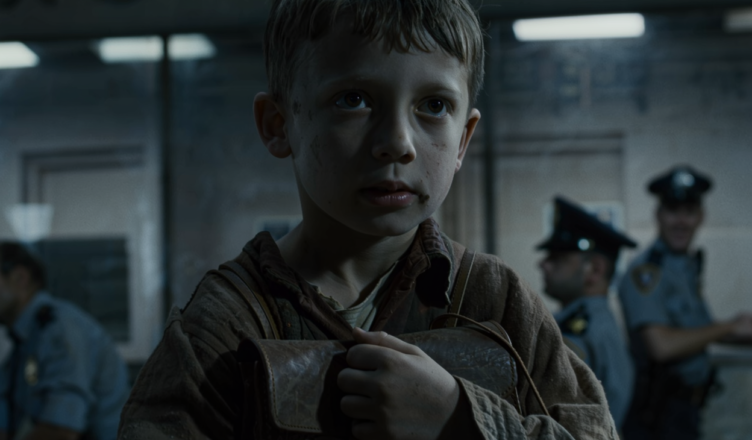
The station was loud that night, the way it always was. Phones rang without pause. Officers shouted numbers and names across desks. Keyboards clattered under tired fingers. It was the kind of noise that people stopped hearing after a while — background static to a job that never really ended.
But when the boy walked in, the noise didn’t stop.
It just seemed to matter less.
He was small — too small to be standing there alone, past midnight, in a building full of strangers with badges and guns. His clothes were worn thin at the elbows and knees, dulled by dirt that hadn’t come from a single day. His hair was a tangled mess, uncombed for what looked like days, maybe longer. He didn’t cry. He didn’t look around nervously the way lost children usually did.
He simply walked forward, one careful step at a time, toward the front desk.
In his hands, held with both arms wrapped around it like it might slip away, was a leather bag.
Not an ordinary bag. Not a school bag, or a gym bag, or anything a child should be carrying.
It was old. Ancient, even — the kind of leather that had cracked and healed and cracked again over decades, maybe longer. The kind of bag that looked like it belonged in a museum case behind glass, not in the small hands of a child standing in a fluorescent-lit lobby at midnight.
“What Do You Need, Kid?”
The officer at the front desk didn’t look up right away. He was buried in paperwork, the kind of tedious late-shift reports that never seemed to end. A boy standing quietly at the counter wasn’t unusual enough to interrupt that.
“Yeah?” he said, not lifting his eyes.
Silence.
He glanced up, expecting the boy to speak, to ask for a bathroom, or say he was lost, or that his parents were arguing outside. Kids came in for all sorts of small reasons.
But this boy just stood there. Still. Watching.
The officer sighed, set his pen down, and gave him a proper look this time.
“What do you need, kid?”
Nothing.
The boy stepped closer to the desk. There was no fear in his expression — not the kind you’d expect from a child alone in a police station at night. What was in his eyes instead was harder to name. Something older than his face. Something heavy, like he was carrying more than just the bag in his arms.
Without a word, he lifted it onto the counter.
It landed with a dull, solid thud — the sound of something dense, not something that belonged to a child at all.
The Bag
“What is this?” the officer asked, frowning down at it.
Still, no answer.
The boy only pushed the bag an inch closer, his palm flat against the leather, his eyes fixed on the officer’s face. It wasn’t a request. It wasn’t even really an offering. It felt, somehow, like a decision the boy had already made — long before he walked through that door.
The officer hesitated. His hand hovered over the bag for a second longer than it should have. Then, slowly, he pulled it toward himself.
A small cloud of dust lifted into the air — old dust, the kind that only settles on things left untouched for years, maybe decades. It caught in the fluorescent light and drifted between them like smoke from something already burned out.
“Alright,” he muttered, mostly to himself now. “Let’s see what we’ve got here.”
He unbuckled the worn straps. The leather resisted at first, stiff with age, before finally giving way.
And when he opened it, everything in the room seemed to change — not loudly, not dramatically, but in that quiet way a room changes when the person inside it understands they’ve stumbled onto something they weren’t prepared for.
What Was Inside
Papers, first. Yellowed and brittle, their edges curling inward like they were trying to protect whatever was written on them. The officer didn’t dare unfold them yet.
Beneath the papers, a pocket watch. Silver, though tarnished and scratched from years of handling — or maybe years of neglect. Despite its wear, it still held a strange elegance, the kind that suggested it had once belonged to someone who mattered.
Then came the figurines. Small, oddly shaped, carved from a material the officer couldn’t immediately place. They weren’t toys — that much was obvious at a glance. They weren’t decorations either. They looked deliberate. Purposeful. Like they’d been made to mean something, not just to be looked at.
And finally, the coins. Dozens of them, dark with age, their surfaces rusted and rough. Heavy in a way that modern currency never was.
The officer reached in and picked one up between two fingers.
And that’s when his expression started to change.
Recognition
At first, it was confusion — the natural reaction to holding something you don’t understand. But confusion gave way to something else within seconds. His eyebrows drew together. His jaw tightened. His breathing, which had been steady and bored just moments earlier, began to slow.
He turned the coin over in his fingers, catching the light, studying the markings etched into its surface like he was trying to convince himself he wasn’t imagining what he saw.
Then he looked back into the bag — not casually this time, but carefully, like a man checking a wound to see how deep it really went.
When he finally lifted his eyes to the boy again, it wasn’t the way he’d looked at him before. This wasn’t a man looking at a lost child anymore.
It was a man looking at a question he wasn’t sure he wanted answered.
“Where did you get these?”
His voice had dropped. Quieter now. Careful, the way people speak when they suspect the answer might be something they can’t take back once they hear it.
The Boy Speaks
For the first time since he’d walked through the doors, the boy opened his mouth.
“They were never mine to keep,” he said. His voice was calm — too calm for someone his age, too steady for someone standing in a police station in the middle of the night. “They belonged to someone who ran out of time.”
The officer’s grip on the coin tightened. “Ran out of time how?”
The boy didn’t answer that directly. Instead, he reached into his pocket and pulled out a folded photograph, its corners soft from being carried too long. He set it on the counter beside the bag.
It showed a man — older, gaunt, standing in front of a building that had long since been torn down, according to city records the officer would later pull. In the man’s hands: the same pocket watch. The same bag.
“He told me if anything ever happened to him,” the boy continued, “I was supposed to bring it here. Not to my family. Not to anyone else. Here.”
“Why here?”
“Because,” the boy said, finally meeting his eyes without blinking, “he said someone in this building would recognize what it means. He said you’d know the name on the coins.”
The officer looked down again — this time at the markings he’d been avoiding, the ones etched faintly into the metal. A name. An old case number, worn but legible.
A case that had gone cold thirty years before he’d ever put on the uniform.
The station noise around them hadn’t stopped. Phones still rang. Officers still moved between desks. But for the two of them, standing on either side of that counter, none of it registered anymore.
Only the bag. Only the boy. Only the question that had just cracked open, decades after anyone thought to ask it.
To be continued.