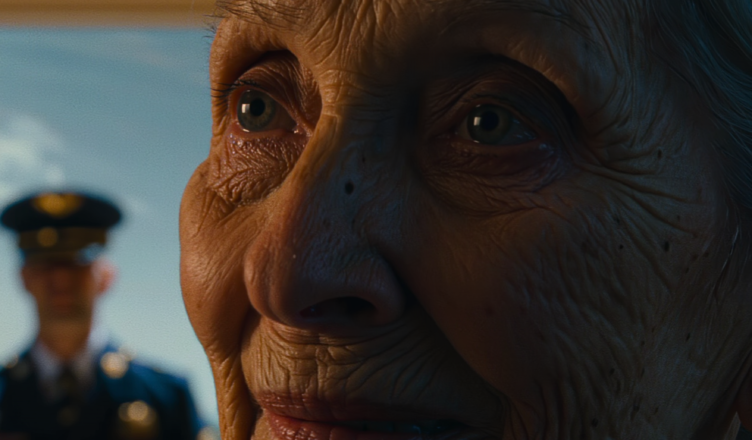
At the end of Maple Street in Dayton, Ohio, past the point where the sidewalk cracks give way to overgrown roots and the streetlights grow further apart, there stood a small white house with peeling paint and wind chimes that hadn’t rung in months. Neighbors said the silence around that house had a weight to it — the kind that settles into a place when someone inside is waiting for something they’re afraid to name.
Inside lived Margaret Hale, seventy-three years old. Widow. Mother. And, as the years had slowly reshaped her, keeper of silence.
Evenings were the hardest.
That was the time her son used to call.
The Sunday Ritual That Held Her Together
6:30 PM sharp. Every Sunday, from wherever the Army had sent him — Texas, Germany, somewhere in the desert whose name she could never quite pronounce, no matter how many times he patiently spelled it out for her over a crackling line. He always sounded calm. He always said the same thing before hanging up.
“Don’t worry, Mom. I’ll be home soon.”
She believed him every time.
Because mothers have to believe. It isn’t a choice so much as a survival instinct — the quiet architecture that keeps a person standing when the alternative is too heavy to hold.
A Tuesday That Felt Different
That Tuesday evening felt colder than the others, though the thermostat read the same as it always had. The television played softly in the corner, some game show she wasn’t really watching, its studio laughter arriving in hollow little bursts. A cup of tea had gone untouched beside her chair, the steam long gone, a thin skin forming on its surface.
Margaret sat with a folded Army letter in her lap — the last one he’d sent two weeks ago. She had already memorized every word, the way you memorize a prayer you’re afraid to stop saying.
Food’s terrible. Sand gets everywhere. Tell Mrs. Donnelly her cookies saved my life. And Mom… don’t worry. I promise I’ll walk through that front door myself.
She read that last line again. And again.
Her fingers trembled slightly, though she told herself it was only the cold.
Outside, the sky dimmed into the quiet blue of early night. Streetlights flickered on one by one, humming softly like distant memories trying to find their way back to her.
The house felt too still. Too quiet. As if it were holding its breath along with her.
The Knock
Then — knock.
Not loud. Not urgent. Just… certain.
Margaret’s heart stopped before it started racing. For a strange second, she couldn’t move, because somewhere deep inside, a truth had already arrived before the sound did — the way dread always seems to travel faster than footsteps.
Another knock followed, gentle but final.
Her voice came out thin, barely air.
“Is… is it my son?”
Silence answered.
She pushed herself up from the chair, every joint protesting the distance to the door — a distance that had never, in seven years of Sundays, felt so long. Each step carried hope, and something darker walking beside it, matching her pace exactly.
Her hand reached the doorknob. Cold metal. Shaking fingers.
She opened the door.
The Soldier on the Porch
A young U.S. Army soldier stood on the porch in full dress uniform. Perfect posture. Polished shoes catching the last of the porch light. Cap held respectfully under one arm. He looked barely older than her son.
And in that instant — Margaret knew.
Not from his face. Not from words he hadn’t spoken. But from the silence. The terrible, respectful silence that soldiers are trained to carry into moments like this one, because there is no version of this visit that words can soften.
Hope tried to rise inside her, the way it always did, stubborn and unkillable — but it collapsed before it reached her eyes. The beginning of a smile touched her lips, an old reflex from a thousand ordinary door-openings, then slowly disappeared, chased away by something she had feared for seven years without ever saying it out loud.
Because mothers know. They always know, long before anyone confirms it for them.
The soldier swallowed, his throat tight with a duty he wished didn’t exist. He had practiced the speech in the car. Every official word. Every careful sentence, rehearsed until it felt like it belonged to someone else.
But standing here now, in the soft yellow porch light, looking into a mother’s waiting eyes — none of those words would come.
Instead, he did the only thing he could. With trembling hands, he reached into his pocket.
What He Placed in Her Hands
What emerged was not the telegram Margaret had braced herself for.
It was a small, sand-worn envelope, her son’s handwriting scrawled across the front in the same careless slant she’d know anywhere — the same hand that used to sign birthday cards “love, your favorite son” even though he was her only one.
“Ma’am,” the soldier finally managed, his voice cracking on the single syllable, “your son asked me to deliver this myself. In person. He was very specific about that.”
For a moment Margaret simply stared at the envelope, afraid that touching it would somehow make the moment real in a way she wasn’t ready for.
“Is he—” she started.
“He’s alive, ma’am,” the soldier said quickly, seeing the question form before she could finish it. “Wounded. Stable. They’re flying him stateside in the morning. He wanted you to have this before you heard anything else — before the Army’s official letter, before the phone call, before any of it. He made me promise.”
The porch light flickered, as if even the house needed a moment to absorb the news.
Margaret’s knees nearly gave out, but this time it wasn’t grief pulling her down — it was seven years of held breath finally, finally exhaling. She pressed the envelope to her chest the way she used to hold him as a baby, and for the first time in months, the wind chimes on the porch stirred, just slightly, in a breeze that hadn’t been there a moment before.
She opened the letter with shaking hands and found, in his familiar scrawl, the words she’d been waiting to believe:
“Told you I’d walk through that door myself, Mom. Just gotta borrow some crutches first.”
Margaret Hale stood on her porch in the fading Ohio light, laughing and crying in the same breath, while a young soldier who had braced himself for the hardest conversation of his career found, instead, that he got to be part of the one kind of visit that makes this job worth doing.
The wind chimes rang for the first time in months.